
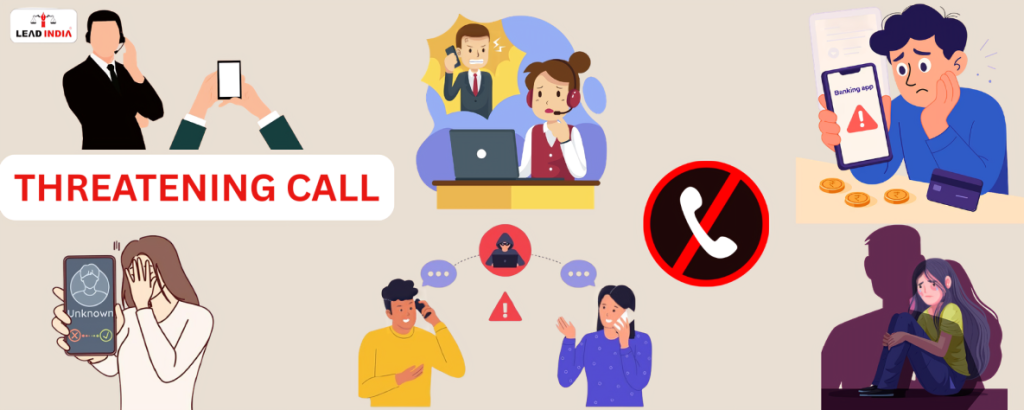
When a person receives a threatening call from an unknown number for the first time, the confusion is: “Can an FIR be filed for a threat received from an unknown number, or will the police take no action if the caller’s identity is not known?”
This confusion is very much natural.
Understanding as to what exactly constitutes the threatening call, what the law says, as well as what are the steps that you should take immediately that can help you avoid all the serious legal and personal consequences.
What Threatening Calls Are and What They Are Not
A threatening call is not just any rude or abusive conversation. It becomes a legal offence when the caller tries to create fear, pressure, or harm.
Common situations include:
- Threats to life, property, or the reputation
- Demands for money or extortion
- Repeated harassment causing mental distress
- Blackmail or coercion
- Anonymous intimidation through unknown numbers
One of the key misunderstandings regarding taking action is that an action cannot take place unless the caller’s identity has been established. This is not true; in regard to law, the action in question is based on the existence of a threat, and how serious that threat is, not whether the caller’s identity was known when making the initial report of the incident in question.
The other key point is that even one serious threat may constitute an offence without the need to have multiple threats present. If the seriousness of the threat warrants it, one instance may be sufficient.
What Threatening Calls Really Mean in Practice
In the most practical terms, threatening calls create the situation wherein a person feels unsafe, pressured, or very much mentally disturbed. Such cases often arise in situations like:
- Loan recovery pressure tactics
- Personal disputes or relationship breakdowns
- Business conflicts
- Cyber fraud or the impersonation scams
The threatening calls are not just the personal issues. They directly affect all your right to live peacefully and with dignity. Once the fear or coercion gets involved, the law steps in to protect you.
Is It Mandatory to Take Legal Action?
This is the paramount issue and the legal standpoint on this issue is unequivocal.
Legally you are not obliged to raise a complaint; however, practically the longer the delay in taking action, the worse the scenario will become, after you have ignored several phone calls, you will only decide to act after the evidence has weakened or there is an escalation in the threats made against you.
Indian legal statutes authorise actions against you regardless if:
- The caller is unknown
- The number is private or masked
- The call is made through internet applications
The offence exists irrespective of the identity of the caller at the time of filing the complaint.
Which Laws Apply to Threatening Calls in India
The primary law that is governing such type of offences is Bharatiya Nyaya Sanhita, 2023 under this particular law, the following acts are punishable:
- Criminal intimidation
- Anonymous threats
- Extortion
The Information Technology Act may apply in situations where electronic platforms are involved, including impersonation, fraud, or similar types of crime.
Keep in mind that the previous legislation such as IPC has been replaced and that the more current legal system is based upon virtual communications and cybercrimes.
How Police Handles Unknown Number Threat Cases
A common concern is whether the police can actually trace an unknown caller. In practice, the investigation process includes:
- Call Detail Record (CDR) analysis
- SIM card ownership verification
- Mobile device tracking through IMEI
- IP address tracing in internet-based calls
- Coordination with the telecom service providers
In the most serious cases involving threats to life or extortion, the immediate action is taken and the arrests can also be made.
Who Can File a Complaint
There is no restriction as to who can file the complaint. Any person receiving threatening calls can approach the police this includes:
- Individuals
- Employees facing workplace harassment
- Business owners receiving extortion threats
- Women facing harassment or stalking
- Senior citizens targeted by fraud calls
There is no minimum requirement of proof at the initial stage. Even a reasonable apprehension of threat is sufficient to initiate the complaint.
How to File a Complaint for Threatening Calls
Step 1: Collect Evidence
Before approaching the police, gather basic evidence such as:
- Call logs
- Call recordings (if available)
- Screenshots of messages
- Dates and time of calls
Even partial evidence is helpful. Do not delay the action just because you do not have the complete proof.
Step 2: File the Complaint at Police Station
You can visit nearest police station and then file an FIR for:
- Criminal intimidation
- Anonymous threat
- Extortion (if money is demanded)
In practice, if the police delays or refuses to register an FIR, you can submit a written complaint and take it.
Step 3: Cyber Complaint (If Digital Platform Involved)
If all the threat is through WhatsApp, VoIP calls, or the online platforms, you can also file the complaint on the cyber crime portal.
Step 4: Inform the Telecom Operator
You should:
- Report the number
- Request blocking
- Register complaint for misuse
This helps prevent further harassment.
Step 5: Approach Higher Authorities or Court
If no action is taken:
- You can approach senior police officers
- You can file an application before the Magistrate
This is a legally effective remedy when police inaction occurs.
What Happens After You File the Complaint
Once the complaint gets registered:
- Police begin technical investigation
- Telecom data is obtained
- Suspect is identified
- Statements are recorded
- Legal action is initiated
In the most serious matters, the police may take the immediate preventive steps to ensure all your safety.
Practical Consequences for the Accused
Depending on nature of the threat, the accused may face the:
- Imprisonment for the criminal intimidation
- Additional punishment for anonymous threats
- Strict penalties in extortion cases
- Additional liability in cyber-related offences
The serious threats, especially those involving life or the large financial demands, are treated very strictly.
What Happens If You Ignore Threatening Calls
Ignoring the threatening calls is one of the common mistakes. In our practical experience:
- Threats often escalate if ignored
- Evidence becomes weaker over time
- Accused becomes more confident
- Legal remedy becomes more complex
Taking early action always strengthens all your cases.
Practical Benefits of Taking Timely Legal Action
Taking timely action usually helps you:
- Stop further harassment
- Create official legal record
- Enable faster police investigation
- Protect your personal safety
- Strengthen your position in court
In many cases, even a single police complaint is enough to deter the caller.
Legal Importance of Threatening Call Cases
Threatening calls are not treated lightly under Indian law. They directly relate to:
- Right to life and personal liberty
- Right to privacy
- Protection against coercion as well as harassment
The courts have consistently held that the mental harassment and the intimidation are actionable as well as punishable.
Threatening Calls and Consumer / Cyber Law
If at all the threatening calls are linked with the fraud or the misrepresentation, the additional legal remedies may be available as per:
- Consumer Protection Law
- Cyber crime provisions
- Cheating and fraud laws
This is relevant in cases of loan scams, fake recovery agents, or online blackmail.
What You Should Practically Do Right Now
If you are receiving threatening calls:
- Do not ignore the situation
- Do not engage emotionally with the caller
- Start recording and documenting immediately
- File complaint at the earliest
- Seek the legal advice if the situation escalates
Wrong decisions or delay often increase both legal risk and mental stress.
How We Help in Such Cases
We assist clients in:
- Drafting proper police complaints
- Ensuring FIR registration
- Escalating cases to higher authorities
- Providing legal protection strategies
- Handling serious intimidation or extortion matters
Our focus is always on taking quick, legally strong, and practical action.
One can talk to a lawyer from Lead India for any kind of legal support. In India, free legal advice online can be obtained at Lead India. Along with receiving free legal advice online, one can also ask questions to the experts online free through Lead India.
FAQs
1. Can the FIR be filed for the threatening calls from any unknown number?
Yes, the FIR can be filed even if the caller is unknown.
2. Is the single threatening call also considered a crime?
Yes, even the single call can amount to offence if the threat is very much serious in nature.
3. How does police trace the unknown caller?
The police may trace the caller through the Call Detail Records (CDR), SIM ownership data, IP tracking, as well as the telecom service provider records.
4. What should I do if at all the police refuse to register the FIR?
You can approach the senior police officer or you can file the application before the Magistrate.
5. Can the case be filed for threatening the calls made via WhatsApp or the internet calls?
Yes, the threats made through the digital platforms are also punishable as per the law.


 Talk to a Lawyer