
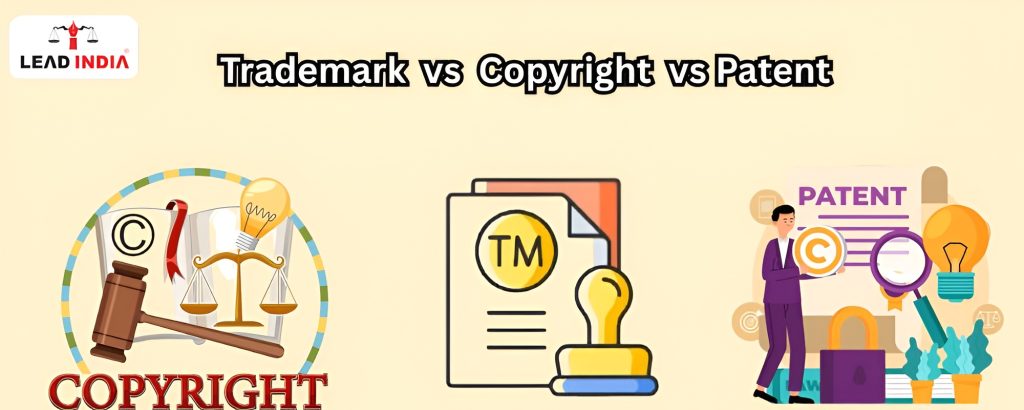
Whenever you are starting a business, launching a book, or developing a new product, one can expect this question always coming up: How do you legally protect your work? India intellectual property laws allow one to safeguard ideas, brand identity, and innovations. With the Plaintiffs having so many options, however, trademarks, copyrights, and patents, many creators and businessmen become confused as to what applies to them.
Each kind of protection serves a different purpose; trademarks protect your brand name and logo, copyrights protect creative works, and patents accord inventors exclusive rights over inventions. The knowledge of differing rights will guard you against entering into disputes and help you execute your rights at the right time.
In whatever guise, an entrepreneur, an artist, or an inventor, if you find that IP laws are of interest to you, then adjustment becomes mandatory for survival. Some brands get wiped out because they failed to register a trademark; filmmakers lose money because they ignored copyright; startups lose on innovation battles because they have no patents.
This article explains trademarks, copyrights, and patents in India with practical examples and landmark case laws, so you can choose the right protection for your work.
Need A Legal Advice
The internet is not a lawyer and neither are you. Talk to a real lawyer about your legal issue
Trademarks: The Shield for Your Brand
With a small food startup, they discovered another shop down the street using a nearly identical logo. Customers were getting confused. A registered trademark would have stopped that instantly.
What a Trademark Covers
- Your name, logo, slogan, color, or even a sound
- Anything that sets your business apart
Real-Life Examples
- The Amul tagline- “The Taste of India”
- The Nike swoosh logo
- The McDonald’s Golden Arches
How Long Does It Last?
Ten years at a time, renewable forever
Case That Proves It
In Cadila v. Cadila (2001), the Supreme Court said that even a slight similarity in names can mislead customers. This is why distinctiveness is everything in trademarks.
Copyright: Protecting Creativity
One of the clients, a YouTuber, had their videos copied by others and as well as they re-uploaded. Because their work was totally copyrighted, the law firm quickly issued takedown notices and filed a legal complaint.
What Copyright Covers
- Books, films, music, photos, software, choreography
- Anything you create from scratch
Indian Examples
- Amar Chitra Katha comics
- Bollywood movie Sholay
- Songs by A.R. Rahman
How Long Does It Last?
- For individuals → Lifetime + 60 years
- For films, sound recordings, or government works → 60 years from release
Case That Proves It
In R.G. Anand v. Deluxe Films (1978), the Court decided that:
- Ideas aren’t protected
- Expression of ideas is
So, if two people write stories with the same theme, only the way they express it matters.
Patents: Securing Inventions and Innovation
It was once advised to a biotech startup that had developed a new process for producing medicines. They had great innovation but no legal protection. Filing a patent saved them from competitors who were already circling.
What a Patent Covers
- Products, processes, and technology
- New, useful, and innovative ideas
Indian Reality
Unlike the U.S., India doesn’t use “utility/design/plant patents.” Instead:
- Patents: inventions and processes
- Design registrations: product aesthetics
- Plant varieties: separate law
Duration
Twenty years from filing, after which anyone can use it
Case That Proves It
In the case of Novartis v. Union of India (2013), the Supreme Court has rejected a drug patent just because it was just a minor tweak of an existing drug. This ruling stopped “evergreening” and kept medicines affordable.
Quick Comparison: Trademark vs Copyright vs Patent
| Feature | Trademark | Copyright | Patent |
| Purpose | Protects your brand identity | Protects your creative work | Protects your invention |
| Scope | Stops lookalike logos/names | Stops copying of books, music, films, software | Stops others from using your invention |
| Duration | 10 years, renewable forever | Life + 60 years | 20 years |
| Examples | Nike logo, Amul tagline | Sholay, Amar Chitra Katha | Pharma drugs, iPhone technology |
| Best For | Startups, businesses | Authors, musicians, filmmakers | Inventors, scientists |
| Enforcement | Sue for brand confusion | Legal action for piracy | Legal action for unauthorized use |
How Do You Know Which One You Need?
Here’s what it is usually told to clients:
- Want to protect your brand name or logo? → Trademark
- Wrote a book, song, or made a film? → Copyright
- Invented a machine or product? → Patent
Many times, you’ll need a combination.
For example, a software company might:
- Patent the core technology
- Copyright the software code
- Trademark the brand name and the logo
Common Mistakes People Make
1. “My work is automatically protected.”
Only copyright gives automatic protection. Trademarks and patents must be registered.
2. “Trademarks cover my invention.”
Wrong. That’s what patents are for.
3. “IP lasts forever.”
Only trademarks can be renewed forever. Copyrights and patents expire.
4. “Small businesses don’t need it.”
In fact, I’ve seen small businesses lose customers because they skipped IP protection.
Final Takeaway
Whether you’re an entrepreneur, artist, or any type of inventor, understanding the IP laws is not optional, it’s survival. There are brands that are destroyed because they didn’t register a trademark, filmmakers lose money because they ignored copyright, and startups lose innovation battles without patents.
In indicative cases like Cadila v. Cadila, R.G. Anand v. Deluxe Films, and Novartis v. Union of India, it can be seen that Indian courts have taken a serious view of IP disputes.
Do not wait until your work is copied or misused. For personalized advice, talk to an IP lawyer. At Lead India Law, we’ve helped startups, authors, and inventors secure their rights before trouble begins.
One can talk to lawyer from Lead India for any kind of legal support. In India, free legal advice online can be obtained at Lead India. Along with receiving free legal advice online, one can also ask questions to the experts online free through Lead India.
FAQs
1. Do I need to register my trademark in India?
Yes, unlike copyright which applies automatically, a trademark must be formally registered in India to claim exclusive rights and take legal action against infringers.
2. How long does copyright last in India?
For literary, musical, and artistic works, copyright lasts for the author’s lifetime plus 60 years. For films, sound recordings, and government works, it lasts 60 years from publication.
3. How long is the patent valid in India?
Patents in India are usually valid for 20 years from the date of filing, after which the invention enters the public domain.


 Talk to a Lawyer