
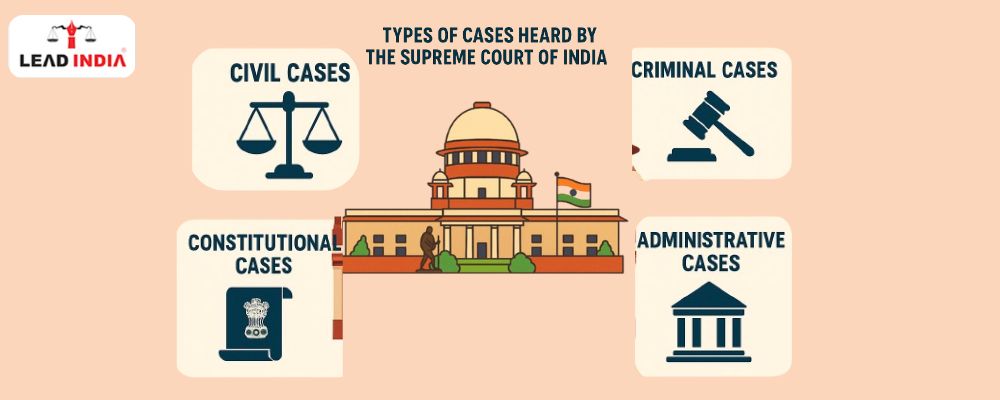
The Supreme Court of India is the supreme caretaker of the Constitution, and the defender of the Fundamental Rights guaranteed under the Constitution. The Constitution of India, among other things, establishes the Court in Article 124, and Articles 131 to 139A spell out the various form of cases, appellate system, advisory power and review power, etc.
This article describes some form of cases heard in the Supreme Court, the constitutional basis for each case, and the significant cases themselves that have shaped and created Indian jurisprudence.
Original Jurisdiction (Article 131)
Definition: As per Article 131, the Supreme Court of India particularly has the exclusive original jurisdiction in disputes between:
- The Government of India and one or more States
- The Government of India and any State on one side and one or more States on the other, or Between two or more States.
Key Features:
- The dispute should be involving a question of law or fact on which the existence of the legal right will depend upon.
- Private individuals or entities cannot invoke Article 131.
- The Supreme Court acts as a federal arbiter.
Landmark Case Law:
In the case of Jharkhand vs. Bihar (2015), the Court reiterated its power to resolve the inter-state conflicts, including those on the issues of property and resources after the separation of the states, through the very disputes mentioned in the judgment.
Writ Jurisdiction (Article 32)
Definition and Purpose:
Article 32 of the Constitution gives the Supreme Court the authority to grant the specific writs which are meant for the enforcement of Fundamental Rights.
Landmark Case Law:
ADM Jabalpur vs Shivkant Shukla (1976): This emergency case narrowed the Article 32 rendering it to be non-existent for the time being, which was later then overturned by various rulings by fulfilling its absolute value.
Appellate Jurisdiction (Articles 132-134A)
Overview: The apex court is the Supreme Court. It entertains the appeals from High Courts in cases where the interpretation of the constitution is particularly involved.
(a) Constitutional Matters (Article 132)
The Supreme Court possess power in the case of appeals and it can only be decided by interpreting the Constitution.
(b) Civil Matters (Article 133)
An appeal can be made in civil cases if:
- The case involves a substantial question of law, and
- The High Court certifies the matter if it is FIR for appeal or not.
(c) Criminal Matters (Article 134)
An appeal in criminal cases is heard by the Supreme Court if:
- The High Court has overturned an acquittal as well as it imposed the death sentence on the accused, or
- The High Court has declared the case as one fit for appeal
(d) Article 134A – Certificate for Appeal
This article order the High Courts to issue the certificate for appeal to the SC when constitutional or the substantial legal questions are in question.
Advisory Jurisdiction (Article 143)
Definition and Scope:
The Supreme Court is empowered by Article 143 to the President of India for his advisory opinion to refer questions of law or fact. Although not binding, such opinions are very influential.
Two Types of References:
- Under Article 143(1): The President requests guidance on any question of public importance or an interpretation of the Constitution.
- Under Article 143(2): For conflicts about treaties or agreements made before the Constitution was enacted.
Landmark Case Law:
In re Berubari Union (1960): The Court advised that Parliament should be the one to amend the Constitution in order to give up a part of Indian territory.
Special Leave Jurisdiction (Article 136)
Meaning: Article 136 provides the Supreme Court the power of discretion to grant Special Leave Petition (SLP) against any decision, ruling or order from any court or tribunal (excluding those under armed forces laws).
This power that is quite vast gives the Court the chance to rectify very serious injustices or mistakes in the law even if in the ordinary course of events no appeal is allowed.
Key Chracteristics:
- It is a remedy subject to the Court’s discretion, not a right.
- May be utilized even if the case does not raise constitutional issues.
- The Court may decline to consider cases that lack substantial importance.
Landmark Case Law:
Kunhayammed v. State of Kerala (2000): This case particularly explained the doctrine of merger when the Supreme Court dismissed an SLP.
Review Jurisdiction (Article 137)
Overview: The Supreme Court as per Article 137, have the right to review its own decisions. This is a measure that guarantees the rectification of errors that are evident on the record.
Grounds for Review:
- Discovery of new evidence,
- Apparent error on record, or
- Other sufficient reasons.
Case Law:
Lily Thomas v. Union of India (2000): Shredded to bits the review concept as one being an appeal in disguise.
Election Disputes and Presidential References
As per Article 71, the Supreme Court resolves the disputes. They are:
- Election of the President or the Vice-President of India.
- Interpretation of constitutional provisions that is relating to elections.
Case Law:
Indira Nehru Gandhi v. Raj Narain (1975): The SC examined the legality of the election of the Prime Minister and it laid down certain principles of free as well as fair elections, which are a part of the basic structure of the Indian constitution.
Public Interest Litigation (PIL)
Meaning:
It usually gives the right to any person or group to seek relief by approaching the Supreme Court in accordance to Article 32 for the redressal of the public wrongs or violations of fundamental rights that usually can affect a large section of the community.
Significance:
Access to justice has been democratized by PILs thus allowing the underprivileged to be able to seek the judicial remedy.
Landmark PIL Cases
- S.P. Gupta v. Union of India (1981): This case has introduced the PIL concept as well as it expanded the scope of standing.
- M.C. Mehta v. Union of India (1987): This case has created new environmental jurisprudence as well as the the rule of “absolute liability.”
Conclusion
The Supreme Court of India has different kinds of jurisdictions which altogether make sure that no case of injustice is left to be unheard. The Court’s decisions or the judgments still influence the legal system operating as per the Indian democracy.
One can talk to lawyer from Lead India for any kind of legal support. In India, free legal advice online can be obtained at Lead India. Along with receiving free legal advice online, one can also ask questions to the experts online free through Lead India.
FAQs
1. Can one individual go to the Supreme Court without having a lawyer?
Going to the court alone is not technically possible. Therefore, it is recommended to hire a lawyer who can represent you in the Supreme Court.
2. How much time the Supreme Court take to render a judgment?
It mostly depends on the type of the case. Constitutional as well as public interest issues may be dealt faster, while civil or any type of appellate matters might take months or in some case even years.


 Talk to a Lawyer