
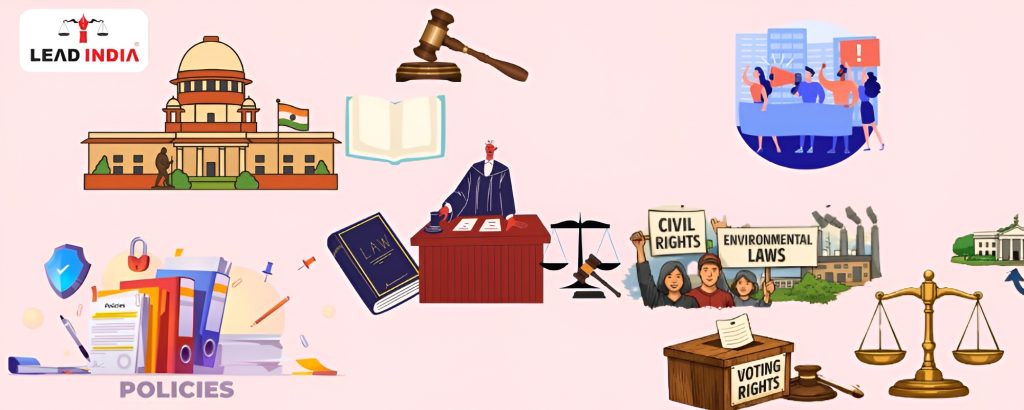
The Supreme Court of India does more than interpreting the law, it plays a role in determining how we govern ourselves. As the custodian of the Constitution, the Court will ensure that the legislature and the executive do not step outside legal bounds. It has the power of judicial review which allows it to review whether the policies of the State are legal, constitutional, and reasonable.
Through the years, the Supreme Court has changed the interpretation of social justice, environment conservation, economic changes, and citizens’ rights. This dynamic connection among the judicial branch and the government is what makes our democracy alive and it is the main reason why the Constitution is not subject to any authority.
Inside the Courtroom Where Law Meets Policy
It is seen that the moments in court where a single judgment rewired decades of governance. The Indian Supreme Court do not simply decide the cases; it also redraws the boundaries of power.
Most of the time the government frames a policy, it needs to make sure that it withstands the constitutional scrutiny. The Court’s ability to examine these policies keeps India’s democracy healthy and its executive accountable.
This living dialogue between the judiciary and the state ensures that no authority is ever above the Constitution.
The Constitutional Backbone of Judicial Power
The Constitution gives the Supreme Court a toolkit to influence public policy. “Articles 13 and 142 are the Court’s real weapons.”
Here’s why these Articles matter:
- Article 13 allows the Court to strike down laws violating Fundamental Rights.
- Article 32 lets citizens directly approach the Supreme Court for rights enforcement.
- Article 136 grants special leave to appeal in any case.
- Article 141 makes its rulings binding nationwide.
- Article 142 lets the Court deliver “complete justice,” often beyond statutory limits.
Judicial Review The Constitution’s Silent Guardian
Few doctrines are as powerful, or as misunderstood, as judicial review. In Kesavananda Bharati v. State of Kerala (1973), it is still remembered that the older advocates saying it felt like “the night India saved her soul.”
This case gave birth to the Basic Structure Doctrine, ensuring Parliament could never amend away democracy, secularism, or the rule of law. Since then, judicial review has acted like a constitutional checkpoint, where every government decision must prove it respects India’s basic framework.
Protecting People, Shaping Policy The Human Face of Fundamental Rights
Behind every landmark judgment lies a human story.
- Vishaka v. State of Rajasthan (1997): When women activists approached the Court after the brutal Bhanwari Devi case, the law firm recall the courtroom’s silence as the bench pronounced the Vishaka Guidelines. Until Parliament acted in 2013, these judicially created safeguards defined workplace ethics across India.
- Unnikrishnan v. State of Andhra Pradesh (1993): In countless village legal aid camps, it is seen that the children attend school because of this case. The Court’s recognition of education as a part of the right to life later became Article 21A, rewriting India’s education policy forever.
When Courts Become Policymakers: Judicial Activism in Action
Sometimes, the SC steps in a case not from its choice but out of any kind of necessity.
During one of the M.C. Mehta pollution hearings, it is seen that the Court demand cleaner air for Delhi. The order for the usage of CNG in buses seemed the most drastic then, but years later, it saved thousands of lives.
Hussainara Khatoon v. State of Bihar (1979): This particular judgment on the undertrial prisoners opened the eyes to the human side of justice. The Court said a “speedy trial” is a fundamental right, forcing policy reforms in bail and legal aid systems.
The Fine Line Between Oversight and Overreach
The S.R. Bommai (1994) case, which restricted the arbitrary application of President’s Rule, defended the federalism of India. However, in NJAC (2015), when the Court invalidated the establishment of the Judicial Appointments Commission, many in the bar questioned whether the independence of the judiciary had gone too far.
The necessity of both judicial restraint and activism relates to one truth, namely that for democracy to breathe easily, there has to be a balance between the two.
How the Court Has Redefined India’s Social and Economic Landscape?
Right to Privacy: Justice K.S. Puttaswamy (2017)
The 9 judges confirmed the existence of a right to privacy as a fundamental right resulting in data protection being affected, the initiation of the Aadhaar project being delayed, and the enactment of the Digital Personal Data Protection Act of 2023 being the last move.
Environmental Governance: T.N. Godavarman (1996 onwards)
Through a stream of continuing orders, the Court protected India’s forests. From mining bans to conservation zones, it is seen that the policymakers draft rules only after verifying if the Supreme Court had already spoken.
Precedents: The Legal Compass for Future Policymakers
Every advocate knows that Article 141 makes Supreme Court rulings binding, but few appreciate how they silently shape new laws.
- The Basic Structure Doctrine still guides every constitutional amendment.
- Subhash Kumar v. State of Bihar (1991) turned the “right to a clean environment” into public policy.
- The Right to Information existed judicially before the RTI Act 2005 was enacted.
Each precedent becomes a reference point, a legal compass for every policymaker drafting a new regulation.
The Challenges: Power, Patience, and Policy
Having worked on policy litigation, it is seen how difficult implementation can be.
Many judgments, like Prakash Singh on police reforms, remain in limbo due to political inertia. Others face accusations of judicial overreach, where courts are asked to do what the executive failed to.
Still, these interventions have often been the only relief for citizens when governance failed. The judiciary’s limitations, lack of follow-up mechanisms or institutional capacity, don’t diminish its moral authority.
Conclusion
From two decades of experience watching the Supreme Court work, one truth has emerged, the Supreme Court is not merely a legal institution, it is India’s moral compass.
Its rulings have rewritten our collective conscience around the right to privacy, the empowerment of women, the defence of the environment and reminding every government that it must be the custodian of the Constitution as the supreme authority. In a Democracy as large as ours, that quiet declaration of justice is what keeps the system humanised and accountable.
One can talk to lawyer from Lead India for any kind of legal support. In India, free legal advice online can be obtained at Lead India. Along with receiving free legal advice online, one can also ask questions to the experts online free through Lead India.
FAQs
1. What is the Basic Structure Doctrine, and why is it important?
The Basic Structure Doctrine is a device that limits the power of Parliament to amend the Constitution by identification of certain essential characteristics of the Constitution which are non-legislative and thus immune to changes. No legislation can change the features of a democratic process, secularism, and rule of law.
2. What will happen if the government declines to comply with a Supreme Court ruling?
Non-compliance with the judgment may set off contempt proceedings as per the Contempt of Courts Act of 1971 and the authorities may be compelled to follow the Court’s orders and/or face the possibility of being punished.


 Talk to a Lawyer