
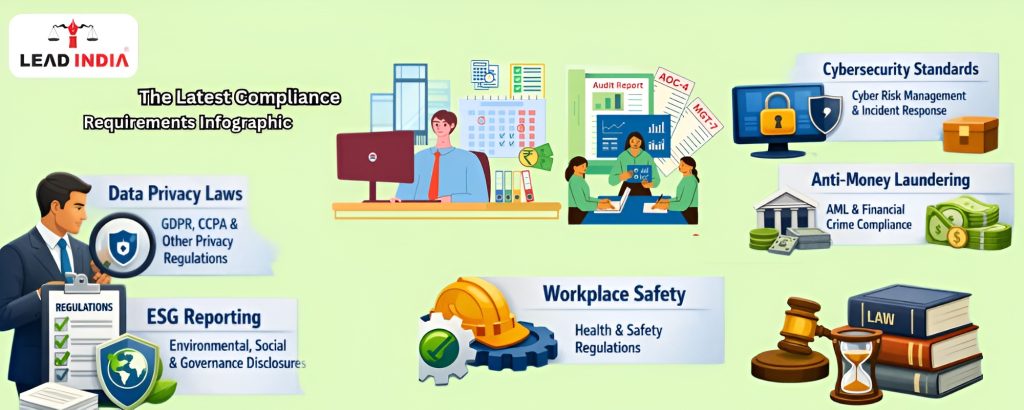
When the business owners start their journey with the Private Limited Company, the first confusion that comes to their mind is: “What are the compliance requirements, and why are they so complex?”
The confusion which exists here for new entrepreneurs appears to be a normal human reaction. Many businesses reach out to us only after their tender applications get rejected, or, a government client demands certain compliances, or, they are informed that compliance is mandatory without any clear explanation.
Your knowledge of requirements, their timing, and methods to maintain compliance will help you prevent excessive fines while making correct choices.
What Compliance Means for Private Limited Companies
The process of corporate compliance in India extends beyond mandatory legal duties because it protects business operations from all legal obstacles. Compliance requirements include multiple areas of responsibility which businesses must address.
- Statutory filings with the Registrar of Companies (RoC)
- Corporate governance duties like the board meetings as well as reporting.
- Workplace and employee welfare compliance,
- CSR obligations for larger companies,
- Digital record maintenance,
- Penalties for the non-compliance,
- Data protection under digital laws.
The Ministry of Corporate Affairs (MCA) most constantly updates the compliance rules, as well as staying updated is very much important for the businesses of all sizes.
What You Need to Do: Key Compliance Requirements
1. Statutory Filings & Disclosure Obligations
a. Annual Filings with RoC
Private companies are required file multiple types of reports each year:
- Annual returns (Form MGT-7): provide the details of the company’s shareholders and directors along with their shares.
- Financial statements (Form AOC-4 XBRL): must include company balance sheet, profit and loss statement and accompanying notes. As of July 2025, companies will be required to file a digitally signed audit report (as a pdf) along with their XBRL data.
- KYC for all directors (form DIR-3 KYC): every 3 years will provide less burden on companies for annual compliance.
b. Quality & Timeliness of Filings
Filling is now available on the MCA V3 portal and companies must ensure all information is accurate and returns are filed within the specified timeframes (usually 30-60 days).
2. Corporate Governance & Board Compliance
a. Board Meetings and Minutes
Every Private Limited Company must regularly convene a Meeting of the Board and keep a record of their decisions (minutes). The Minutes must be made available to the Company in accordance with their governance obligations.
b. Appointment of Key Officers
Companies with larger capital resources are recommended to establish an Audit Committee. Companies with capital exceeding the limits prescribed in the Act, require the appointment of a Company Secretary.
c. Independent Directors & Related Party Transactions (RPTs)
The recent amendments clarify the roles of Independent Directors and impose greater obligations on Company to ensure that all Related Party Transactions (RPTs) are disclosed.
3. Workplace & Social Compliance
a. POSH Act Reporting
Under all the recent amendments, the companies needs to report the sexual harassment complaints in all the Board’s Report, by detailing how many complaints were totally received, disposed of, and are pending.
b. Employee Welfare
Compliance with labor laws like the Maternity Benefit Act must also be disclosed in the Board’s Report to ensure employee welfare.
4. Corporate Social Responsibility (CSR)
For the companies that is surpassing the CSR thresholds:
- Prepare the CSR policy as well as an annual implementation plan.
- Report the CSR spending, that includes the unspent amounts, with all the clear rationale.
- CSR-1 registration norms now mostly require the implementing agencies as well as the enhanced disclosures.
5. Maintenance of Books & Digital Records
a. Audit Trail Requirement
As per the Companies (Audit and Auditors) Rules of 2014, the companies are usually required to keep all the audit trails in the accounting systems. By failing to comply may lead to very hefty penalties, as is evidenced by RoC Ahmedabad’s recent ruling against the company for not having necessary accounting software.
b. Statutory Registers & Beneficial Ownership
Companies are also required to keep accurate records of their directors, members and beneficial owners and notify them.
6. Dematerialisation & Capital Compliance
The dematerialisation of securities is now a requirement for almost all private companies except those classified as “small”. All transfers of securities must be done through a demat account in order to provide transparency.
7. Penalties & Enforcement Trends
a. Tiered Penalty System
Small companies now mostly face the reduced penalties for all the non-compliance, whereas all the larger companies incur very higher fines.
b. Real-Time Compliance & Daily Penalties
Filing delays will now incur daily penalties. The companies need to file the changes (like directors or the share transfers) within the period of 7 days. The repeated offenses could lead to the double penalties.
8. Data Protection & Digital Rules
All businesses must follow Digital Personal Data Protection Regulations 2025 which require organizations to establish strict data management procedures and complete documentation about data security incidents.
Conclusion: Why Compliance Matters
In countries like India, the compliance domain for the Private Limited Companies is fully evolving rapidly. The latest updates emphasize:
- Detailed financial and social disclosures,
- Digital filing mandates through MCA21 V3,
- Governance as well as the transparency norms (POSH, CSR, RPTs),
- Robust the enforcement of all the compliance through penalties as well as the expanded monitoring.
The business case has evolved from its original purpose of protecting against compliance penalties to a new requirement which demands that companies develop trustworthy business models that demonstrate their commitment to sustainable practices.
The implementation of proactive compliance initiatives together with regular legal and accounting assessments and the use of compliance monitoring tools will help companies reduce their non-compliance risks while creating paths for their sustainable business growth.
What You Should Do Right Now
Do not ignore compliance requirements
- Ensure accurate and timely filings through the MCA portal
- Review corporate governance and board compliance practices
- Implement all of the necessary digital systems for the record-keeping as well as transparency
- Stay updated on all of the latest legal amendments
The compliance can seem to be complex, but the understanding usually helps you to avoid all the unnecessary risks as well as the penalties, keeping all of your business on the right direction.
One can talk to lawyer from Lead India for any kind of legal support. In India, free legal advice online can be obtained at Lead India. Along with receiving free legal advice online, one can also ask questions to the experts online free through Lead India.
FAQs
1. What are the penalties that a company face for the late filings in India?
The companies face usually the daily penalties for late filings, with the double penalties for any of the repeat non-compliance.
2. What is the POSH Act as well as what it requires from the companies?
The POSH Act mostly mandates the companies to disclose all of the sexual harassment complaints in all their annual reports.
3. How Digital Personal Data Protection Rules usually affect the businesses?
These particular rules mandate the data handling, breach reporting, as well as the consent standards for the companies who are managing the personal data.
4. What do companies need to do to maintain all the compliance with corporate governance?
The companies should basically conduct all the regular board meetings, maintain the minutes, and also adhere to the governance standards like RPT disclosures.


 Talk to a Lawyer