
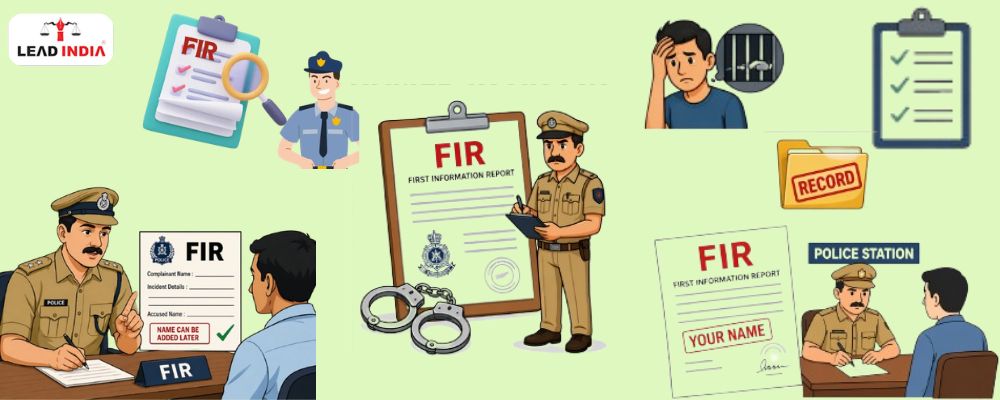
When a person comes to know that their name has been added in the FIR after it was already registered, the biggest confusion is: “Can police legally add my name later, or is this illegal?”
This confusion is very much natural.
Understanding as to how the FIR procedure actually works, when your name can be added, as well as what are the legal remedies that are available which helps you avoid panic, wrongful arrest, as well as the serious legal consequences.
What FIR Is and What It Is Not
When a crime is initially reported to the police, an FIR must be created so the police will begin an investigation into the matter. An FIR is filled out when the police receive reports of crimes that are cognizable.
Many people believe that the FIR contains the final list of persons who are deemed to be guilty. This belief is totally untrue. The FIR merely contains the initial details of the incident that the complainant (reporter) provided to law enforcement at the time of reporting the incident.
It should also be noted that an FIR does not determine whether or not a person committed a crime; therefore, the investigation is initiated but the determination will take place at a later date in a courtroom with the help of physical and other types of evidence.
Many people wrongly assume that if their name is not mentioned in FIR, they are safe. In reality, the investigation stage is where names are actually finalized.
What Adding Name in FIR Later Really Means in Practice
When someone is added as a suspect to a filed case report (FIR), it’s due to law enforcement obtaining evidence during their investigative process which indicates the suspect is partially culpable with another party or parties in connection to the alleged crime.
The police may receive this additional evidence from an eye witness statement, a document or piece of digital evidence, or even through an interview conducted with a co-defendant. Once law enforcement agencies obtain this additional evidence through some form of recorded delivery, they can process adding the suspect to the original FIR file and then move forward with proceeding with additional investigations and ultimately charge the suspect.
What you need to understand about your being “added as a suspect” is that the original FIR is, for the most part, “unchanged”, as the scope of the investigation is expanded, the name of the suspect will be entered into the case file and any supporting documentation created with regard to the investigation.
The fact that you have been “added as a suspect” does not in itself imply that you have committed a crime. It only implies you are now being investigated and therefore will have to defend yourself if a charge is brought against you by law enforcement
Is Adding Name Later Legally Allowed in India?
There’s no doubt about the relevance of this matter, with the law on this subject matter being clear. A person’s name can be added by the Police whilst investigating them, irrespective of whether or not their name was originally included in the FIR.
The investigation power of the Police comes from Section 173 of the Criminal Procedure Act/Section 193 of Bhartiya Nagarik Suraksha Sanhita, that authorises the Police to undertake an investigation to completion before being able to lay a charge based on the evidence obtained in relation to the investigation.
The Indian courts have repeatedly clarified that the FIR is not at all an encyclopaedia of facts. Just because a person is not named initially does not mean they cannot be prosecuted later.
However, this power is not unlimited. The police must have some credible material or reasonable basis before adding any name.
How Your Name Usually Gets Added
- In most cases, names are added during investigation through the following ways.
- Witness statements recorded by police under law can mention new individuals. The documentary evidence like the bank records, call data, CCTV footage, or the emails may also indicate the involvement.
- Sometimes, the co-accused persons name others during the process of interrogation, though such statements require independent verification. In certain cases, the complainant gives additional statements identifying more persons.
- All of these situations are very much in common in the case of financial fraud, matrimonial disputes, property conflicts, as well as cybercrime cases.
What Happens After Your Name Is Added
When you are added to a First Information Report (FIR) it is serious and has to be treated urgently with immediate action.
You will now be considered either accused or suspect and be summoned to appear for questioning. A notice may be issued in the case of a non-serious investigation and a police officer may arrest you if the investigation is serious.
If there is evidence against you arising from the investigation your name will be included in the charge sheet filed with the court. The court will then take cognizance of the charge sheet and the trial proceedings will commence.
At this point in time, any delay in taking action or increase in ignorance of the FIR will be extremely damaging to your case.
Can Police Add Your Name Arbitrarily?
The law does not allow arbitrary action by police. For a name to be included in an FIR, it should be based on some type of objective evidence or reasonable suspicion.
If you believe your name has been added to an FIR due to a personal vendetta, false allegations, or without any accompanying evidence, then you will have grounds for challenging the inclusion of your name through legal channels.
Indian Courts have repeatedly underscored the importance of conducting criminal investigations in a fair, impartial manner using objective evidence. Any abuse of investigation authority could result in the dismissal of an FIR or additional legal proceedings against the person making the complaint.
Legal Remedies Available to You
There are strong remedies available for someone who has had their name improperly added; however, the timing is of utmost importance.
- The first and most essential action to take is to file for anticipatory bail to prevent arrest. This is especially important if it is a serious crime.
- You can also file with the High Court to have the FIR quashed based on false allegations or lack of prima facie evidence. The courts are able to prevent the misuse of the criminal justice system via malicious prosecution in this situation.
- If there is no evidence against you by the time your trial commences, you can also file for discharge. If you can prove that you were falsely accused of a crime, you can file for malicious prosecution.
Early intervention through the legal process can prevent other damage from being done due to your alleged actions.
What Courts Say About False Implication
- False accusations can lead to irreparable damage such as: damaged reputations; mental trauma; years of litigation due to continued mistrials.
- Judges have also held that investigations cannot cease upon just mere suspicion; they must provide sufficient verifiable evidence to prove beyond reasonable doubt that a person has committed an offence.
- In cases of false allegations made against individuals, judges have granted anticipatory bail; judges have rejected the FIRs against alleged offenders; and in some cases, judges have taken appropriate actions against the complainants of such false allegations.
- There must also be an also balance between protecting victims’ rights and rights of the innocent parties that have been falsely accused.
Practical Situations Where This Happens
- In real life, adding the names later is very common in cases such as financial fraud, business disputes, matrimonial complaints, as well as cyber offences.
- For example, in a fraud case, an initial FIR may name two persons. Later, bank transactions may reveal involvement of a third person whose name is then added.
- This does not mean automatic guilt. It simply means investigation has expanded based on evidence.
What You Should Practically Do Right Now
- If your name is added to an FIR, act fast. Don’t ignore police communication, and don’t assume that the problem will take care of itself. Speak with a criminal lawyer as soon as possible to understand how serious the case is.
- In case there is a possibility of being arrested, you should apply for anticipatory bail. Also be sure to collect any documents or evidence that supports your innocence.
- Do not provide admissible statements and do not hyperventilate. Being proactive in your legal strategy at this time can save you from further issues later.
How We Help in Such Cases
We assist clients in handling cases where their name has been added later in FIR by providing immediate legal strategy, anticipatory bail support, and representation before courts.
Our primary focus is on protecting your liberty, preventing wrongful arrest, as well as ensuring that the false or weak cases are challenged at the earliest stage.
One can talk to lawyer from Lead India for any kind of legal support. In India, free legal advice online can be obtained at Lead India. Along with receiving free legal advice online, one can also ask questions to the experts online free through Lead India.
FAQs
1. Can police add names later in FIR without evidence?
No. There must be some material or reasonable suspicion. The arbitrary addition can only be challenged.
2. What should I do if at all my name is falsely added?
You can consult the lawyer immediately, you can apply for the anticipatory bail, as well as explore the quashing options.
3. Can I get the bail if at all my name is added later?
Yes. The courts consider such cases as well as it may grant the anticipatory bail depending on the facts.
4. Is being named later proof of guilt?
No. It only means the investigation is ongoing. Guilt is decided by the court.
5. Can the FIR be quashed in such types of cases?
Yes, if at all the allegations are false or do not disclose any of the offence.


 Talk to a Lawyer