
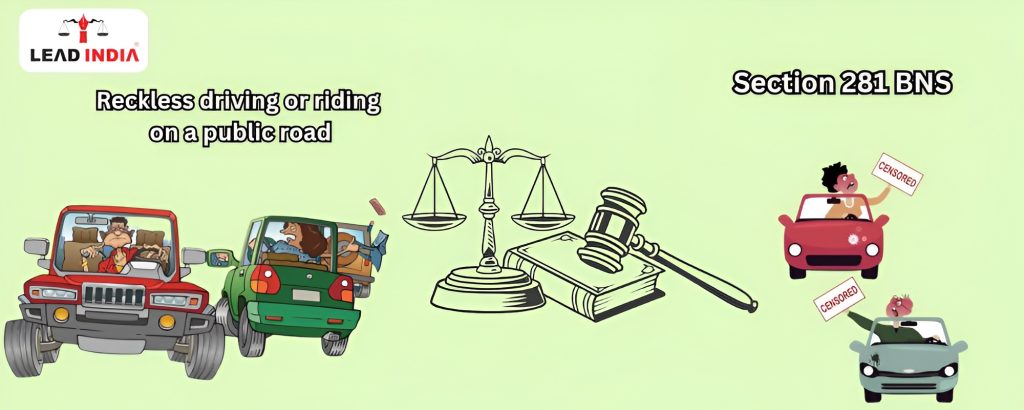
Whenever someone faces any type of police case for rash or the negligent driving, the first reaction is that they panic.
People immediately start asking:
- “Will the police arrest me?”
- “Is this a serious criminal case?”
- “I didn’t even hit anyone, then why FIR?”
- “Can my licence or job be affected?”
It is not uncommon that doubts come to your mind, especially if for you it is the first police or criminal law encounter. Knowing what Section 281 of the Bharatiya Nyaya Sanhita, 2023 works and how it works will be a great help in your not being the recipient of unnecessary arrest, harassment, or escalation of charges.
When Does Rash Driving Become a Criminal Case?
A rash driving case becomes a criminal matter when the police think that your driving endangered human life or public safety. Accidents or injuries are not necessary. No one might be hurt, yet the police may file an FIR if they believe your driving made the public road a dangerous place. Since Section 281 is punishable by the State and allows police to take action, it is designated a criminal case and not merely a traffic violation.
What Is Section 281 of Bharatiya Nyaya Sanhita, 2023?
Section 281 pertains specifically to rash or negligent driving or riding on a public way. It is the new provision that has been made to replace the now defunct Section 279 of IPC. Despite the renumbering, the legal doctrines are the same as before. The courts frequently refer to older Supreme Court judgments while adjudicating cases under this section. A lot of people presume it is a trivial traffic matter but in actuality, it is a criminal provision that permits FIR registration.
Situations Where Police Commonly Apply Section 281
Police typically invoke BNS Section 281 in the scenarios of alleged high-speed driving, wrong-side driving, reckless overtaking, ignoring traffic signals in crowded areas, or road rage incidents where no physical injury has occurred. The criterion is not damage but whether the act may have endangered someone’s life or safety.
Will You Be Arrested in a Section 281 Case?
The arrest is the most prevalent worry. Offence under section 281 is a bailable one, hence an arrest is not obligatory. The person is not arrested immediately by police in most instances; rather they register an FIR and issue a notice instead. The arrest occurs usually when the person is uncooperative, he repeatedly ignores police calls, or when later on extra serious offences are added. In normal rash driving cases, the arrest can very often be avoided with proper legal assistance given at the right time.
What Should You Do If Police Stop You or Call You?
If the police stop you on the road or later call you regarding a complaint of rash driving stay calm and be helpful. Don’t argue, and don’t yell, and don’t make emotional statements. Do not admit guilt casually and don’t sign any document before you understand it. Statements given in fear or under pressure can be used against you in litigation later.
When Is Anticipatory Bail Required?
If you feel that the police might arrest you or are unjustly pressuring you, then applying for anticipatory bail is a safe legal option. Generally, courts grant anticipatory bail in cases of section 281 when no injury or death has taken place, police do not need to keep the accused for investigation, and the accused is cooperating. One of the advantages of anticipatory bail is that it prevents unnecessary detention and harassment.
What If You Have Already Been Arrested?
If arrest has already taken place, the remedy is regular bail. Courts generally grant bail in Section 281 cases because the offence is minor in nature and continued custody is rarely required. Bail may be delayed only if the police add serious charges or if the accused has a history of similar offences.
What If Police Are Harassing or Threatening You?
There are instances when police might call you many times, threaten to arrest you, or even coerce you into admitting your fault. Do not fret in such a case. Make a record of all the calls and messages and get an attorney for consulting before you proceed any further. If the police abuse their power, the options available to you are: going to the police high command, filing a petition in the lower court or requesting for a stay order from the High Court.
What If the FIR Filed Against You Is False or Exaggerated?
More often than not, rash driving FIRs are complaints that are greatly blown up or even completely fabricated! If the FIR is either not true or overstated in any way, don’t just overlook it. First, get bail and then start your evidence collection tape with CCTV, dashcam and vehicle inspection reports along with the corresponding location data. The courts have been very clear on the issue including in the case of State of Karnataka v. Satish, that mere speeding is not sufficient to prove rash driving unless it is accompanied by dangerous conduct.
Can a False Rash Driving FIR Be Quashed?
Yes, a false or an abusive FIR can be contested before the High Court. When the accusations are seen as excessive, partly driven by bias or when no real crime is made out, courts squelch FIRs. Nonetheless, the courts generally side with the prosecution where serious injuries have been inflicted, evidence is robust, or the investigation is still in its early stage.
Can Police Apply the Motor Vehicles Act Along with Section 281?
Absolutely. Such a scenario is not uncommon. The police might try to suspend one’s driving privileges or issue a punishment ticket under the Motor Vehicles Act while at the same time filing an FIR under Section 281 BNS. Both actions are legally sound and can run parallelly.
What Should You Practically Do Right Now?
- Stay calm & avoid confrontation
- Do not visit police station alone without advice
- Preserve all evidence immediately
- Avoid discussing the incident publicly
- Contact a criminal lawyer at the earliest
Early legal steps often prevent additional sections from being added.
How Our Criminal Law Team Helps in Rash Driving Cases
Whenever someone faces the rash driving FIR or any police action, our duty is to prevent the unnecessary arrest, secure the bail quickly, stop harassment, as well as protect the license of the client, job, and his reputation. We mostly focus on the practical legal solutions, correct representation before the police and the courts, as well as timely action so that the minor incident does not turn into one long-term legal problem.
One can talk to lawyer from Lead India for any kind of legal support. In India, free legal advice online can be obtained at Lead India. Along with receiving free legal advice online, one can also ask questions to the experts online free through Lead India.
FAQs
1. Is an accident mandatory for Section 281?
No. Endangerment alone is sufficient.
2. Does high speed automatically mean rash driving?
No. Courts require proof of dangerous conduct, not speed alone.
3. Can my driving licence be affected?
Yes, through Motor Vehicles Act proceedings.
4. Should I consult a lawyer for a minor rash driving case?
Yes. Early legal advice helps avoid escalation and protects your record.


 Talk to a Lawyer