
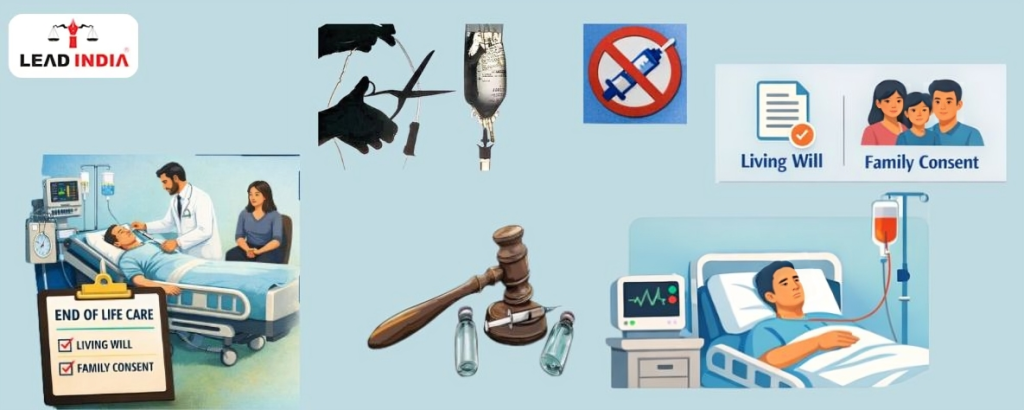
When most of the families hear of passive euthanasia, the biggest question is: “Is euthanasia legal in India, or is it completely prohibited by law?”
This confusion is very much natural.
Understanding as to what passive euthanasia is, when it is legally allowed, as well as what is the process that must be followed helps the families make the informed decisions without fear of legal consequences.
What Passive Euthanasia Is and What It Is Not
People use the term passive euthanasia to describe the process which occurs when an individual stops all medical care that extends life to a patient who will inevitably die and thus enables the patient to pass away through natural death instead of artificial methods which use machines and drugs to sustain life. The practice of passive euthanasia consists of the following procedures which lead to patient death:
- The medical team decides to stop using a ventilator for a patient who experiences complete brain damage.
- The medical staff decides to stop using feeding tubes for a patient who will never recover from their condition.
- The medical team stops all dialysis treatments together with all essential medicines which sustain life.
- The medical facility refuses to perform any medical treatments which will only extend the patient’s biological existence.
The general public has a misconception about passive euthanasia because they think it involves direct actions which bring about another person’s death. This misunderstanding is completely false.
The practice of passive euthanasia exists through medical procedures which maintain life yet their removal results in a patient’s death because the individual will not make any recovery. The medical procedure of active euthanasia requires doctors to give patients either special drugs or death-inducing injections which will result in their immediate demise. Active euthanasia remains prohibited in India which creates potential legal consequences for those who practice it.
In contrast, with appropriate safeguards set forth by the Indian Supreme Court, passive euthanasia has been determined to be legally allowed.
What Passive Euthanasia Really Means in Practice
The legal term passive euthanasia exists in practice to describe the situation when a doctor or family member chooses to discontinue life-supporting medical care for a patient who will die according to modern medical standards and who remains in a state of brain death or persistent vegetative state.
Example: When a person is in permanent coma (vegetative state) with no possibility of consciousness or recovery. Continuing to give or provide the artificial, life-supporting measures will not help the patient but it will continue their suffering and it will prolong the inevitable death.
Under these conditions passive euthanasia provides a pathway for the withdrawal of life- sustaining treatments so that the individual can die with dignity and according to God’s intended plan. Passive euthanasia is linked to the principle that the right to life protected by the constitution does not create an obligation for an individual to suffer indefinitely because of the effect of medical intervention on his or her life.
Is Passive Euthanasia Legal in India?
This is one of the most common legal questions asked regarding this issue.
The courts in India have made it clear that:
- Active euthanasia is illegal in India.
- Passive euthanasia is legally permitted subject to a defined set of strict conditions.
The Supreme Court of India has also recognised that forcing someone who is terminally ill to continue living with the use of a machine would constitute a violation of one’s dignity as protected by Article 21 of the Constitution.
Furthermore, passive euthanasia can only be accomplished through a very specific procedure established by the courts to prevent abuse and protect vulnerable people.
Important Supreme Court Judgments on Passive Euthanasia
The Indian legal system has recognized passive euthanasia through multiple important Supreme Court decisions which have developed this legal matter over time.
Gian Kaur v State of Punjab (1996)
This case marked the beginning of constitutional discussions about euthanasia which would later define Indian law.
The Supreme Court established that people do not possess the right to end their life but the Court recognized that terminally ill individuals can die with dignity according to Article 21.
The Court recognized passive euthanasia through this statement which it made about terminally ill patients.
Aruna Ramchandra Shanbaug v Union of India (2011)
A petition was filed before the SC requesting the permission for mercy killing.
The Court refused to allow the active euthanasia but it made an important ruling:
The legal system will permit passive euthanasia but only in special situations which require strict judicial control.
The Court required that the decision-making process must include the following steps:
- The High Court must give its approval
- The evaluation must be conducted by medical professionals
- The system needs to have protections which will prevent any potential abuse.
This mostly marked the first instance in which India legally recognized the passive euthanasia.
Common Cause v Union of India (2018)
This ruling represents the most important legal determination regarding passive euthanasia.
The Supreme Court Constitution Bench consisting of five judges established that:
- The right to die with dignity exists as a fundamental right protected by Article 21.
- The law allows people to create Living Wills which function as Advance Medical Directives.
- The living will enable the individuals to declare their wish to discontinue the life-support treatment once they reach the terminal illness or the permanent unconsciousness.
Harish Rana vs Union of India Case (2026)
This is the very first case where the SC allowed the passive euthanasia.
For Harish Rana, a 32-year-old man who was in a persistent vegetative state for over thirteen years, the Supreme Court of India approved passive euthanasia, allowing the discontinuation of life-sustaining treatment under medical supervision.
The decision, which is India’s first court-approved use of passive euthanasia, applies previous principles acknowledging the right to die with dignity under Article 21.
When Passive Euthanasia May Be Applied
This may only be considered in the limited and carefully evaluated medical situations like:
- Terminal illness: When the patient suffers from incurable disease and the medical science confirms that the recovery is totally impossible.
- Permanent vegetative state: When there is severe brain damage that leaves the patient unconscious with no realistic chance of regaining the awareness.
- Medical futility: When the treatment only prolongs the biological survival without improving the quality of life.
- Valid Living Will: When a patient has previously written the advance directive refusing the life-support treatment in the most certain medical conditions.
Living Will and Advance Medical Directives
It is also known as Advance Medical Directive. It is a written document where the person states how the medical treatment has to be handled if they become incapable of making the decisions in the future.
In a Living Will, a person may specify that:
- Life-support treatment should not be continued in case of terminal illness
- Artificial ventilation should be withdrawn if recovery is impossible
- Doctors may allow natural death rather than prolong suffering
The SC recognized that the legal validity of the Living Wills in 2018 as well as later mostly simplified the procedural requirements.
The living wills mostly allow the individuals to exercise autonomy over their own end-of-life medical decisions.
How Passive Euthanasia Is Implemented in Practice
The Supreme Court has given the strict process to make sure that the passive euthanasia is not at all misused.
- Living Will or Family Request: The process may begin either through a valid living will or through a request made by family members or legal guardians.
- Medical Board Evaluation: Assess the patient’s condition by senior physicians through the medical board to see if the patient’s condition can be recovered (is it medically impossible to recover).
- Independent Medical Review: Review the findings of the medical evaluation by an independent medical board to determine whether the evaluation was medically justified.
- Documentation and Consent: Hospitals need to keep a record of what happened and have consent from the family and/or obtain a copy of the examining physician’s report.
- Institutional Oversight: The hospital authorities have processes which enable them to verify that patients made their decisions without restraints and that their choices remained intact through the entire decision-making process.
The protective measures exist to safeguard patients who present vulnerable conditions while they maintain their personal independence and respect throughout the entire procedure.
Ethical and Legal Concerns Around Passive Euthanasia
The ongoing discussion about passive euthanasia presents serious ethical and social problems because people need to understand its current status in society and its legal standing.
People who want to use passive euthanasia and assisted suicide face an important challenge because these practices bring potential for misuse.
Uncertainty regarding medical prognosis creates another challenge, as it arguably has become even more difficult to establish that one has exhausted all possible avenues for recovery, if there was ever doubt, even if one were given a terminal illness.
Certain religions and moral beliefs also cite objection to passive euthanasia and assisted suicide because they are believed to be morally or ethically wrong.
Finally, thus far there has been no adequate legal framework for the provision of both forms of euthanasia in India. The legal basis for both is established by the Supreme Court of India, and there has been a request from the Court for the Parliament of India to define clearly, comprehensively and adequately a law regarding euthanasia.
Passive Euthanasia vs Active Euthanasia
Euthanasia is the act of helping someone to die. There are two types: active and passive.
- Active euthanasia occurs when medical professionals administer lethal drugs to patients through direct injection or by providing them with medications which will result in their demise.
- Passive euthanasia occurs when medical practitioners stop offering vital medical care to patients and permit them to pass away from their existing medical conditions.
Currently, in India, active euthanasia is illegal and will result in criminal charges. There are strict procedures that must be followed to provide passive euthanasia within India.
Why Passive Euthanasia Remains a Sensitive Legal Issue
The decisions relating to end-of-life care are among the most difficult choices families as well as the doctors must make.
The law needs to strike the delicate balance between:
- Protecting human dignity
- Preventing misuse
- Respecting medical ethics
- Safeguarding vulnerable patients
What You Should Practically Do in Such Situations
If at all your family faces the situation involving the terminal illness as well as the life-support treatment, it is very important to take careful as well as informed steps.
- Do not make the decisions without the medical clarity
- Obtain opinions from qualified doctors
- Understand the legal procedure before withdrawing treatment
- Consider whether a living will exists
- Seek legal guidance if necessary
Handling such types of situations properly makes sure that the decision remains lawful, ethical, as well as respectful of the patient’s dignity.
How Legal Guidance Can Help in Passive Euthanasia Matters
The legal professionals can assist all the families in understanding:
- The legal framework that is governing the passive euthanasia
- The procedure for living wills and advance directives
- Documentation requirements for medical decisions
- Protection against potential legal disputes
One can talk to lawyer from Lead India for any kind of legal support. In India, free legal advice online can be obtained at Lead India. Along with receiving free legal advice online, one can also ask questions to the experts online free through Lead India.
FAQs
1. Is the euthanasia legal in India?
Active euthanasia is fully illegal. Passive euthanasia is permitted as per the strict conditions established by the Supreme Court.
2. What is the living will?
A living will is the document where the person states their medical wishes in case, they become unable to make all the decisions in future.
3. Can the family members request for the withdrawal of life support?
Yes, but the decision needs to follow the medical as well as the legal safeguards that are laid down by the Supreme Court.
4. Does the Indian law recognize the right to die with utmost dignity?
Yes. The Supreme Court has held that the right to die with dignity mostly forms part of Article 21 of the Constitution.


 Talk to a Lawyer