
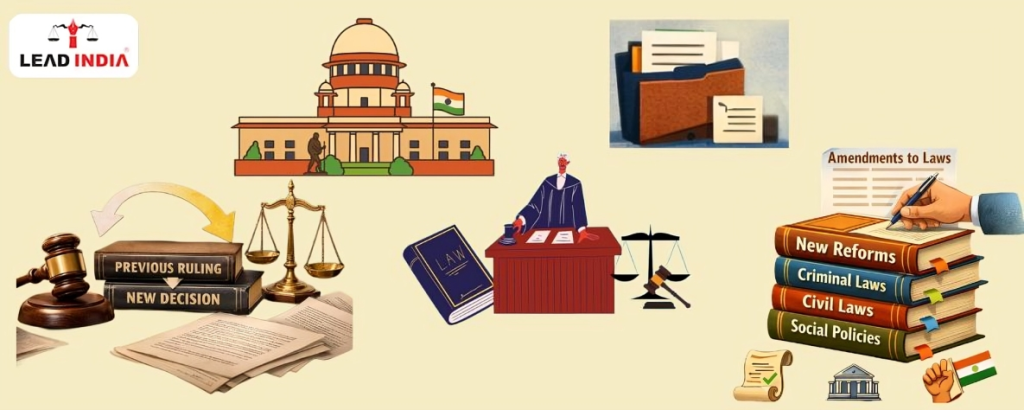
The Supreme Court of India is the highest court of law in the country. It has the ultimate authority on the interpretation of the Constitution of India, which is given legal force by Article 141, and its judgments are considered the “law of the land.” The Supreme Court can, however, vary interpretations based on changing legal circumstances or social realities.
The question now becomes; can the Supreme Court be overruled?
The answer is yes, but only in the ways which are qualified by the Constitution and statutory law. This article seeks to explain how a decision can be overruled by the Court itself, by the legislature, or through legislative change, all supported by landmark decisions that have become benchmarks in Indian jurisprudence.
Inside the Court: Why “Final” Doesn’t Mean “Forever”
When lawyers call the Supreme Court the “final court,” they mean final for that moment.
During the Puttaswamy hearing, one senior advocate remarked, “Even the final word of the Court must yield to the Constitution.” That statement captures the spirit of judicial evolution.
Article 141 and 137 – The Constitution’s Safety Valves
Article 141: Binding but Not Eternal
- “The law declared by the Supreme Court shall be binding on all courts within the territory of India.”
- This gives Supreme Court decisions nationwide authority yet allows correction when the law itself evolves.
Article 137: Power of Review and Curative Petitions
- The power of the Supreme Court to review its own judgment is contrived under Article137 and can occur if there is an error on record or the need for justice.
- There was a client who lost a matter on a technical point, they then went on the file a review then a curative petition, the last remedy recognised in Rupa Ashok Hurra v. Ashok Hurra (2002). Very few curative petitions succeed, but usually the door is not fully closed, and sometimes it is possible to continue with an attempt to secure a favourable result.
Path 1: Overruling by a Larger Bench: How the Court Corrects Itself
When Precedent Meets Progress
India follows stare decisis, respecting precedent, but a larger bench may overrule an outdated or unjust view.
From experience assisting in constitutional benches, these hearings feel historic: volumes of precedent, intense debate, and the sense that the law is being rewritten.
From Gopalan to Maneka Gandhi (1950- 1978)
Gopalan presented a limited view of personal liberty found under Article 21 of the Constitution. In Maneka Gandhi, the Court rejected Gopalan’s narrower interpretation of personal liberty and effectively reinterpreted Articles 14, 19, and 21 together in order to impose an affectation of fairness and reasonableness with respect to a person’s liberty by the State.
From ADM Jabalpur to Puttaswamy (1976- 2017)
- ADM Jabalpur upheld suspension of liberty during the Emergency.
Puttaswamy overruled it, affirming privacy as a fundamental right. Many senior lawyers in the courtroom that day called it the Constitution’s moment of redemption.
S.R. Bommai v. Union of India (1994)
- Limited misuse of Article 356 (President’s Rule) and declared federalism part of the Constitution’s basic structure.
Takeaway: Overruling is the judiciary’s way of saying, “We can do better.”
Path 2: Constitutional Amendment: When Parliament Steps In
Article 368: When Lawmakers Rewrite the Rules
It is well established that Parliament has plenary power to amend any part of the Constitution, it cannot be exercised so as to destroy the basic structure of the Constitution, this is a doctrine established in the case of Kesavananda Bharati v. State of Kerala (1973).
Real Examples
| Judgment | Parliamentary Response | Impact |
| Golaknath (1967) | 24th Amendment (1971) | Restored Parliament’s power to amend Fundamental Rights |
| Kesavananda (1973) limits | 42nd Amendment (1976) | Tried to curb judicial review—later struck down in Minerva Mills (1980) |
| Indra Sawhney (1992) | 77th and 81st Amendments | Allowed reservation in promotions and carry-forward rule |
| EWS Quota Case (2022) | — | Court upheld 103rd Amendment but reaffirmed basic-structure limits |
In short: Parliament can respond to a judgment but not rewrite the Constitution’s core values.
Path 3: Legislative Action: When New Laws Change Old Outcomes
Lawmakers Can Rewrite the Ground Below a Judgment
They cannot change any ruling, but they can only alter or change the underlying statute to ensure that the same issue does not happen continuously.
Shah Bano (1985): Muslim Women Act (1986)
- The Court mostly ruled that most of the divorced Muslim women were entitled for maintenance, which the Parliament has limited through legislation.
- In Danial Latifi (2001), the Court interpreted that law to preserve women’s rights, a balanced outcome between Parliament and the judiciary.
Anuj Garg (2008)
- Struck down gender-based employment restrictions; state legislatures later amended their excise laws to comply.
- Lesson: The legislature can change tomorrow’s law, not yesterday’s judgment.
The Real Balance: Judicial Review and Parliamentary Supremacy
- From constitutional bench hearings, one theme stands out: the Supreme Court guards the spirit, and Parliament voices the people.
- Neither dominates; each corrects the other.
- In State of Tamil Nadu vs State of Kerala (2014), the Court mostly described this relationship as all about mutual respect and not about mutual exclusion.
From a Lawyer’s Desk: What These Changes Mean for You
- If you ever wonder whether justice can change with time, the answer is yes, and that is its strength.
- It is seen that, precedents fall, rights expand, and outdated doctrines replaced.
- Overturning a Supreme Court ruling is not defiance; it is democracy working through the Constitution.
One can talk to lawyer from Lead India for any kind of legal support. In India, free legal advice online can be obtained at Lead India. Along with receiving free legal advice online, one can also ask questions to the experts online free through Lead India.
FAQs
1. In what manner can an individual challenge a Supreme Court ruling in India?
A person cannot appeal a Supreme Court ruling directly. However, a review petition can be filed under Article 137 to have the petitioner’s application reconsidered within 30 days of the delivery of the judgment or order. In very exceptional circumstances, a curative petition may be submitted after the review has been turned down.
2. Can a High Court go against a ruling by the Supreme Court?
No, under Article 141 the law declared by the Supreme Court is binding on all High Courts and authorities subordinate to the Supreme Court.


 Talk to a Lawyer