
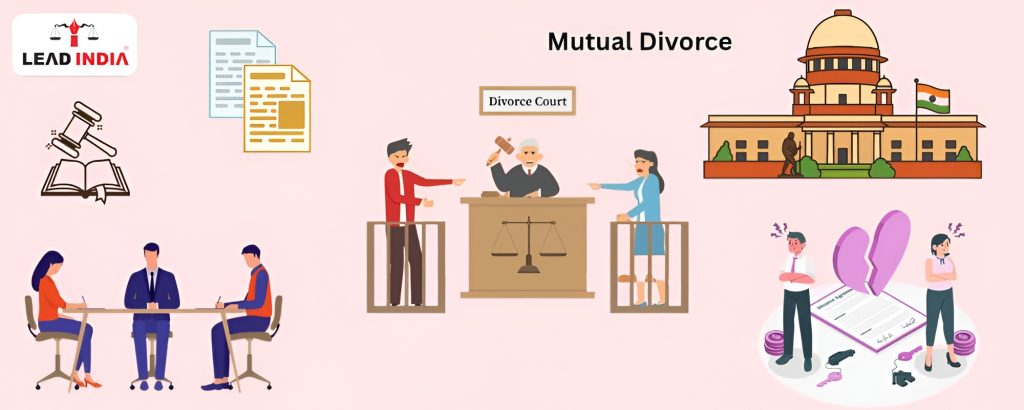
On September 12th, 2017, the Supreme Court of India rendered a very significant judgment in the case of Amardeep Singh v. Harveen Kaur (AIR 2017 SC 4417; (2017) 8 SCC 746). As a matter of importance, the Court answered:
Is the 6-month cooling period in accordance with Section 13B (2) of the Hindu Marriage Act, 1955, compulsory or is it optional?
The Court ruled that the waiting period is not mandatory but directory. As a result, the courts, in appropriate situations, can excuse the six-month waiting period and allow couples to end their marriage soon.
The judgment of the Supreme Court has reformulated the method for going through the procedure of mutual consent divorce in India. It is now more streamlined, and it is compassionate.
Need A Legal Advice
The internet is not a lawyer and neither are you. Talk to a real lawyer about your legal issue

The Story Behind the Case: Amardeep and Harveen’s Journey
- They both got married in 1994, and they have two children out of wedlock.
- They got separated in the year 2008 due to various irreconcilable differences.
- Several civil as well as criminal litigations have taken a toll on both of their finances as well as their emotional well-being.
- Concluded their settlement in April of 2017:
- ₹2.75 crore alimony finalized.
- Custody issues resolved.
- Mutual consent divorce agreed.
- When they filed the case in accordance with Section 13B, they asked why they should wait six more months when they have already been separated for 9 years?
The Big Question: Do You Really Have to Wait Six Months?
Mutual consent divorce is governed in accordance with Section 13B of the Hindu Marriage Act:
- Section 13B (1): The couple must live separately for at least one year.
- Section 13B (2): After filing the case, they must wait for 6 months before the final motion for divorce.
A waiting period is useful for families that need a moment to revisit their decision. But what about families who have exhausted their attempts at reconciliation and only seek closure?
Supreme Court’s Answer: Justice Over Procedure
The bench of Justice A.K. Goel and Justice U.U. Lalit ruled that:
Cooling-Off Period Is Directory, Not Mandatory
- If reconciliation is clearly impossible, forcing six months of waiting only increases suffering.
- Procedure must serve justice, not the other way around.
When Can Courts Waive the Six Months?
From practice, we know that courts look for these conditions:
- The couple had been staying separately for over a year.
- Mediation or the counselling attempts failed.
- Alimony, custody, and property issues are already settled.
- Waiting longer would only add to the couple’s misery.
Confusion Before This Case and How It Was Resolved?
Earlier judgments had created a mess:
- Manish Goel (2010) said cooling-off couldn’t be waived.
- Anjana Kishore (2002) and Nikhil Kumar (2016) allowed waiver under special powers.
This left families and lawyers confused. Amardeep Singh finally brought clarity: Family Courts themselves have discretion to waive the period.
How does This Case help couples in Real Life?
Here’s what is seen firsthand as a family lawyer since 2017:
- Faster Closure: A couple who were assisted in Delhi got their divorce decree within four months instead of waiting almost a year.
- Less Stress: Many clients have told me the waiver spared them from reliving bitterness for six extra months.
- Practical Flexibility: NRIs benefit the most, as they can use video conferencing or even be represented by close relatives.
This case has humanized divorce law, recognizing that dead marriages don’t serve anyone’s well-being.
What Courts Said After Amardeep Singh?
- Delhi High Court (2018, 2021): Validated waivers upon satisfying particular criteria.
- Supreme Court in Shilpa Sailesh v. Varun Sreenivasan (2023): Further clarified that even the Supreme Court can waive the period under Article 142.
This shows the principle is now well accepted across India.
Concerns You Should Know
- Risk of Pressure: Quick divorce may be misused if one spouse is coerced.
- Varied Judicial Perspectives: Certain judges exercise more caution compared to others.
- Legislation Remains Unchanged: The Formal amendment to Section 13B by parliament remains pending.
Why Does This Case Matter If You’re Seeking Divorce?
If you are considering a mutual consent divorce, this ruling means:
- You may not have to wait six months if you meet the conditions.
- You can move on faster with less emotional strain.
- With proper paperwork and legal guidance, courts are open to granting waivers.
As a lawyer, we can say that the key is settlement. If finances, custody, and property issues are already resolved, the path to waiver becomes much smoother.
Conclusion
Amardeep Singh v. Harveen Kaur (2017) brought a much-needed balance between law and life. By declaring the cooling-off period directory, not mandatory, the Supreme Court ensured that the law remains a tool of justice, not a barrier.
This case has allowed thousands of couples to part ways respectfully and rebuild their lives sooner, proving that procedures should never overshadow human dignity.
One can talk to a lawyer from Lead India for any kind of legal support. In India, free legal advice online can be obtained at Lead India. Along with receiving free legal advice online, one can also ask questions to the experts online for free through Lead India.
FAQs
1. Does Amardeep Singh automatically waive the 6-month waiting period for divorce?
No. Waiver is not automatic. You must file a separate application and satisfy the court that reconciliation is impossible and settlement is complete.
2. What is the duration of a mutual consent divorce in India following the waiver?
If the six-month waiting period is waived, divorce may be finalized within 3 to 4 months, depending on the court’s schedule and case load.
3. Can both spouses file for a waiver together, or can one spouse do it alone?
Both spouses must jointly request a waiver since a mutual consent divorce itself requires joint agreement at every stage.
4. What documents should be attached to the waiver application?
You should attach proof of separation, settlement deed (alimony, custody, property division), mediation failure report, and affidavits from both spouses.


 Talk to a Lawyer