
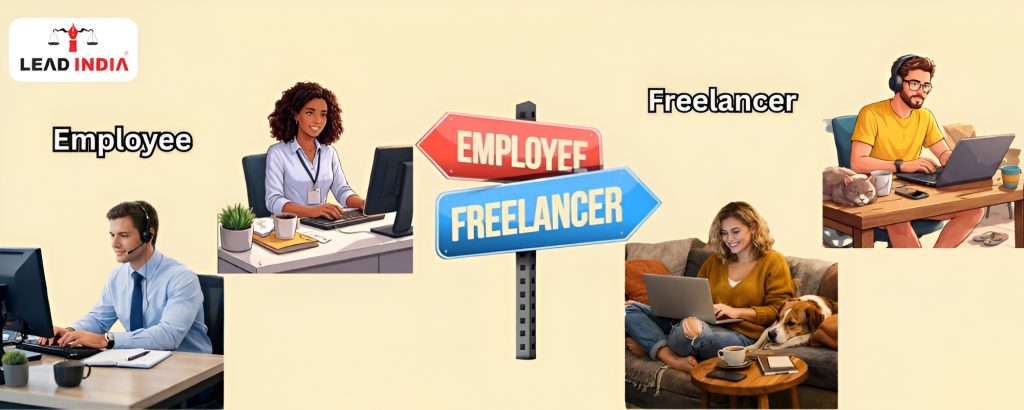
The modern Indian workforce is rapidly evolving. Companies today employ freelancers, consultants, gig workers, and contract workers much more often. However, in many situations, individuals who believe they are being hired as freelancers are, in fact, working in the manner of a full-time employee, and without any of the protection or benefits that Indian labour laws dictate.
Indian courts have repeatedly held that the nature of work decides your status, not what the contract calls you. That is why every professional, designer, engineer, content creator, consultant, tech worker, or gig worker, must understand the legal difference between an employee and a freelancer.
This article explains everything in simple, practical terms on how to know whether you are legally an employee or a freelancer, what tests courts apply, important Supreme Court and High Court rulings, real-life indicators used in disputes, what rights you get under each category and what to look for before signing a contract.
Why Your Status Matters More Than You Think?
Benefits You Lose If You’re Misclassified
The law firm have seen employees lose PF money, ESI coverage, maternity benefits, protection against sudden termination, and yearly leave balance simply because the company labelled them as “freelancers.”
Who Controls Your Work? Most Common Red Flag
Whenever someone shows me a contract, the first thing the law firm ask is: “Do they decide your work timings and reporting structure?”
If yes, the company is treating you like an employee no matter what the contract says.
Tax Differences
Employees receive Form 16 and standard salary deductions. Freelancers receive TDS under Section 194J or 194C and must manage invoices and business-income filings.
Risk and Responsibility
Employees get compensation for workplace injuries. Freelancers bear most risks themselves.
How Courts Actually Check Your Status (Not What Your Contract Says)
Courts frequently ignore the title (consultant, freelancer, contractor) and examine the real relationship.
The “Real-World Control” Test
Courts ask these questions:
- Does the company decide how you work?
- Do you follow office timings?
- Do you report to a supervisor daily?
If yes, the court is likely to classify you as an employee.
A common example:
A video editor engaged as a “consultant” was required to attend morning meetings and complete daily assignments. The labour court declared her an employee despite her consultancy contract.
The “Are You Part of Their Team?” Test
If you attend internal meetings, collaborate with teams, use company tools, and are part of the internal workflow, you are considered an employee.
The Economic Dependence Test
If you depend primarily on one organisation for livelihood, courts treat you as an employee.
The Composite Test
Courts also consider:
- Who provides equipment
- Whether you can take other clients
- Whether you can delegate work
- Whether the payment resembles salary or project fees
Important Case Laws Explained
Dharangadhra Chemicals Case (1957)
The Supreme Court held that control and supervision are the key tests. The label used in the contract is irrelevant.
Silver Jubilee Tailoring House Case (1973)
Even if workers were paid per piece, they were treated as employees because the employer dictated how work was done.
Hussainbhai Case (1978)
Introduced the “economic reality” test. If a worker is dependent on one company, the relationship resembles employment.
P.M. Patel Case (1986)
Home-based workers were considered employees due to the company’s control over materials, standards, and payments.
Bangalore Water Supply Case (1978)
Defined what qualifies as an “industry” and clarified employer–employee relationships in broader contexts.
Modern Gig Worker Cases
Recent observations involving food delivery workers and app-based drivers show courts are willing to examine platform control and treat workers as “workmen” in certain situations.
How To Check Your Real Status: A Practical Guide
These are the exact questions the law firm ask during consultations:
Do you have fixed working hours?
If yes, you are more likely an employee.
Are you supervised or monitored daily?
If yes, employee.
Are you paid monthly instead of per project?
If yes, employee.
Do you use company-provided tools or laptop?
If yes, employee.
Can you take other clients freely?
If no, employee.
The more you lean towards these answers, the stronger your legal claim as an employee.
Rights You Get as an Employee in India
Even if labelled a freelancer, these rights apply if your working pattern matches employment:
- PF
- ESI
- Paid leaves
- Overtime
- Maternity benefits
- Notice period protection
- Gratuity after 5 years
- Protection against illegal termination
The law firm has seen workers recover unpaid PF, pending salaries, and compensation by proving they were misclassified.
Rights You Get as a Freelancer in India
Freelancers rely mainly on contract law. From real cases, these are the protections that matter:
- Right to timely payment (You can file an Order 37 summary suit if payments are delayed.)
- Right to retain IP unless assigned
- Right to work with multiple clients
- Right to exit the contract as per terms
- Right to claim compensation for breach
Freelancers have greater flexibility but lack the statutory safety net employees receive.
Before You Sign Any Contract: Practical Checklist
The law firm makes clients follow this checklist before signing any agreement.
Nature of Engagement
Employee, consultant, or contractual worker, understand the real implications.
Work Hours and Control
If the contract mentions fixed timings or daily reporting, it resembles employment.
Payment Terms
Check:
- TDS
- Payment cycle
- Salary-like structure or invoice-based structure
Termination Clause
What happens if you leave early or the company ends the contract?
Confidentiality and IP
This is crucial for developers, designers, marketers, and writers.
Non-Compete Clauses
Freelancers should avoid harsh non-competes that restrict future opportunities.
Indemnity Clauses
Avoid clauses that shift all liability on you.
Dispute Resolution
Prefer arbitration or a court jurisdiction convenient for you.
When You’re Called a Freelancer but Treated Like an Employee?
This is the most common pattern the law firm sees in startups, design agencies, and IT companies.
Typical signs:
- Fixed 10 AM to 7 PM working hours
- Daily standup calls
- KPI tracking
- Use of company laptop or software
- Dependence on one company for income
In such cases, courts often classify you as an employee regardless of the contract wording.
Workers in such situations can claim:
- PF and ESI
- Salary dues
- Illegal termination compensation
- Overtime
- Even gratuity if eligible
The law firm has personally helped clients recover dues by proving they were misclassified.
How To Protect Yourself Before Signing (Lessons from Real Clients)
The following points come directly from actual contract disputes:
- Ask for every term in writing.
- Never sign a document with blank spaces or incomplete clauses.
- Clarify whether PF, ESI, and leaves apply.
- Read penalty and termination clauses carefully; they often hide risks.
- If anything feels unclear or unfair, take legal advice before signing.
Conclusion
Too many people lose benefits worth lakhs because they did not understand their contract before signing. Companies may call someone a “consultant” to reduce compliance effort, but what matters in law is your actual working arrangement.
Before signing a contract, ask yourself:
- Do they control my time?
- Do they control my work?
- Do they treat me like internal staff?
If yes, you may be legally an employee and entitled to all corresponding rights.
Understanding this difference today protects your financial and professional future.
One can talk to lawyer from Lead India for any kind of legal support. In India, free legal advice online can be obtained at Lead India. Along with receiving free legal advice online, one can also ask questions to the experts online free through Lead India.
FAQs
1. Is it legal for a company to impose non-compete clauses on freelancers?
Strict non-compete clauses are difficult to enforce against freelancers because they violate the freedom to carry on one’s trade under Section 27 of the Indian Contract Act. Courts rarely enforce them unless they protect trade secrets.
2. Can a freelancer be terminated without notice?
Yes, unless the contract specifies a notice period. Unlike employees, freelancers do not have statutory protection under the Industrial Disputes Act, so termination depends on the agreement.


 Talk to a Lawyer