
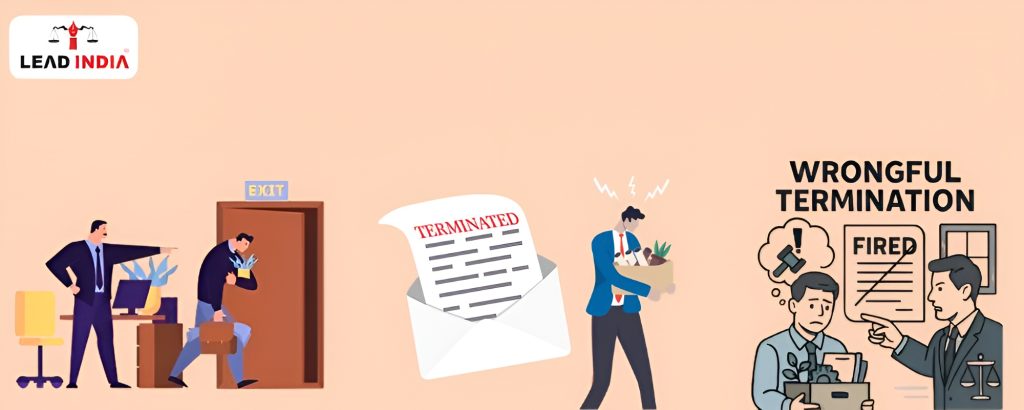
When employees suddenly lose their job, the biggest question is: “Can my employer terminate me without notice in India, or is this illegal?”
This confusion is very much in common.
Workers receive daily information about their termination rights yet employers fail to provide them with actual legal definitions of those rights.
Employees who know the legal requirements for firing employees together with their associated notice periods and wrongful termination procedures will gain a better understanding of their legal rights after they experience job loss.
What Employment Termination Really Means
The employment termination means the end of the employer–employee relationship.
This can happen in most different ways, including:
- Resignation by the employee
- Retirement
- Expiry of a fixed-term contract
- Termination by the employer
- Dismissal for misconduct
- Retrenchment due to business reasons
Most often, when someone speaks of someone being suddenly terminated, they’re referring to a circumstance where an employee is let go with no warning, notice or proper procedures being observed.
Indian Law allows companies to fire workers at any time except under very specific conditions which will not apply to most situations. An employee cannot be terminated by an employer without following due process.
Laws That Regulate Job Termination in India
In India, there are many different labour laws and employment contracts that determine when an employer can terminate a job.
The most important laws are as follows:
Industrial Disputes Act, 1947
This law provides employee protection for those considered “workmen”, and defines the rules regarding lay-offs, retrenchment and termination that are considered unfair.
This law states that if the employee has been continuously employed by the employer for at least 1 year, usually if they wish to dismiss you from their company, the employer will give you:
- One month notice or salary in lieu of notice
- Retrenchment compensation
- Notice to the appropriate government authority
Failure to follow all of these conditions may make termination illegal.
Shops and Establishments Acts
Each of the states in India has its own Shops and Establishments Act which regulates the employment conditions in the private businesses.
These laws often specify rules regarding:
- Notice period
- Working conditions
- Termination requirements
Employment Contracts
Most of the employees sign the appointment letter or the employment agreement. All these contracts then usually contain the clauses relating to:
- Notice period
- Termination conditions
- Disciplinary procedure
Employers are required to follow these contractual terms before terminating an employee.
When Sudden Termination May Be Legal
Although sudden termination appears unfair in many cases, there are situations where it may be legally allowed.
Termination During Probation
It is generally easier to terminate an employee (i.e., terminate) who is in their period of probation than an employee who has permanent status.
Some employment contracts have clauses stating that employers can terminate the employment of a probationary employee with a shorter notice or without notice.
However, probationary employees cannot be terminated for discriminatory or malicious reasons.
Termination for Serious Misconduct
If there is serious misconduct, employers may terminate employees without notice or prior warning. Examples of this include:
- Fraud or financial irregularities
- Theft of company property
- Workplace violence
- Sexual harassment
- Data theft or breach of confidentiality
Even in such cases, employers are generally expected to conduct a domestic inquiry before terminating the employee.
The employee must normally be given:
- Notice of allegations
- Opportunity to respond
- Fair investigation
Skipping all this process may make termination legally questionable.
Expiry of Fixed-Term Contracts
When an employee is hired under a fixed-term employment agreement and his/her employment relationship ends at the expiry of the fixed term, the courts will generally uphold the validity of the termination as both the employer and employee agreed to the length of the term at the time the contract was executed.
When Job Termination Becomes Illegal
Unlawful terminations occur where the employer breaches or fails to comply with applicable labour laws, a written contract of employment, or a fundamental principle of fairness.
Termination Without Notice
If at all the employment contract requires the notice period like one month or three months, then the employer must either:
- Provide notice, or
- Pay salary in lieu of notice
If neither is done, the termination may amount to breach of contract.
Dismissal Without Fair Inquiry
The Indian courts then strongly emphasize principles of natural justice. Before terminating the employee for misconduct, the employers should conduct a fair disciplinary inquiry.
This process may generally include:
- Informing the employee about charges
- Giving an opportunity to defend
- Conducting an impartial investigation
If at all an employee is dismissed without all of these steps, the courts may declare the termination illegal.
Illegal Retrenchment
Under the labour law, the retrenchment requires the compliance with specific legal procedures.
Employers must provide:
- Notice or wages in lieu of notice
- Retrenchment compensation
- Notification to authorities
Failure to follow all of these procedures may then entitle the employee to reinstatement or the compensation.
Discriminatory Termination
Termination based on discrimination may violate constitutional protections.
Examples include dismissal due to:
- Gender or pregnancy
- Religion or caste
- Union activity
- Whistleblowing
Such dismissals can be challenged before labour courts or higher courts.
Important Court Decisions on Wrongful Termination
Indian courts have delivered several important judgments protecting employees against arbitrary dismissal.
The Supreme Court has made repeated assertions that, prior to making such decisions, employers must carry out fair processes (including legal compliance as a minimum requirement) and observe natural justice when they terminate employees.
In earlier rulings, courts determined that an employer’s termination of an employee without a fair process (which includes conducting an investigation) or without following a legally-compliant termination process would result in the termination being deemed void and that the employee may not only be entitled to reinstatement but also back pay.
In addition, courts have found unlawful any employment agreements to terminate an employee without cause or explanation and have held that such actions violate the obligations of fairness.
In particular, the courts have consistently taken the position that an employer’s rights with respect to the management of their operations must be balanced with an employee’s rights.
What Employees Can Do If They Are Suddenly Terminated
If at all you believe that your termination is unfair or it is illegal, several legal remedies are available.
Employees classified as “workmen” may approach labour authorities such as:
- Labour Commissioner
- Conciliation Officer
- Labour Court or the Industrial Tribunal
These bodies are able to provide remedies such as reinstatement, compensation, or settlement.
Employees who are managers or have a contract of employment may file a civil action for damages resulting from the termination of their employment if it was contrary to the terms of their contract.
In some circumstances the High Court can be approached via a writ petition by aggrieved employees on the grounds that their termination violated principles of natural justice.
Practical Steps Employees Should Take Immediately
If at all you are suddenly terminated from the job, taking the right steps early can protect your legal position.
You should:
- Request a written termination letter
- Review your appointment letter carefully
- Collect emails, salary slips, and HR communication
- Avoid signing resignation or settlement documents under pressure
- Consult a labour lawyer for legal advice
Acting early often helps employees challenge wrongful termination more effectively.
Practical Importance of Understanding Termination Laws
Knowing all your rights as per employment law helps you to protect yourself from unfair treatment at the workplace.
The employees often assume that the companies have unlimited authority to dismiss the workers. In reality, the employers must comply with the:
- Labour laws
- Contractual obligations
- Principles of natural justice
If all of these rules are ignored, then the termination may be declared illegal by the courts or labour authorities.
The employees may then be entitled to compensation, reinstatement, or other relief.
What You Should Practically Do Right Now
If you are confused about sudden job termination:
- Do not assume the termination is automatically legal
- Check your appointment letter and notice period clause
- Verify whether any disciplinary inquiry was conducted
- Collect evidence related to your employment
- Seek professional legal advice before taking further steps
Wrong decisions or delayed action can sometimes weaken your legal case.
How We Help Employees in Termination Disputes
We assist workers in knowing if the dismissal was legally valid or not, looking at the employment contracts, protecting you under the Labour Act, and taking any necessary legal steps for wrongful dismissal.
We advocate for employee rights and will make sure that you get the best possible outcomes from your legal intervention.
One can talk to lawyer from Lead India for any kind of legal support. In India, free legal advice online can be obtained at Lead India. Along with receiving free legal advice online, one can also ask questions to the experts online free through Lead India.
FAQs
1. Can the employer terminate the employee without the notice in India?
Yes, but only in the limited circumstances like the serious misconduct or the contractual provisions.
2. Is sudden termination always illegal?
No. It mostly depends on the employment contracts, labour laws, as well as the reason for termination.
3. Can I challenge the wrongful termination legally?
Yes. The employees can approach the labour authorities, the labour courts, or the civil courts depending on the employment category.
4. Can the probation employees get terminated anytime?
The probation employees can get terminated more easily, but the termination cannot be arbitrary or it cannot be discriminatory.
5. What is the compensation that an employee can receive for the illegal termination?
The courts may grant the reinstatement, back wages, or the monetary compensation.


 Talk to a Lawyer