
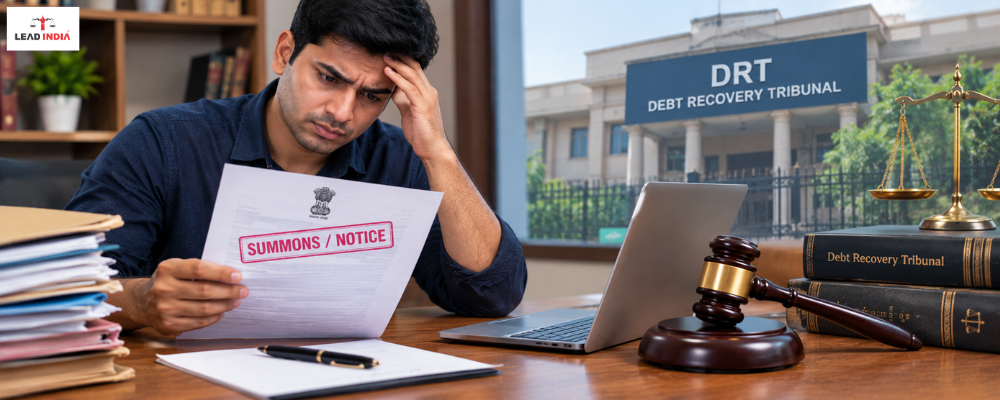
When a borrower, guarantor, or the family member receives notice from Debt Recovery Tribunal (DRT), the first reaction is fear.
Most of the people immediately start thinking:
- “Will the bank take my house now?”
- “Can my bank account be frozen?”
- “Will the police come to my home?”
- “Has the case already been decided against me?”
- “Can I still settle the loan?”
It is only natural for anyone to feel anxious. Many times, the notices from banks and other courts are written with an intimidating tone, and they are also very technical in nature and usually urgent.
Many borrowers receive a DRT summons, and automatically assume they have already lost their defense to the bank. This simply is not accurate.
While a DRT notice can appear to be overwhelming at first, it is actually the start of an oppressive legal recovery process, where you will have the opportunity to defend yourself, contest any incorrect claims, attempt to negotiate a settlement, and preserve your legal rights.
Understanding as to what the notice means, why you received it, as well as what you should do immediately can make a major difference in outcome.
What Is the Debt Recovery Tribunal (DRT)?
The Debt Recovery Tribunal (DRT) is a specific type of court for settling disputes between banks and other financial organizations about recovering debts. The DRT was developed to provide a faster way to resolve debt claims than normal civil courts.
The DRT is primarily governed by the Recovery of Debts and Bankruptcy Act of 1993, which is sometimes still referred to as the RDDBFI Act. In a lot of cases, the DRT will also deal with other disputes based on the SARFAESI Act if a borrower contests recoveries such as possession orders, auction notices, or other enforcement actions against secured creditors.
To put this another way, when a bank or a financial institution is seeking to collect on a loan that has been defaulted, the bank may bring this matter in front of the DRT instead of in front of a regular civil court.
What Does a DRT Notice Actually Mean?
A DRT notice means that the legal proceedings relating to debt claim have been initiated, and you are being called upon to mainly participate. It does not automatically mean:
- You have committed fraud,
- Your property will be taken immediately,
- You will be arrested,
- Or the case has already been decided.
- The notice is your opportunity to respond.
Usually, such a notice contains the name of the bank or financial institution, the case details, the amount being claimed, the hearing date, and directions regarding filing a reply. You may receive a DRT notice if you are:
- A principal borrower,
- A co-borrower,
- A guarantor,
- A legal heir in certain circumstances,
- Or a person claiming rights in a secured property involved in the dispute.
This is why even people who did not directly take the loan sometimes receive notices.
Why Did You Receive a DRT Notice?
Loan default is the most common reason for banks to file cases at the DRT. If you have not paid EMIs for an extended time, and the lender has decided to initiate a formal recovery process, it is likely that the bank will file a case against you in the DRT.
Although loan defaults are very common, they are not the only cause for bank actions. For example, if a person is listed as a co-signer (guarantor) on a loan, then that person could also be subject to legal action for repayment of that loan.
Many signing as a co-borrower believe they will only be pursued upon the borrower’s complete inability to pay; however, once the loan papers are executed, the co-borrower is placed under a continuous, immediate and broad liability which can be enforced against them.
In other instances, banks may initiate SARFAESI action to take possession and/or enforce security against property either prior to or during a stage at which a case has been filed in the DRT.
These cases can sometimes be filed on behalf of banks after they have received a recovery certificate from the lender or during the bank’s efforts to collect against collateral. This is why reading the exact contents of the notice carefully is critical.
Is a DRT Notice the Final Decision?
No. This is one of the greatest misconceptions. A DRT summons is not a judgment. It does not mean the Tribunal has already accepted everything the bank has claimed.
The DRT still has to hear from both sides, examine documents, consider objections, as well as pass a legal order.
If you participate properly, you may be able to:
- Challenge incorrect calculations,
- Raise limitation objections,
- Dispute illegal charges,
- Question procedural defects,
- Seek interim relief,
- Or negotiate settlement.
But if at all you ignore the notice, the Tribunal may then proceed without hearing you. That is where the serious problems begin.
What Should You Do Immediately After Receiving a DRT Notice?
The first thing one should do is to remain calm and read each and every page. Most of the borrowers only read the first page and completely miss the annexures, hearing dates, calculation sheets, or the legal directions. Check:
- Who filed the case,
- The claimed outstanding amount,
- The hearing date,
- The DRT location,
- The type of proceedings,
- And whether the claim relates to simple recovery, SARFAESI enforcement, or execution. Then collect your documents.
This includes loan sanction letters, agreements, EMI payment history, bank statements, restructuring emails, settlement discussions, notices exchanged, and any communication with the lender. These papers often reveal major legal issues.
In many real cases, borrowers discover inflated interest, duplicate charges, incorrect penal fees, or accounting errors only after document review. Legal advice should be taken early, not after missing deadlines.
Can You Challenge the Bank’s Claim?
Yes. A bank’s claim is not automatically correct just because it comes through a legal forum. Several defences may be available depending on the facts.
For example, calculation disputes are common. Interest may have been wrongly compounded, penal charges may be excessive, or payments may not have been properly adjusted. Limitation can also become important.
However, this area requires caution. Many borrowers incorrectly believe that an old loan automatically becomes time-barred. Limitation may be extended through acknowledgments, restructuring documents, balance confirmations, part payments, or revival letters. Documentation defects may also create valid legal objections.
If signatures are disputed, documents are incomplete, authorization is defective, or security documents suffer from legal flaws, those issues may affect the bank’s claim.
In some matters, borrowers also raise fraud, coercion, or misrepresentation as part of their defence. Each case depends heavily on documentary evidence.
What If the Notice Is Related to SARFAESI Action?
This is extremely important. Not every recovery-related notice is identical.
If the matter involves possession of property, symbolic possession, auction action, or enforcement measures against secured assets, SARFAESI remedies become relevant.
In line with Section 17 of the SARFAESI Act, a borrower who feels disadvantaged may challenge actions undertaken by a secured lender in front of a DRT.
Many borrowers erroneously go to the High Court before fully exploring statutory or administrative remedies. The Supreme Court has consistently reiterated that specialized remedies should be utilized as much as possible before someone seeks to intervene under their constitutional rights.
Therefore, if you are in jeopardy of losing your home or business due to foreclosure, you need to develop a strategy quickly.
Can the DRT Attach Your Property Immediately?
Not automatically. This is where borrowers often panic unnecessarily. A DRT notice itself does not mean instant seizure. The stage of proceedings matters.
- If at all the matter is still at adjudication stage, the claim is still under proper examination.
- If a recovery certificate has already been issued, recovery mechanisms may become more aggressive.
- If the SARFAESI enforcement is underway, then separate statutory actions may already be in the motion.
So, the answer mainly depends on the procedural stage, not simply on the existence of a notice. Ignoring the case, however, significantly increases the risk of adverse recovery action.
Can the DRT Freeze Your Bank Account?
In certain recovery contexts, attachment-related proceedings can affect financial assets. But again, this does not happen merely because a notice was issued. There must be proper legal process.
Different recovery mechanisms may operate depending on the stage and nature of proceedings. This is exactly why prompt legal review matters.
Can Police Come to Your House?
This is one of the most frequently asked questions. In ordinary DRT proceedings, police do not casually appear at your house merely because you received a summons.
However, separate enforcement actions, possession execution, or other legally authorized recovery measures may involve administrative assistance depending on circumstances.
Recovery agents often create panic by using threatening language that does not accurately reflect the legal position. Do not rely on verbal threats. Rely on legal documents.
What Happens If You Ignore the DRT Notice?
Ignoring the notice is one of the worst decisions. Many borrowers believe delay will buy time. In reality, silence often weakens your position. If you fail to appear or respond, the Tribunal may proceed ex parte. This means the matter may continue without your participation. The bank’s documents may go largely unchallenged. Orders may be passed based only on one side’s evidence. Once adverse orders are passed, correcting the damage becomes harder, more expensive, and procedurally complicated. Ignoring the matter never improves your legal position.
Can You Still Settle After Receiving a DRT Notice?
Yes. This is another common misconception. A DRT case does not automatically destroy settlement opportunities.
In fact, many disputes are resolved after proceedings begin. Banks may consider:
- One-time settlement (OTS),
- Structured repayment proposals,
- Negotiated compromises,
- Or other commercial resolutions.
However, verbal discussions should never be blindly trusted. A borrower often assumes settlement talks mean proceedings have paused. That assumption can be dangerous.
Unless properly recorded and documented, the legal case may continue. Settlement terms must be formally documented and approved through proper channels.
What If You Are Only a Guarantor?
Guarantors often believe they are secondary parties with limited exposure. That assumption can be legally risky.
Under Indian contract law principles, a guarantor’s liability may be co-extensive with that of the principal borrower unless the contract provides otherwise.
This means banks may proceed against guarantors even where the borrower is also being pursued.
That said, guarantors may still have valid legal defences depending on the documentation, notices, conduct of parties, and facts of the transaction. Never ignore a notice merely because you think “the loan was not mine.”
Filing a Reply Before the DRT
- Your written reply is critical. This is where your legal position formally begins.
- The proper response may include the factual denials, legal objections, calculation disputes, limitation arguments, procedural challenges, as well as the documentary support.
- The poorly drafted replies can only weaken otherwise the strong cases.
- This is not the space for the emotional explanations alone.
- The response needs to be legally structured as well as strategically drafted.
Appeals Against DRT Orders
- If an adverse order is passed, appellate remedies may exist.
- Appeals generally lie before the Debt Recovery Appellate Tribunal (DRAT), subject to statutory requirements.
- However, this area has practical complications. Pre-deposit requirements often apply in appeal matters, though legal provisions may permit limited relief or reduction in appropriate cases.
- This means waiting until the appeal stage can become financially difficult.
- That is why early defence is often more practical than damage control later.
Important Court Decisions You Should Know
In Mardia Chemicals Ltd. v. Union of India, the Supreme Court highlighted the need for borrower’s protection against unreasonable activity by creditors using the SARFAESI framework.
The Transcore v. Union of India case clarified how SARFAESI remedies relate to DRT procedures.
The Court in United Bank of India v. Satyawati Tondon strongly endorsed using statutory remedies before moving too quickly to writ jurisdiction.
The Court of Authorized Officer, State Bank of Travancore v. Mathew K.C. reiterated the importance of using DRT remedies and only using alternative means with restraint.
These cases demonstrate a strong consistent judicial trend; specialized forums and procedural strategies are important.
Common Mistakes Borrowers Make
- One of the most damaging mistakes is ignoring the notice.
- Another is assuming recovery agents’ statements are legally accurate.
- Some borrowers hide documents from their lawyer out of embarrassment.
- Others rely on verbal settlement promises without written confirmation.
- Some file weak or delayed replies.
- Many do nothing until property action becomes imminent.
All of these mistakes repeatedly worsen the cases that may otherwise have been manageable.
Practical Reality Not Every Bank Claim Is Untouchable
The banks are the regulated institutions, but that does not mean that every claim is flawless.
- Errors happen.
- Calculations can be challenged.
- Procedures can be questioned.
- Documentation may be defective.
- Recovery conduct can be scrutinized.
But these rights help only borrowers who act in time.
Final Thoughts
Receiving a DRT summons is serious, but panic is not a legal strategy. The notice is not your conviction. It is your warning that a legal process has begun.
The borrowers who protect themselves best are usually not the ones with perfect financial situations, they are the ones who act quickly, understand the process, preserve documents, and seek proper legal guidance.
If you have received a DRT notice, SARFAESI action notice, or bank recovery summons, taking timely legal advice can make the difference between a controlled resolution and an avoidable legal crisis.
One can talk to lawyer from Lead India for any kind of legal support. In India, free legal advice online can be obtained at Lead India. Along with receiving free legal advice online, one can also ask questions to the experts online free through Lead India.
FAQs
1. Is receiving a DRT notice equal to losing the case?
No. It only means proceedings have begun.
2. Can I settle after receiving the notice?
Yes, settlement remains possible depending on the lender’s position.
3. Can guarantors receive DRT notices?
Yes. Guarantors can face substantial liability.
4. Can the bank take my house immediately?
Not automatically. The stage and legal process matter.
5. Should I ignore the notice if settlement talks are happening?
No. Unless formally documented, proceedings may continue.


 Talk to a Lawyer