
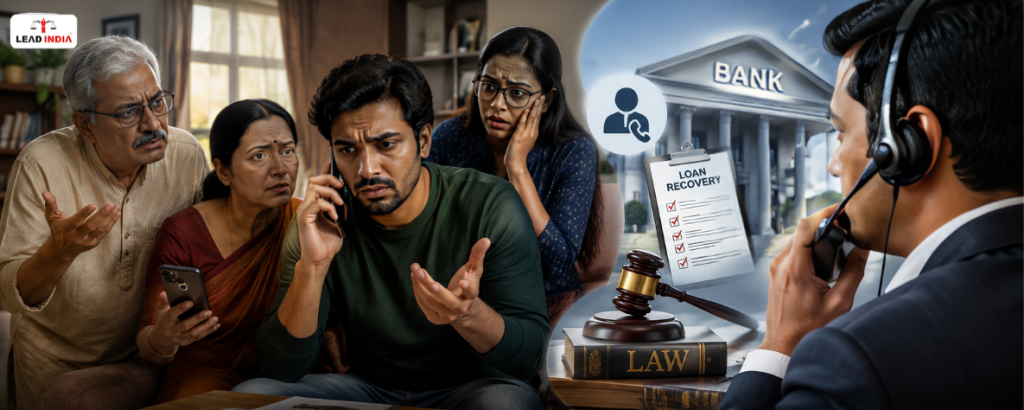
When the borrower starts missing the EMIs on personal loan, credit card, business loan, or the digital loan app repayment, the biggest fear is this: “Can the bank call my parents, spouse, employer, friends, or relatives for loan recovery?”
People who borrow money in India often have legal questions about problems with collecting on their loans. This is especially true for borrowers who have money difficulties, for example, if they have lost their job, if their business is shut down, or if they have multiple loans to repay. Many borrowers do not seek legal assistance until after repetitive phone calls from recovery agents, threats sent via WhatsApp, contact with other employees, or attempts made to publicly shame the borrower.
The legal answer must be clearly understood. Banks and financial institutions have the legal right to recover what is owed them. The borrower cannot believe that their obligation to repay their loan is gone because it has become difficult to do so. However, the right of a lender to collect on a debt does not extend to the extent that it gives the lender the right to harass, intimidate, disgrace or violate the privacy rights of the borrower.
The law in India attempts to strike a reasonable balance between the lender’s right to collect on a debt and the borrower’s right to maintain their dignity, privacy and to receive fair treatment.
What Loan Recovery Really Means in Practice
When a bank or other financial organization wants to get back money that they have lent out there are legal ways they do this called Loan Recovery.
The first thing that happens to recover the debts will be a series of phone calls or emails, reminders, snail mail (hard copies), texting, or letters of demand, trying to get you (the borrower) to pay what you owe to them. If the borrower continues to default, lenders may escalate recovery through arbitration, civil recovery proceedings, Debt Recovery Tribunal proceedings, or SARFAESI enforcement in applicable secured lending matters.
However, recovery becomes problematic when lenders move beyond lawful communication and start using pressure tactics designed to emotionally break the borrower.
Many borrowers experience situations where recovery agents begin calling parents repeatedly, spouses multiple times a day, siblings, employers, office HR departments, colleagues, neighbours, or even unrelated persons whose numbers were somehow accessed. This is where the legality changes.
Can Banks Legally Call Your Relatives?
The legal answer is not an absolute yes or no.
A bank may contact a relative in limited circumstances, but it cannot use relatives as a pressure mechanism for harassment.
For example, if the borrower is genuinely unreachable, the bank may attempt a limited communication to verify whereabouts or establish contact. Similarly, if the relative is a co-borrower, guarantor, or joint account holder, the lender can legally communicate because that person has direct contractual liability.
But where a parent, spouse, sibling, friend, employer, or colleague has no legal liability under the loan agreement, repeated recovery calls can become unlawful if the purpose shifts from communication to coercion.
The law does not permit recovery by humiliation. A bank cannot simply assume that because a person is related to the borrower, they can be pressured into paying someone else’s debt.
What RBI Rules Say About Recovery Practices
The Reserve Bank of India has repeatedly emphasized that recovery practices must remain lawful, professional, and non-harassing.
Banks and NBFCs are mostly expected to follow the fair recovery standards while dealing with the borrowers. Even where the recovery agents are outsourced through the third-party agencies, the original lender remains responsible for their conduct.
A borrower’s default does not suspend their legal rights. Recovery agents cannot behave as private enforcers.
One of the biggest misunderstandings among borrowers is that once an EMI is missed, the bank can do “anything” to recover money. That is legally incorrect. The law permits recovery, but only through lawful means.
When Calling Relatives Becomes Illegal
A limited tracing call is very different from harassment.
The issue becomes illegal when recovery conduct crosses into intimidation or privacy violation.
An example will be that if you repeatedly call the parents of a borrower every day for payment, this may be harassment where the parents are not co-signers on the loan.
If you call an employer to make a borrower feel embarrassed by telling them that the borrower has unpaid debts, this could be considered an illegal disclosure of private information resulting in harm to the borrower’s reputation.
If you send threatening messages via WhatsApp to the borrower’s family or tag the borrower on social media, this generally crosses over legal and ethical lines of behavior.
The problem is not merely the act of communication. The problem is the purpose, frequency, tone, and nature of communication.
If the objective is humiliation rather than lawful recovery, the conduct becomes challengeable.
Are Relatives Legally Liable for the Borrower’s Loan?
This depends entirely on documentation.
If a relative signed as a guarantor, co-applicant, or co-borrower, they may be legally liable.
For example, if a father guarantees an education loan, the lender can legally pursue him. If a spouse signed a home loan jointly, the bank can lawfully demand repayment from the spouse.
But if the relative merely happens to be a family member with no contractual role, there is generally no automatic repayment liability.
A mother is not legally required to repay her adult child’s unsecured personal loan merely because she is the mother.
A brother is not responsible for someone’s credit card dues simply because he is family.
A wife is not automatically liable for her husband’s independent unsecured loan unless she has legally signed.
This distinction is extremely important because recovery agents often attempt to create false pressure by implying legal responsibility where none exists.
Right to Privacy and Dignity of Borrowers
Indian constitutional law protects the individual dignity and privacy.
The Supreme Court in a landmark privacy judgment recognized privacy as the part of Article 21, which protects life and personal liberty.
Financial distress does not eliminate constitutional protection. A borrower may be in default, but that does not permit public humiliation.
Debt information is sensitive personal information. Unnecessary disclosure of unpaid loan details to unrelated third parties can raise serious legal concerns relating to privacy, dignity, and reputational harm.
This becomes even more serious where recovery calls are made to employers, neighbours, or social acquaintances.
The legal system increasingly recognizes that recovery cannot be converted into social punishment.
Supreme Court’s Stand on Recovery Harassment
The Supreme Court of India has repeatedly condemned unlawful recovery practices.
The ICICI Bank Ltd. v. Prakash Kaur is one of the better-known decisions regarding banks, with a specific reference to their use of force and intimidation in collecting debts. The Court, therefore, reaffirmed the very essential principle that recovery is to be done by due process, as opposed to using coercion to collect.
In the Citicorp Maruti Finance Ltd. v. S. Vijayalaxmi case, the Court also criticized repossession that is done inappropriately and has placed a duty on financial institutions to remain within the law.
Both of these rulings make it quite clear that even honest collections cannot be done without following legal procedures.
A borrower’s financial default does not authorize abusive conduct.
Can Banks Call Employers or Office Colleagues?
This is another highly sensitive issue.
Banks may verify employment details at the loan application stage or attempt limited communication if the borrower is completely untraceable.
But contacting office HR, supervisors, or colleagues merely to pressure repayment can become legally problematic.
If the purpose is to embarrass the borrower professionally, the conduct may amount to harassment or reputational injury.
In practical legal disputes, employer-contact harassment is often viewed seriously because workplace embarrassment can directly affect livelihood.
A borrower’s financial dispute cannot automatically become a public workplace issue.
Credit Card Recovery Harassment
Credit card borrowers frequently face aggressive recovery conduct because these are unsecured lending exposures.
Repeated calls, automated threats, legal notice pressure, and emotional intimidation are common complaints.
However, even in credit card defaults, lawful boundaries remain the same.
- The bank can demand payment.
- The bank can issue notices.
- The bank can pursue recovery through lawful channels.
But harassment, abuse, threats of arrest without lawful basis, family intimidation, or reputational pressure remain legally challengeable.
Default is a civil financial issue unless specific criminal conduct exists. Recovery teams often create panic by using fear tactics.
Borrowers should understand the difference between lawful recovery and intimidation.
Loan App Harassment and Contact List Abuse
Digital lending harassment has become one of the most disturbing modern issues.
Some illegal loan apps have reportedly accessed borrowers’ phone contact lists and started messaging friends, family members, and acquaintances.
Such conduct is far more serious than ordinary bank recovery communication.
Unpermitted use of personal contacts raises issues of an unlawful nature in terms of privacy laws, cybercrime laws, consumer protection laws and/or harassment laws.
If you have been subject to app-based harassment, you should take action immediately as digital harassment tends to increase in severity much quicker than traditional recovery processes do.
Taking action may include submitting screenshots, recording harassment calls, escalating through complaints, reporting cybercrime and/or pursuing legal action.
Consumer Protection Remedies
Borrowers are consumers of banking services, and unlawful recovery conduct may become actionable consumer disputes.
Where harassment causes mental agony, reputational damage, unfair treatment, or deficiency in service, a consumer complaint may be maintainable.
Compensation may be claimed for mental harassment and improper conduct.
This becomes particularly relevant where recovery agents repeatedly target family members, misuse abusive language, or disclose private financial distress to outsiders.
Consumer law provides a practical civil remedy beyond pure contractual disputes.
Criminal Complaint in Serious Cases
Some recovery conduct may cross into criminal territory.
A criminal complaint may be warranted if there is evidence to support that there are threats, extortion-style pressure, abusive intimidation, trespassing, unlawful visita and threats to one’s reputation.
If a recovery agent is threatening arrest and/or physical harm without authority, abusing female family members and/or assaulting through intimidation; police intervention may be warranted immediately.
Aggressive phone calls are not always a criminal act, but should not be dismissed when they involve serious misconduct.
The appropriate remedy will depend upon a variety of factors, including the evidence presented, the severity of the actions taken, and the facts leading up to the incident.
RBI Ombudsman Complaint
Where the lender is a regulated institution, borrowers may escalate complaints through the RBI complaint mechanism after first approaching the institution’s grievance system.
A properly documented complaint becomes stronger where evidence includes call logs, call recordings, WhatsApp messages, emails, and witness details.
Many borrowers make the mistake of only arguing verbally with recovery callers. That usually weakens the case. Written escalation creates evidence.
What Borrowers Should Practically Do
If recovery agents start calling relatives, panic usually makes borrowers react emotionally.
That often worsens the situation.
- The practical approach is structured documentation and escalation.
- Preserve all call logs, screenshots, recordings, messages, caller details, dates, and names wherever possible.
- Send a written complaint to the bank’s grievance officer or the nodal officer clearly recording harassment.
- If at all the financial hardship is genuine, then communicate that fact professionally and seek restructuring, rescheduling, or the settlement options.
- Where conduct escalates, legal intervention becomes necessary.
A lawyer’s formal notice often changes recovery behaviour significantly because institutions become aware that documentation exists.
Can Loan Settlement Help?
Settlement talks can be helpful in many true hardship scenarios.
In some cases, borrowers who are losing money or experiencing bankruptcy because of difficulties in making their payments may be able to negotiate with creditors to negotiate either a one-time settlement or by restructuring their obligation to repay what they owe immediately.
Settlement does not eliminate liability immediately, but can act as a means of managing growth.
However, borrowers should negotiate carefully. Improper informal settlements without closure documentation can create future disputes. Any settlement should be documented properly.
Difference Between Lawful Recovery and Harassment
This distinction matters. Lawful recovery includes reasonable reminders, written notices, settlement discussions, demand communications, arbitration, civil proceedings, or lawful secured enforcement.
Harassment includes repeated family intimidation, abusive calls, threats, public embarrassment, workplace shaming, unlawful visits, or misuse of personal data.
The borrower may owe the money, that does not mainly legalize harassment.
Final Legal Position
Banks have a lawful right to recover unpaid dues. What they do not have is the right to destroy a borrower’s dignity in the process.
Calling relatives in genuinely limited lawful circumstances may be permissible. But the repeated intimidation, public humiliation, unnecessary disclosure, as well as the emotional coercion cross the legal boundaries.
The financial hardship is not crime. The borrowers must understand both the sides of the law: repayment obligations are fully real, but so are the legal protections against harassment.
If you are facing the loan recovery harassment, recovery agent intimidation, employer embarrassment, or the illegal pressure on the family members, proper legal strategy can make substantial difference.
One can talk to lawyer from Lead India for any kind of legal support. In India, free legal advice online can be obtained at Lead India. Along with receiving free legal advice online, one can also ask questions to the experts online free through Lead India.
FAQs
1. Can a bank call my parents if I miss EMI?
If your parents are guarantors or co-borrowers, yes. If they are unrelated to the loan contract, repeated harassment calls may be challengeable.
2. Can recovery agents call my employer?
Limited tracing communication may occur in some situations, but workplace harassment or public embarrassment is not lawful.
3. Can banks threaten arrest for loan default?
Ordinary loan default is generally a civil financial issue unless specific criminal conduct exists. Empty intimidation tactics should be legally evaluated.
4. Can I complain against recovery harassment?
Yes. Depending on facts, complaints may be made to the lender, RBI mechanism, consumer forum, police authorities, or civil courts.
5. Can a bank contact my wife for my personal loan?
Only if she is legally connected as guarantor, co-borrower, or joint obligant. Marriage alone does not create automatic loan liability.
6. What if a loan app calls all my contacts?
Immediate legal action, cyber complaint, documentation, and escalation are advisable because contact misuse may involve serious privacy violations.


 Talk to a Lawyer