
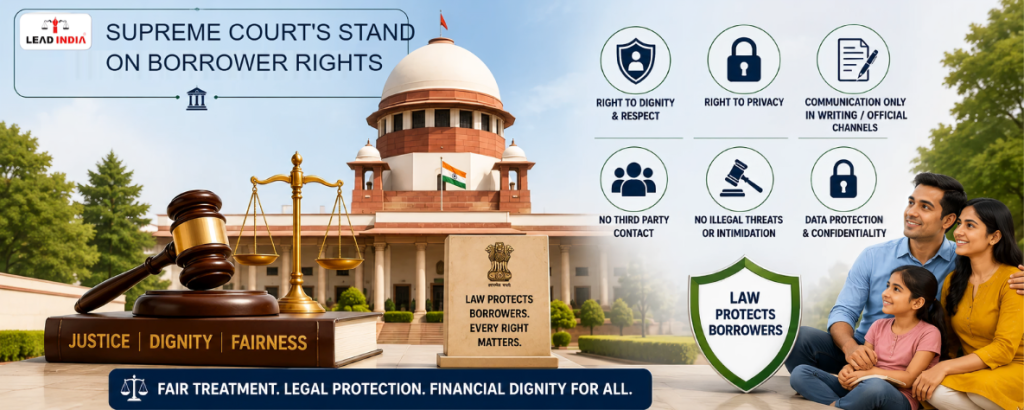
The most common questions the borrowers ask after missing a few EMIs is: “Can bank recovery agents threaten me, come to my house, call my family members, or publicly humiliate me for unpaid loan dues?”
People are often afraid that they will be harassed by banks, financial institutions, and/or lenders once a loan has been defaulted upon due to various reasons such as financial stress or other unexpected events (job loss, etc.). Further, many believe that once they default, the bank can use any means necessary to get their money back. This assumption is incorrect and is contrary to the law.
As to the first point, while banks, NBFCs and other financial institutions have the legal right to pursue outstanding debts, recovery agents are prohibited from harassing, intimidating, threatening, abusing or using unlawful means to force you to pay.
In numerous decisions over the years, the Supreme Court of India has confirmed that loan recovery should take place in accordance with the law and not based on fear, humiliation or muscle power.
If you are receiving threatening calls or ongoing harassment through phone, email, text, unsolicited visits or through pressure from a recovery agent, use this legal guide to learn about your rights, how the Supreme Court has ruled regarding the bank’s ability to recover loans and your options under India’s RBI rules and the law.
What Recovery Agents Really Do
Recovery agents act on behalf of banks, NBFCs, Fintech lenders or other financial institutions to follow up with borrowers who are behind on their payments on their loans and due to this have missed payments of their EMIs.
They can do this by contacting and discussing repayment options with the borrower, helping to explore financing or settlement options, reminding the borrower of their default via a letter or phone call, or where authorized under the applicable secured loan laws in the country pertaining to recovery of the loan from the borrower. However, there is a very important legal distinction here.
- A recovery agent is not a police officer.
- A recovery agent is not a court authority.
Under no circumstances are recovery agents legally entitled to use threats of force or to enter your home without your permission, or otherwise illegally take your possessions from you, or intimidate your family, or publicly humiliate you in any manner. Recovery agents’ authority is limited under various laws, RBI guidelines, directives and court ordered controls.
What the Supreme Court Has Clearly Said
The Supreme Court has taken a strict view against unlawful recovery practices.
In several cases, the Court has strongly criticized banks and financial institutions for using aggressive recovery methods through outsourced agencies.
The core legal principle is simple: A borrower may be in default, but that borrower does not lose dignity, privacy, or legal protection.
The courts have held many times that you cannot sue someone for money by violating their constitutional rights or their right to basic human dignity. The need to respect someone’s human dignity became especially critical following the receipt of numerous complaints about the aggressive means used by repossession personnel to recover automobiles through the force of arms, intimidation, and other bullying tactics.
Landmark Supreme Court Judgment Every Borrower Should Know
ICICI Bank v. Prakash Kaur
This is one of the most important judgments on recovery harassment.
In this matter, the Supreme Court strongly condemned banks for using aggressive recovery agents and musclemen for repossession and loan collection.
The Court made it clear that financial institutions cannot adopt extra-legal methods merely because money is outstanding.
The judgment effectively established that:
- Banks must follow lawful recovery processes,
- Forceful repossession is unacceptable,
- Intimidation is unlawful,
- Outsourcing recovery does not remove bank liability.
This case remains one of the strongest borrower-protection precedents in India.
Can Banks Escape Liability by Blaming Recovery Agencies?
No. This is another critical legal principle. Many institutions try to argue that recovery misconduct was committed by outsourced vendors or third-party collection agencies.
That defence does not usually help. Courts have repeatedly held that recovery agents act on behalf of the financial institution.
So, if harassment happens, the bank or lender may also be legally responsible.
In practical terms, if a recovery agent threatens you, humiliates you, or acts illegally, your complaint should not be limited to the individual agent—you can proceed against the lender as well.
RBI Rules on Recovery Agents
The Reserve Bank of India has issued clear conduct expectations for lenders and recovery personnel.
These protections are highly important for borrowers. Recovery agents must identify themselves properly.
They should carry authorization and disclose which institution they represent.
Borrowers generally should not be contacted at unreasonable hours. The commonly accepted recovery interaction window is between 8 AM and 7 PM, unless circumstances justify otherwise.
- Threatening language is prohibited.
- Abusive communication is prohibited.
- Physical intimidation is prohibited.
- Borrowers’ privacy must be respected.
Banks are expected to ensure ethical conduct by outsourced agencies.
In practical legal disputes, RBI violations become very useful evidence against lenders.
What Recovery Agents Cannot Legally Do
This is where borrowers often panic unnecessarily. Recovery agents cannot legally:
- Call you repeatedly just to mentally torture you.
- Use abusive or insulting language.
- Threaten arrest.
- Threaten criminal action without legal basis.
- Visit your office to publicly shame you.
- Call relatives merely to embarrass you.
- Disclose your financial default to neighbours.
- Enter your home forcibly.
- Take away property without legal process.
- Seize vehicles unlawfully.
- Threaten social exposure.
- Send fake legal threats.
- Pretend to be government authorities.
- Use WhatsApp harassment campaigns.
- Use intimidation through multiple unknown numbers.
These actions may expose the lender and the individuals involved to civil and criminal consequences.
But Can Banks Recover Their Money Legally?
Yes. This is equally important. Borrowers should not misunderstand legal protections as immunity from repayment. Banks absolutely have lawful recovery rights.
They may send repayment notices, issue legal notices, file civil recovery proceedings, initiate arbitration if contractually allowed, proceed under SARFAESI in eligible secured loan matters, approach tribunals in certain debt matters, enforce contractual remedies and seek repossession through lawful procedures.
So, the issue is not whether recovery can happen. The issue is how recovery happens. Legal recovery is allowed but harassment is not.
Secured Loan vs Unsecured Loan: Why It Matters
Borrowers often get confused here.
If a loan is unsecured, for instance, it is a personal loan, an app loan, or an unsecured business loan, the lender typically doesn’t have the ability to take ownership of your property (i.e. properly seize property) without a legal process first.
In contrast, if you have used your property as collateral for a loan (i.e. vehicles, real estate, machinery, etc.), then the lender has stronger rights of recovery due to their ability to fulfill the necessary legal requirements.
Even then, a lawful process must be followed. A secured lender still cannot send musclemen to forcibly take possession. The Supreme Court has clearly discouraged such practices.
Can Recovery Agents Visit Your Home?
Yes, in some circumstances, recovery representatives may attempt lawful contact. But lawful contact is very different from harassment.
A simple professional visit for repayment communication may not automatically be illegal.
However, the moment the conduct becomes very much threatening, humiliating, coercive, repeated, or mostly invasive, the legal issues arise.
For example:
- If agents come with threatening language.
- If they pressure family members.
- If they create neighbourhood embarrassment.
- If they attempt forceful entry.
- If they create fear.
That becomes actionable misconduct.
Can Recovery Agents Call Family Members?
Generally, this becomes legally problematic when done for pressure or humiliation.
Some may be contacted frequently, but if that means calling family members, spouses, relatives, or employers repeatedly in an attempt to embarrass the borrower for no other reason other than that they owe money (and/or are unable to pay), this is likely to be prohibited by law and also violate the borrower’s rights to privacy. This is a very common area of complaints.
Can Recovery Agents Visit Your Workplace?
- This is another major issue. Public workplace embarrassment can seriously damage reputation and employment.
- If recovery interaction is designed to shame, threaten, or pressure through public exposure, courts take a serious view.
- Borrowers do not lose their dignity merely because repayment is delayed.
Supreme Court’s View on Borrower Rights
The judiciary has consistently recognized that borrowers retain important legal protections. A financial default does not erase constitutional values. Borrowers continue to have:
- The right to dignity
- The right to fair treatment
- The right against harassment
- The right to privacy
- The right to lawful procedure
- The right to challenge illegal recovery action
This is one of the strongest principles emerging from judicial decisions.
Practical Signs That Recovery Conduct Has Become Illegal
Many borrowers are unsure when legal lines are crossed. Watch for these warning signs.
- Repeated calls from multiple numbers every day
- Threats of arrest without legal basis
- Threats to contact relatives
- WhatsApp abuse
- Social humiliation threats
- Workplace embarrassment
- Forceful home visits
- Threatening language
- Illegal repossession attempts
- Fake legal intimidation
- Pressure to transfer money immediately under fear
The presence of these indicators usually means you should start documenting evidence immediately.
What You Should Do If Recovery Agents Harass You
The biggest mistake borrowers make is panicking and verbally fighting. Instead, act strategically. Start preserving evidence. Save call recordings where legally permissible. Preserve WhatsApp messages. Take screenshots. Note dates, times, caller details, and behaviour.
Ask the caller for full name, agency details, bank name, authorization details. Then escalate in writing. Written complaints create documentary evidence. Without the documentation, proving the harassment becomes harder.
Legal Remedies Available to Borrowers
Complaint to the Bank or NBFC
Your first formal step should often be a written grievance to the lender. Address it to:
- Branch manager
- Grievance redressal officer
- Nodal officer
- Customer complaints department
- Loan account details
- Nature of harassment
- Dates
- Calls
- Threats
- Agent details if known
RBI Ombudsman Complaint
If the institution is regulated and grievance redressal fails, borrowers may escalate through RBI complaint mechanisms.
This becomes especially effective where:
- RBI conduct rules are violated
- Ethical recovery norms are breached
- Unfair treatment occurs
Police Complaint
If conduct becomes criminal, police intervention may become necessary Examples:
- Criminal intimidation
- Trespass
- Assault
- Extortion threats
- Harassment
- Abusive intimidation
Loan recovery does not provide immunity from criminal law.
Consumer Court Remedy
Borrowers may approach consumer forums in appropriate circumstances Claims may include:
- Mental harassment
- Deficiency in service
- Unfair practices
- Illegal recovery behaviour
Compensation may be claimable depending on facts.
High Court Writ Petition
In serious rights-violation matters, especially where regulatory or public law concerns arise, constitutional remedies may become relevant. This is generally used in stronger or exceptional cases.
Common Borrower Mistakes
Many borrowers unintentionally worsen their legal position.
- Ignoring all communication completely.
- Making false promises repeatedly.
- Paying random recovery numbers without verification.
- Reacting emotionally.
- Deleting evidence.
- Believing fake arrest threats.
- Signing documents without understanding them.
- Assuming harassment means the debt disappears.
- Legal protection against harassment does not erase genuine repayment liability.
- Strategic legal handling is always better.
Can a Lawyer Help in Loan Recovery Harassment Cases?
Definitely, there is often a big difference in what a lawyer can do. By sending a legal notice, making appropriate lender communications, analysing secured and unsecured exposure, disputing unlawful repossession, filing complaints, planning and structuring settlements, defending against coercive methods of collection, advising on consumer rights/recovery options, creating a plan for litigation whenever appropriate, a lawyer can provide assistance in these ways. In many cases, early legal intervention has proven successful in preventing escalation quickly.
How We Help Borrowers
Acting promptly through legal means will ultimately help those who experience recovery harassment, coercive phone calls, illegally attempting to repossess, or who are being pressured by banks, NBFCs, and digital lenders.
The correct approach to take depends on the type of loan, the security document associated with the loan, the current stage of default, and the type of lender and level of evidence of harassment; as well as whether or not a settlement is possible or if litigation is likely. Every matter needs proper legal assessment before action.
One can talk to lawyer from Lead India for any kind of legal support. In India, free legal advice online can be obtained at Lead India. Along with receiving free legal advice online, one can also ask questions to the experts online free through Lead India.
FAQs
1. Can the recovery agents come to all my house?
The limited professional contact may occur, but the harassment, threats, humiliation, or the forceful conduct are fully unlawful.
3. Can they call my relatives?
Repeated calls to relatives for pressure or embarrassment may create legal liability.
4. Can they arrest me for unpaid loan?
Recovery agents cannot arrest you. Civil loan default does not automatically mean arrest.
5. Can my vehicle be taken without notice?
In secured matters, legal recovery rights may exist, but unlawful forceful repossession is challengeable.
6. Can I file the police complaint against the recovery harassment?
Yes, where the criminal intimidation, trespass, threats, or any unlawful conduct occur.
7. Can I complain to RBI?
Yes, depending on the lender type and complaint circumstances.


 Talk to a Lawyer