
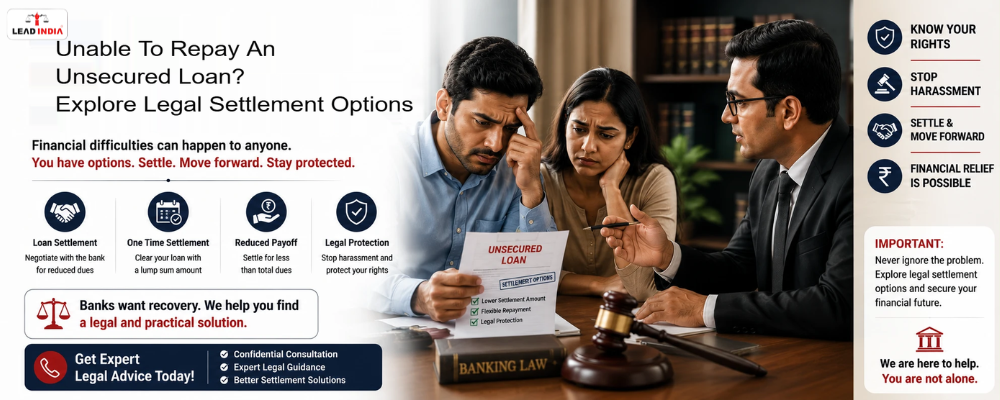
One of the most common fears borrowers faces after missing a few EMI payments is this:
- “Can the bank send the police to arrest me?”
- “Can recovery agents come to my house and harass my family?”
- “Can my salary account be frozen?”
- “Will I be jailed if at all I cannot repay my personal loan?”
These fears are very common for those who have taken out personal loans, credit card debts, immediate cash loans (instant app loans), consumer durable financing, or other unsecured forms of borrowing.
Knowing all of your legal rights, settlement options, as well as practical remedies can help avoid the unnecessary harassment, poor financial decisions, as well as the costly legal mistakes.
What Exactly Is an Unsecured Loan?
An unsecured loan is basically a credit source that doesn’t rely on any collateral, or an asset, as a backup, unlike a secured loan, where you kind of have to pledge something as security. It’s more or less “trust-based”, even if the paperwork says otherwise.
Approval for an unsecured loan is generally based on monthly income, employment history, current liabilities, repayment/history and your CIBIL score.
Things do not always go according to plan. Medical emergencies, business losses, unemployment, salary reductions, family obligations, inflation, failed investments, and sudden crises can make repayment pretty hard, or even unrealistic.
That is where legal confusion begins.
Is Non-Payment of an Unsecured Loan a Criminal Offence?
This is a common misconception. Most people think that if they do not repay their unsecured loan due to financial hardship, then it becomes a criminal offense. But in fact, it is generally civil.
In simple terms, if you borrowed money for the right reasons and intended to pay it back but lost your ability to do so as a result of events outside of your control, this action does not constitute dishonest behaviour.
A bank cannot automatically convert every loan default into a criminal case merely because payments stopped.
However, this principle has important exceptions. If a person lies about their identity, forges documents, or deliberately deceives the lender to obtain a loan, the crime of fraud may be committed. The same goes for any possible case of identity theft where false documentation was used to obtain a loan.
When someone has a legitimate reason for being unable to repay a loan, that is very different than experiencing issues with theirs because they were trying to defraud a bank.
Courts have consistently distinguished between financial inability and criminal intent.
Therefore, if your problem is genuine financial distress, panic about immediate arrest is usually misplaced.
What Usually Happens After You Miss EMI Payments?
The practical recovery cycle usually begins in stages.
Initially, lenders start with reminder calls, emails, SMS alerts, and payment follow-ups. If the default continues, late payment charges, penal interest, and collection escalation may follow.
After prolonged default, the matter may move to internal recovery departments, outsourced recovery agencies, legal notice issuance, arbitration proceedings, or civil recovery actions depending on the agreement terms.
In regulated lending, prolonged default may also impact your credit reporting and account classification. But borrowers often make the mistake of ignoring communication entirely.
That usually worsens the situation. Silence makes lenders assume unwillingness rather than inability. Early communication often creates better settlement possibilities.
Can Recovery Agents Harass Borrowers?
While lenders and non-banking finance companies, NBFCs, do have a legal right to recover the money you owe they don’t have a right to chase you down with threats, humiliation, or coercion. It’s illegal for a recovery agent to threaten you, use abusive or derogatory language toward your family, keep contacting you outside normal business hours, try to make you look publicly embarrassed, harass you at your workplace in order to humiliate you, and/or use violence while attempting to recover debt.
The Supreme Court strongly condemned such practices in ICICI Bank Ltd. v. Prakash Kaur, where coercive recovery methods were criticized in clear terms.
Borrowers frequently report threats like:
- “We will send the police.”
- “We will visit your home daily.”
- “We will inform your relatives.”
- “We will destroy your CIBIL permanently.”
- “We will file a criminal complaint immediately.”
Many such threats are pressure tactics rather than immediate legal realities.
That said, every case depends on its own facts. If the harassment becomes unlawful, the legal remedies are available.
Can Banks Arrest Borrowers?
Banks themselves cannot arrest anyone. Arrest is a state function through police and judicial processes, not a private recovery mechanism.
If the issue is purely loan repayment default arising from genuine financial inability, arrest does not automatically follow.
However, where allegations involve fraud, forged documents, cheating, identity misuse, or other criminal conduct, separate criminal proceedings may arise according to law.
This distinction is extremely important. Missing EMIs does not automatically mean jail.
Can Recovery Agents Visit Your Home?
Yes, lawful recovery follow-up visits may occur. But there are limits.
They cannot trespass, threaten, intimidate, humiliate, force entry, or harass family members.
Professional recovery communication is permitted. Coercive conduct is not.
Borrowers should also avoid all the aggressive confrontation, because that can unnecessarily escalate the matters.
Document everything. If the misconduct occurs, the evidence becomes crucial.
What Are Your Legal Rights as a Borrower?
The borrowers often wrongly assume that once they default, they will lose all protections.
That is not at all correct. Even in default, borrowers retain legal rights.
- You have the right to dignity as well as protection against unlawful harassment.
- You have the right to fair communication.
- You have the right to review settlement terms before accepting them.
- You have the right to challenge excessive or unlawful claims.
- You have the right to legal representation.
- You have the right to respond to legal notices.
- You also have the right to seek remedies if coercive recovery practices occur.
A borrower in financial difficulty is not automatically a wrongdoer.
Legal Settlement Options If You Cannot Repay
Ignoring debt is rarely a good strategy. The practical legal settlement options should be explored early.
Loan Restructuring
If you start having short term money troubles and then end up with more permanent financial issues, a restructuring plan might help your whole budget kind of stabilize.
You might need different payment arrangements, like changing the amount of your monthly repayments, or lengthening the time until it’s all paid back, also you can pause payments for a while.
Another approach is creating a new payment cadence, instead of the previous one. Most of the time this route works best for folks who have lost most, or literally all, of their income.
Still, the restructuring conditions should be examined super carefully, because the overall cost to repay could end up higher than expected.
One-Time Settlement (OTS)
A one-time settlement is one of the most common practical solutions.
Here, the lender agrees to accept a reduced lump sum amount in full and final settlement.
For example, if total outstanding dues are significantly high, negotiated settlement may close the matter at a lower figure depending on recovery assessment.
However, borrowers must understand an important consequence.
- A settled account is not the same as a fully closed account.
- Settlement can negatively affect future creditworthiness.
- Still, in severe distress, it may be a commercially practical exit.
- Never rely on oral assurances.
- Written confirmation is essential.
Negotiated Settlement Through Legal Counsel
This is often the most effective approaches.
Borrowers frequently negotiate poorly because they communicate emotionally or without documentation.
A lawyer can evaluate the claim, assess legal exposure, review the loan agreement, negotiate realistic terms, and prevent exploitative settlement conditions.
In practical matters, many borrowers make the serious mistake of paying “settlement amounts” without obtaining closure documentation.
That creates future disputes. Professional negotiation reduces such risks.
Lok Adalat Settlement
Many financial disputes are resolved through Lok Adalat mechanisms.
This provides faster, practical settlement opportunities where both parties are willing.
For borrowers seeking structured resolution without prolonged litigation, this may be useful.
Complaint Against Harassment
Borrowers can seek legal recourse through the appropriate legal forums for recovery conduct that is unlawful based upon the type of misconduct.
Harassment, slander, abusive behaviour, intimidation, and illegal recovery tactics will not be tolerated.
What Happens If You Ignore Everything?
- This is where borrowers often make the worst mistake.
- Ignoring calls, notices, emails, legal documents, and settlement opportunities rarely help. Instead, the situation typically worsens.
- Your credit profile may deteriorate.
- Collection pressure may continue.
- Legal notices may follow.
- Arbitration may be initiated where contractual clauses permit.
- Civil recovery proceedings may begin.
- Negotiation flexibility may reduce.
- The longer the silence, the weaker your practical position may become.
- Ignoring the debt does not make it disappear.
Can Salary Be Attached?
This depends on legal proceedings. A bank cannot casually freeze or attach salary merely because an EMI was missed. Lawful recovery requires proper legal processes.
However, where judicial proceedings result in enforceable orders or decrees, recovery consequences may become more serious.
Borrowers should therefore avoid reaching advanced litigation stages unnecessarily.
Difference Between Loan Settlement and Full Closure
This distinction matters greatly.
A closed loan means full dues were paid and the liability ended completely.
A settled loan means the lender accepted less than the full outstanding amount as negotiated closure.
Settlement may help immediate financial survival but can affect future borrowing credibility.
Borrowers often focus only on immediate relief and ignore long-term credit impact. The right strategy depends on financial capacity.
What About Credit Score Damage?
Yes, default usually impacts creditworthiness.
The late payments, prolonged overdue status, settlements, as well as the defaults can affect the credit reporting.
The future consequences may include the difficulty obtaining fresh loans, credit cards, or the favorable borrowing terms.
However, financial damage is not always permanent. Improved repayment discipline, closure compliance, and proper financial management can gradually improve credit standing.
What If a Legal Notice Comes?
Do not ignore it. Many borrowers panic or throw legal notices aside assuming they are merely pressure tactics. That is risky a legal notice should be reviewed carefully.
Sometimes the notices contain the inflated claims, contractual demands, arbitration invocation, or any of the settlement opportunities. Silence may weaken your defence.
Special Warning About Online Loan Apps
The growing problem of digital lending abuse is a concern for many people today.
There are a lot of unregulated and abusive lenders that employ aggressive methods of recovering debt, including contacting borrowers’ multiple times a day and threatening to publicly shame them.
It matters a lot for borrowers to understand the gap between a legal, regulated loan and an unlawful loan that was made using abusive techniques.
Also, harassment, infringements on privacy, blackmail, and coercive pressure are all banned by law.
If you’re dealing with an unregulated lender, it’s crucial to get urgent legal guidance as soon as possible.
Practical Mistakes Borrowers Must Avoid
Common errors include failing to respond to demand letters, creating emotional commitments beyond their capabilities, obtaining funds from informal lenders to pay previous debts, trusting verbal agreements to settle debts, paying amounts without written agreement or documentation of the payment, and believing that all threats made by creditors are valid in the eyes of the law.
Panic-based financial choices usually intensify the feeling of despair. Behavioral choices based purely on panic are less successful than developing a purposeful response plan.
What Should You Practically Do Right Now?
If at all you are unable to repay the unsecured loan, first assess whether the hardship is temporary or long-term.
- Collect your loan documents.
- Review outstanding amounts.
- Understand whether the lender is a regulated bank, NBFC, or another entity or not.
- Document all threatening communication.
- Avoid making false repayment commitments.
- Seek legal advice if the harassment begins or the legal notices arrive.
- Explore the restructuring if the recovery is possible.
- Explore the negotiated settlement if at all full repayment is unrealistic.
Important Judicial Position
The Supreme Court has made it very clear that recovery cannot become a tool for intimidation or humiliation.
While the lenders are entitled to lawful recovery, the borrowers remain entitled to dignity, fairness, as well as the due process. This balance is very much essential.
Conclusion
If you are unable to repay an unsecured loan, it can be scary when phone calls, harassment and financial pressure start to build up. However, don’t let fear take the place of understanding your legal rights.
Not being able to make your monthly EMI payments does not make you a criminal. Banks cannot just arrest borrowers with no reason. Recovery agents are not allowed to harass your family. And not every threat made during a collection is legally enforceable against you. However, if the debt you owe is valid and legally enforceable, you should take responsibility for it. You can make smart decisions by communicating with the lender as early as possible, evaluating your options through legal counsel and creating a plan for repayment.
Having a timely legal plan can help to reduce damages from financially and/or emotionally abusive collections, provide a pathway to a lawful resolution, and assist you with taking steps toward a lawful resolution as quickly as possible.
One can talk to lawyer from Lead India for any kind of legal support. In India, free legal advice online can be obtained at Lead India. Along with receiving free legal advice online, one can also ask questions to the experts online free through Lead India.
FAQs
1. Can a bank arrest me for personal loan default?
No, a bank cannot directly arrest a borrower merely for repayment default arising from genuine financial hardship.
2. Will loan settlement damage my credit score?
Yes, settlement may negatively affect future borrowing credibility compared to full closure.
3. Should I ignore the legal notices if I cannot pay?
No. Ignoring the notices usually worsens legal and the financial situation.
4. Can I negotiate with the bank through a lawyer?
Yes. Legal negotiation is often one of the most practical and effective approaches.
5. Can online loan apps legally threaten my relatives?
Unlawful harassment and privacy abuse are not legally acceptable.
6. Is unsecured loan default always a civil matter?
Generally, yes in genuine hardship cases, but fraud-related facts may create criminal exposure.


 Talk to a Lawyer