
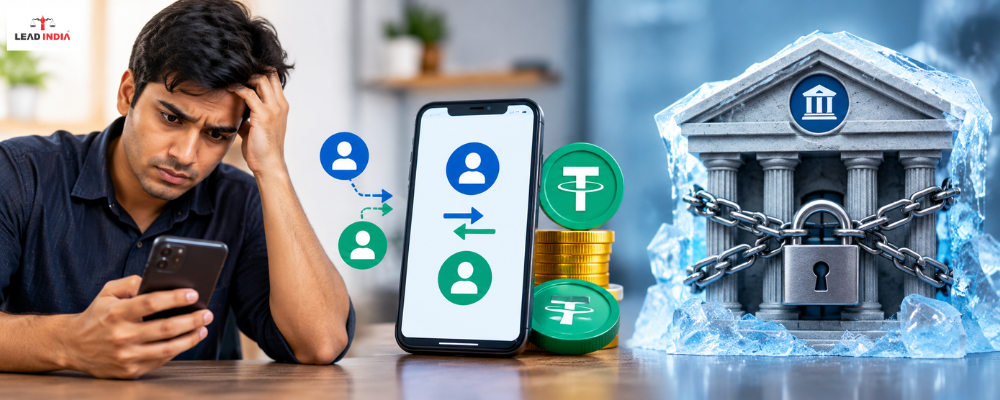
Cryptocurrency transactions, particularly USDT P2P transactions, can create banking and legal complications when funds become linked to cyber fraud. An innocent recipient may face account freezing, lien marking, or debit restrictions due to the money trail. I4C clarifies that such action is taken by concerned law-enforcement agencies or banks, not I4C itself. Therefore, account freezes require prompt attention.
Why Bank Accounts Get Frozen After P2P or USDT Transactions
A bank account can become involved in a cybercrime investigation when a transaction passing through the account is connected to money reported as stolen, fraudulently obtained, or otherwise disputed. For example:
A fraudster may deceive a victim into transferring ₹2,00,000 to Account A. The money may subsequently be transferred to Account B, and Account B may transfer or receive funds from another person through a P2P USDT transaction.
If the banking trail reaches your account, the investigating agency may examine your account even if you were not the original fraudster.
Common situations include:
- Receiving money from an unknown P2P buyer;
- Receiving payment from an account allegedly connected with cyber fraud;
- Buying or selling USDT through informal channels;
- Allowing another person to use your bank account;
- Accepting third-party payments without verifying the sender;
- Receiving funds through a payment intermediary;
- Multiple unexplained high-value transactions; or
- Transactions that appear inconsistent with the account holder’s normal banking activity.
The existence of a freeze does not automatically establish that the account holder committed a crime. The circumstances and evidence have to be examined individually.
What is a P2P or USDT Transaction?
P2P means Peer-to-Peer. In a cryptocurrency transaction, it generally refers to a transaction where one individual buys or sells cryptocurrency directly with another individual, often through a platform that facilitates the transaction.
USDT, or Tether, is a cryptocurrency designed to maintain a value linked to the US dollar.
A typical P2P transaction may involve:
- The buyer agrees to purchase USDT.
- Seller provides payment details.
- The buyer transfers money to the seller’s bank account.
- Cryptocurrency is released according to the platform’s transaction mechanism.
The difficulty arises when the money used by the buyer does not actually belong to the buyer or was obtained through fraud.
Consequently, the seller may receive apparently legitimate payment while unknowingly becoming part of a larger money trail.
How Can an Innocent Person’s Account Become Frozen?
One of the most important things to understand is that the person whose account is frozen may not necessarily be the primary accused.
Suppose a cyber fraud victim loses ₹5 lakh. The fraudulent amount passes through several accounts before reaching an individual who sold USDT through a P2P transaction.
The investigating agency may trace the money through the banking system.
As a result, the account of the P2P seller may become relevant to the investigation.
The account holder may therefore be:
- The alleged beneficiary;
- A recipient of disputed funds;
- An intermediary in the transaction chain;
- A witness or person possessing relevant information; or
- A person whose account requires verification.
The exact legal position depends on the facts, transaction records, investigation and the action taken by the competent authority.
Freeze, Lien and Debit Restriction: What Do They Mean?
People often use the words freeze, lien, and debit freeze interchangeably, although the practical restriction may differ.
A bank may restrict transactions in an account because of:
- An instruction received from a law-enforcement agency;
- A lien relating to disputed funds;
- A court order;
- Internal fraud or risk controls;
- KYC-related restrictions; or
- Other regulatory or banking reasons.
Therefore, the first step should be to find out exactly what restriction has been placed on the account. Ask the bank:
- Is the entire account frozen?
- Is only a particular amount under lien?
- Are only debit transactions restricted?
- Which authority requested the restriction?
- What is the complaint or reference number?
- Which police station or investigating agency is involved?
- What transaction or amount is under investigation?
This information can determine what action should be taken next.
What Should You Do Immediately After Your Account Is Frozen?
Do not panic and do not immediately delete your cryptocurrency records.
Instead, take the following steps.
1. Contact the Bank
Visit the branch or communicate with the bank through its official grievance channel. Request written information regarding the restriction.
2. Ask for the Reference Details
Try to obtain:
- Complaint number;
- FIR or NCRP reference, if available;
- Police station details;
- Investigating officer’s details;
- Disputed transaction amount;
- Date of disputed transaction; and
- Authority that issued the instruction.
3. Preserve All Evidence
Do not delete your P2P chats, transaction history, bank statements, invoices or cryptocurrency records.
The NCRP itself advises complainants to preserve evidence such as bank statements, online money-transfer receipts, emails, chat transcripts, screenshots and other relevant documents.
4. Prepare a Transaction Explanation
Prepare a chronological explanation showing:
Who paid you → when they paid you → why they paid you → what USDT was transferred → through which platform → where the transaction records are available.
5. Contact the Investigating Agency
Where the bank identifies the concerned investigating agency, the account holder can communicate with the officer and provide documents explaining the transaction.
Documents and Evidence You Should Preserve
A strong documentary record can be extremely important in demonstrating that a P2P transaction was genuine. Preserve:
- Complete bank statements;
- UTR/transaction numbers;
- P2P order IDs;
- Cryptocurrency wallet addresses;
- Blockchain transaction hashes;
- Platform transaction history;
- Screenshots of the P2P order;
- Buyer/seller communications;
- Invoices or payment records;
- Identity/KYC records available from the platform;
- Tax records, where relevant;
- Emails and SMS relating to the transaction; and
- Correspondence with the bank or investigating agency.
Avoid editing screenshots or deleting messages.
The objective should be to preserve the complete transaction trail, not merely selected portions that support your position.
How to Communicate with the Bank and Investigating Agency
Communication should be factual and professional.
Do not send angry messages alleging that the bank or police have acted illegally without understanding the basis of the restriction.
Your representation should explain:
- Your identity and bank account details;
- The nature of the P2P transaction;
- Date and amount of the transaction;
- Identity/details of the counterparty available to you;
- Cryptocurrency transaction details;
- Reason for receiving the money;
- Supporting documents; and
- Your request for appropriate removal or modification of the restriction, if legally permissible.
The National Cyber Crime Reporting Portal provides facilities for reporting and tracking cybercrime complaints, and complaints are handled by the concerned State/UT police authorities.
For immediate reporting of cyber financial fraud, the official portal also identifies 1930 as the 24×7 helpline.
Legal Framework Governing Bank Account Freezing
Bank account restrictions can arise under different legal and regulatory circumstances.
Where a law-enforcement agency is investigating a suspected offence, the investigating officer may take appropriate steps concerning property or funds connected with the investigation under the applicable provisions of criminal procedure.
The current criminal-procedure framework includes the Bharatiya Nagarik Suraksha Sanhita, 2023 (BNSS).
The exact legal authority for freezing or seizing an account depends upon the nature of the investigation and circumstances of the particular case.
Importantly, the I4C has clarified that it is a technical coordination body and does not itself possess investigative powers under the BNSS. Investigations of NCRP complaints are conducted by the relevant State/UT law-enforcement agencies.
Banks may also impose restrictions under applicable banking, KYC, fraud-monitoring and regulatory requirements. RBI’s KYC framework contains provisions concerning restrictions in certain KYC-related circumstances as well.
Therefore, the legal basis of the particular freeze should always be identified before deciding the appropriate remedy.
Can a Frozen Bank Account Be Unfrozen?
Yes, in appropriate circumstances. If the account holder can establish that:
- The transaction was genuine;
- The funds were received for a legitimate transaction;
- The account holder was not involved in the alleged fraud;
- The disputed amount does not represent the person’s illegal proceeds; or
- Continued restriction is not justified,
the account holder may seek appropriate relief from the concerned authority or, where necessary, from the competent court.
The outcome depends upon the investigation and the circumstances.
Sometimes the restriction may relate only to a particular disputed amount rather than the entire account. In such situations, the account holder may seek appropriate clarification or modification of the restriction.
What If the Transaction Was Genuine?
A genuine transaction should be supported by genuine evidence.
For example, if you sold USDT through a recognized P2P platform and received ₹1,00,000 from the buyer, preserve:
P2P order → buyer details available on platform → payment screenshot → bank credit → USDT release record → blockchain transaction → communication with buyer.
This creates a documentary chain showing why the money came into your account.
However, a P2P transaction being recorded on a platform does not by itself guarantee that the underlying funds are free from dispute. The source of funds and surrounding circumstances may still be investigated.
Therefore, users should avoid treating every P2P transaction as risk-free.
When Should You Approach a Lawyer or Court?
Legal assistance may become important when:
- The bank refuses to provide meaningful information;
- The investigating agency does not respond;
- A substantial amount remains blocked;
- The entire account has been frozen;
- Your salary or business operations are affected;
- You have been wrongly implicated in a cyber-fraud money trail;
- You receive a police notice or summons;
- There is an FIR naming you as an accused; or
- The restriction continues despite submission of supporting documents.
A lawyer can examine the relevant documents, identify the authority behind the freeze, communicate with the investigating agency and determine whether an appropriate application or court remedy is required.
The exact remedy will depend upon the facts and the stage of the investigation.
Practical Precautions for Future P2P and USDT Transactions
Before conducting P2P cryptocurrency transactions, users should adopt basic precautions.
- Prefer established and reputable platforms.
- Avoid transactions with unknown persons outside the platform.
- Do not accept third-party payments without understanding the reason.
- Avoid allowing anyone to use your bank account to receive or transfer money.
- Maintain complete transaction records.
- Keep screenshots and transaction IDs.
- Preserve blockchain transaction details.
- Verify the counterparty information available on the platform.
- Avoid unusually large transactions inconsistent with your normal activity.
- Do not split transactions merely to avoid banking scrutiny.
- Maintain appropriate tax and financial records.
- Never participate in transactions where the counterparty asks you to receive money on behalf of someone else without a legitimate explanation.
The I4C’s official portal also provides a Suspect Repository, although it cautions that the repository is based on complaints and may contain errors; therefore, information there should not be treated as conclusive proof that a person or account is involved in crime.
A frozen bank account after a P2P or USDT transaction can cause serious stress, even when the transaction was genuine. Account holders should promptly identify the reason for the freeze, obtain reference details, preserve transaction records, and communicate with the bank and investigating agency. Proper documentation and timely legal assistance can help innocent persons seek relief and restore legitimate banking operations.
How Lead India Can Help?
- Provide legal guidance regarding bank account freezes arising from P2P and USDT transactions.
- Assist in understanding the reason and legal basis of the account restriction.
- Help prepare representations to banks and investigating authorities.
- Assist in compiling bank statements, transaction records, P2P records and other supporting evidence.
- Provide guidance where a person is wrongly connected with a cyber-fraud money trail.
- Assist in pursuing appropriate legal remedies for removal or modification of an unlawful or excessive restriction.
- Provide representation and legal assistance in appropriate proceedings before competent authorities or courts.
One can talk to lawyer from Lead India for any kind of legal support. In India, free legal advice online can be obtained at Lead India. Along with receiving free legal advice online, one can also ask questions to the experts online free through Lead India.
FAQs
1. Can my bank account be frozen because I received money through a P2P USDT transaction?
Yes. If the money received through the transaction is connected with a cyber-fraud complaint or disputed money trail, your account may become subject to investigation or restriction. This does not by itself establish that you committed the fraud.
2. Does I4C directly freeze my bank account?
No. I4C has clarified that it does not itself freeze or lien-mark bank accounts. Such action may be taken by the concerned law-enforcement agency or by the bank under applicable regulations.
3. What should I do if my account is frozen?
Immediately contact your bank, obtain the details of the restriction and identify the concerned authority or investigating agency. Preserve your complete bank, P2P and cryptocurrency transaction records and provide an appropriate explanation.
4. Can I prove that my P2P transaction was genuine?
Potentially, yes. Bank statements, P2P order records, payment details, transaction IDs, blockchain records, chats and other documents can help establish the nature and purpose of the transaction.
5. Can a lawyer help to unfreeze my bank account?
A lawyer can examine the basis of the restriction, communicate with the concerned authorities and, where appropriate, pursue the available legal remedy. Whether the account can be unfrozen depends on the facts, investigation and applicable law.


 Talk to a Lawyer