
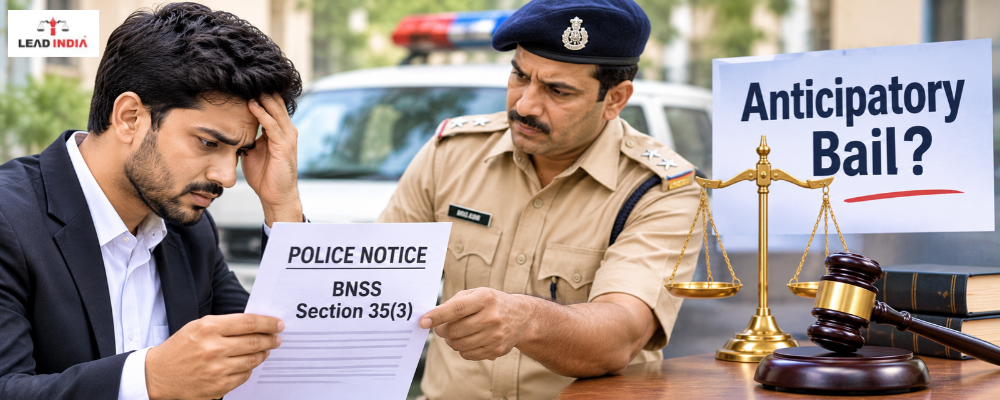
Receiving the notice as per Section 35(3) of BNSS, 2023, does not automatically mean the arrest or require anticipatory bail. The notice generally directs the person to appear before the police for investigation when the statutory conditions apply. Whether the anticipatory bail is necessary depends on alleged offences, the likelihood of the arrest, the applicable legal restrictions, as well as the individual circumstances of the case.
What Is a Notice Under Section 35(3) BNSS?
The BNSS Section 35, delineates the instances in which a police officer may execute an arrest without a warrant. Subsection (3) requires the issuance of a notice of appearance if and when all legally defined requirements for forwarding a notice are met.
The notice serves to inform the relevant party to present themselves to the police officer or begin giving instructions as to his or her whereabouts including location and time.
The notice may be dispatched where investigations concern charges of, for instance, fraud, unlawful threats, assault or other cognizable offences depending on the particulars of the case in question.
Although the notice is issued by the police, it is not intended to be viewed as a judgment, an arrest warrant or a conviction.
Why Does the Police Issue This Notice?
The police may issue the notice when questioning or obtaining information from any person is necessary for investigating the alleged offence and immediate arrest is not considered necessary under the applicable statutory framework. The objectives may include:
- Establishing facts surrounding any alleged incident.
- Recording the relevant information from the concerned person.
- Verifying the documents, communications, or the transactions.
- Identifying any other persons connected with investigation.
- Preventing any unnecessary detention during the investigative process.
Does Receiving a Notice Mean Arrest?
The issuance of a notice under Section 35(3) by itself does not indicate that an arrest shall necessarily follow. For cases involving punishable offences that fall within Section 35(1)(b) and carry a maximum imprisonment of seven years, it will have to be ascertained whether arrest is necessary on statutory grounds, as may be specified for preventing commission of further offences, enabling the trial, etc.
The Supreme Court categorically opined in Satender Kumar Antil v. Central Bureau of Investigation (2026) that, for offences which carry a prison term of up to seven years, a notice under Section 35(3) will be in the nature of the rule and arrest in accordance with relevant provisions will be in the nature of an exception but after completing the statutory requirements.
Thus, receiving a notice should not lead to any panic. However, it should not be ignored as well and the aspect of arrest has to be examined in light of the charges made and the law applicable.
What Is Anticipatory Bail Under Section 482 BNSS?
Anticipatory bail refers to legal relief acquired in anticipation of future arrest. As per Section 482 of the BNSS, 2023, a person having the belief that he will get arrested in a case concerning a non-bailable offence can make an application before the High Court or the Court of Sessions.
The court can grant anticipatory bail with several conditions like cooperate in the investigation process when required, make themselves available for the recovery purposes, avoid influencing witnesses, and don’t leave India without taking permission.
The concept of anticipatory bail is different from the term bail as ordinarily understood which refers to the use of bail after arrest or detention. In addition, anticipatory bail is also different from a police summons, which requires a person to present himself for investigation.
The grant of anticipatory bail is not automatic in nature. Courts on the basis of facts regarding the alleged incident and seriousness of the crime would consider the necessity of custodial interrogation before granting anticipatory bail.
When Should You Consider Anticipatory Bail?
The person should consider all of the legal advice regarding anticipatory bail when there is any genuine apprehension of the arrest in connection with the non-bailable offence. The relevant circumstances may include:
- Serious allegations carrying any substantial risk of arrest.
- Specific information indicating that the arrest is being contemplated.
- A dispute involving the allegations of criminal misconduct supported by the disputed evidence.
- A reasonable concern that arrest may occur despite the cooperation.
- Circumstances requiring the protection while investigation continues.
However, Section 35(3) notice alone does not mainly establish that anticipatory bail is necessary. In most of the cases, the timely compliance and the cooperation may be sufficient.
Certain offences may also be subject to any statutory restrictions or any special procedures affecting the bail eligibility. The legal advice should therefore be obtained before deciding whether to apply.
Legal Framework Governing Police Notices and Arrest
Sections 35 and 482 of the BNSS, 2023 are essential. Section 35 restricts certain powers of making arrest without a warrant while Section 482 deals with anticipatory bail.
According to Article 21 of the Constitution, the right to life and personal liberty is protected but is subject to the procedure as per law. Therefore, police powers must be exercised within the legal parameters.
In Arnesh Kumar v. State of Bihar (2014), the Supreme Court laid down the guidelines to avoid unnecessary arrests; The Supreme Court ruled to avoid wrongful arrests in cases punishable with up to 7 years’ imprisonment under the previous Code of Criminal Procedure. These rules will apply while interpreting the safeguards in the BNSS keeping in mind the current statutory framework and subsequent cases.
Further on, the Supreme Court in the case of Satender Kumar Antil in 2026 clarified that the notice is the rule for the offences covered by this category while arrest is an exception that requires justification as per law.
However, this safeguard does not prevent a legal arrest where the necessary condition applies. Each case is to be decided on its own merits
Rights and Responsibilities After Receiving Notice
The person receiving the police notice should understand both their legal protections as well as their obligation to cooperate. The recipient should:
- Look over the notice, and verify which office has put it out.
- Make an appearance on the given date and time, unless the notice is rescheduled lawfully.
- Give all relevant information, and also supply the relevant documents as the law mandates.
- Do not discard any evidence related to the investigation.
- Make no attempts to threaten the witnesses.
- Consult with a criminal lawyer when the charges are grave or ambiguous.
What Happens If You Ignore the Notice?
Whenever someone fails to respond to any valid notice without any adequate reason, it may lead to most of the troubles.
As per Section 35(4), the recipient of notice must be compliant with requirements of the notice. Section 35(6) deals with the conditions under which someone may get arrested, but only if the officer is acting consistent with law and any applicable instructions.
Just because someone has not complied with a notice does not mean that the arrest is permitted in every situation. The office must still work in accordance with the law.
If at all the recipient cannot appear it would be wise to arrange for the reschedule of meeting formally as opposed to just staying away from meeting altogether. If there is the real fear of the arrest taking place, then a lawyer may be able to advise on applying for anticipatory bail or some other remedy.
How Can You Apply for Anticipatory Bail?
The application process generally involves following steps:
- Analyze the received notice and allegations, along with FIR and any related information.
- Determine the nature of the alleged offenses and assess if they are bailable.
- Review the facts for anticipatory bail, document the grounds, and determine the necessity of custodial interrogation.
- Draft the anticipatory bail application and submit it before the competent Session Court or High Court.
- Attend all hearings of the application and comply with any orders, whether final or interim.
Depending on the facts and statutory constraints of the case, and based on judicial discretion, the Court may grant anticipatory bail, decline it, or impose appropriate conditions.
Role of Courts and Important Judgments
The judiciary ensures a balance between individual freedom and the valid needs of criminal investigation. They may take into account the necessity for arrest, whether the applicant is cooperating or the possibility of tampering with evidence and witnesses.
In the Arnesh Kumar case, the Chief Justice of India emphasized that arrests must not be a norm simply because the police force enjoys the authority of making arrests.
In Satender Kumar Antil case (2026), the court made it clear that Section 35(3) notices and punishable offences under the BNSS which allow for arrests of up to seven years are different issues. The judgment essentially reiterates the statutory requirement of arrests being made only when necessary.
Yet, none of these rulings guarantee any anticipatory bail nor do they make arrests after issuing a notice impermissible. The facts and legal aspects of the cases matter.
Practical Steps After Receiving a Police Notice
The recipients should take following precautions:
- Preserve original notice as well as record the date of receipt.
- Obtain FIR number as well as the relevant case details, wherever available.
- Consult the qualified criminal-law advocate promptly.
- Prepare the truthful explanations as well as the relevant supporting documents.
- Attend the questioning as required as well as retain the proof of attendance.
- Avoid discussing the sensitive evidence publicly or contacting the witnesses improperly.
- Consider the anticipatory bail if the genuine apprehension of the arrest exists.
The early legal advice can help to prevent any avoidable mistakes and also ensure that a person’s rights are protected throughout investigation.
Conclusion
A notice pursuant to Section 35(3) of the BNSS is normally a request for assistance in an investigation rather than an automatic arrest warrant. Section 482 of BNSS grants the anticipatory bail in the case where there is real fear of arrest concerning the non-bailable offence but mere fact of receiving a notice will not at all create the bail irrespective of circumstances. A proper understanding of allegations, compliance with the lawful directions, as well as obtaining the legal advice in a timely manner can enable any person to stay free while allowing the investigation to proceed.
How Legal Assistance Can Help
- Examine police notice as well as the available FIR details.
- Assess legal risk of arrest and need for anticipatory bail.
- Prepare and file the appropriate bail application.
- Advise on the cooperation with the police questioning and preservation of evidence.
- Represent individuals before a competent court wherever it is required.
One can talk to lawyer from Lead India for any kind of legal support. In India, free legal advice online can be obtained at Lead India. Along with receiving free legal advice online, one can also ask questions to the experts online free through Lead India.
FAQs
1. Does the Section 35(3) notice mean I will be arrested?
No. It generally requires the appearance for the investigation and does not automatically mean arrest will follow.
2. Is the anticipatory bail compulsory after receiving notice?
No. It depends on the nature of the allegations, risk of arrest, as well as the applicable law.
3. Which provision governs the anticipatory bail as per BNSS?
Section 482 of BNSS, 2023, governs the anticipatory bail applications before the Court of Session or the High Court.
4. Can the police arrest me after issuing the notice?
An arrest may be possible if at all applicable statutory conditions are satisfied. The failure to comply with the notice may also have legal consequences.
5. What if I cannot attend on a specified date?
Contact the investigating officer promptly, explain the reason, as well as request rescheduling in writing. You can obtain legal advice if necessary.


 Talk to a Lawyer