
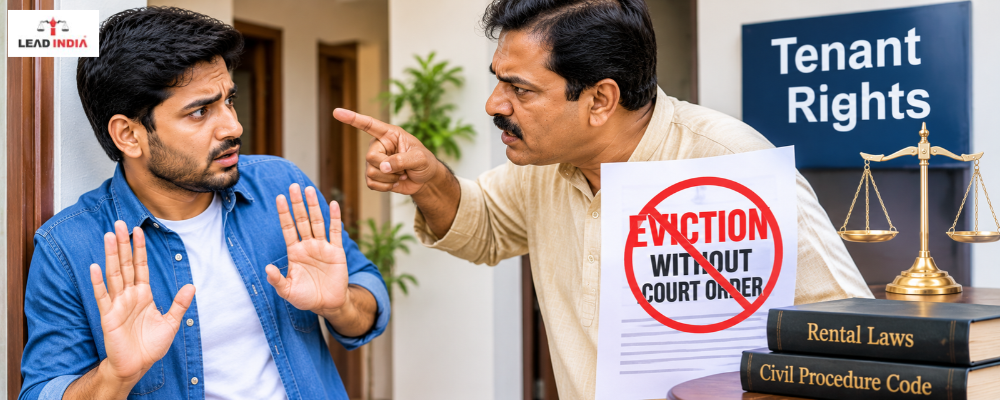
Most of the rental disputes arise whenever the landlords demand for any immediate eviction through the threats, lock changes, utility disconnections, or any kind of physical force. However, ownership does not permit for any forcible removal of tenants. The Indian law provides for protection against any kind of unlawful dispossession, subject to applicable tenancy rules. The tenants mainly who are facing eviction threats should review all of their agreements, preserve the evidence, understand their legal rights, as well as seek timely legal assistance.
Why Understanding Tenant Rights Matters
Understanding the tenant rights helps to prevent the intimidation, wrongful loss of possession, as well as the unnecessary disputes. A landlord’s demand to vacate does not always amount to the legally enforceable eviction order. Knowledge of the applicable law helps tenants to:
- Protect their lawful possession;
- Identify whether an eviction notice is legally sufficient;
- Respond appropriately to threats or harassment;
- Preserve evidence of unlawful conduct;
- Seek police assistance when circumstances justify it;
- Approach the competent court or authority for relief; and
- Avoid the actions that could weaken their legal position.
What Is Forcible Eviction?
The forcible eviction occurs when the landlord attempts to remove the tenant from the rented premises through any physical force, intimidation, or the unauthorised self-help instead of following the applicable legal process. The examples may include:
- Changing locks while tenant is away;
- Removing the furniture or personal belongings without the lawful authority;
- Threatening the physical violence to compel tenant to leave;
- Preventing the access to rented premises;
- Disconnecting the essential services to pressure tenant; or
- Using the private security or any other persons to remove tenants unlawfully.
The legality of the act is determined by the factual circumstances and the present applicable law. A landlord has the right to give proper notice, commence the action for eviction, as well as regain the possession of property through the legal process. The problem occurs when the possession is recovered in a way forbidden by law.
Can a Landlord Evict a Tenant Without a Court Order?
A landlord cannot normally resort to any force on his own in order to break into the premises occupied by a tenant who has kept the right for its possession. However, the exact requirement for a decision of a judge or an appropriate agency will depend on the specific rules regulating rent relations.
In most standard cases, the landlord needs to have a valid ground for eviction and act according to the established procedure before getting possession of the property. Just owning the building doesn’t allow him to change locks or to remove the tenant’s belongings or threats.
A notice to vacate is not the same as an eviction order. The notice may inform about the termination of the tenancy or claim possession, but if the tenant does not vacate the premises, another legal process should be carried out.
Certain types of legal documents may require a different approach and engage certain special law regulations. Thus, the tenants need to receive the legal consultations taking into account their evidence as well as the appropriate geographical and the legislative context.
Major Differences Between Lawful and Unlawful Eviction
| Particulars | Lawful Eviction | Unlawful Eviction |
| Procedure | Follows applicable legal requirements | Bypasses mandatory procedures |
| Notice | Given where required by law | May involve threats without proper process |
| Possession | Recovered through lawful authority | Obtained through force or unauthorised lockout |
| Tenant’s rights | Legal remedies remain available | Tenant may seek appropriate legal protection |
| Consequences | Depends on the applicable law | May attract civil or criminal consequences |
When Can a Landlord Legally Seek Eviction?
The landlord may seek for the eviction whenever the legally recognised ground exists as per the applicable tenancy law or agreement. The common grounds may include:
- Non-payment of the rent;
- Expiry or lawful termination of tenancy;
- Unauthorised subletting, where it is legally relevant;
- Material breach of the rental conditions;
- Bona fide personal requirement, wherever recognised by law; or
- Other grounds prescribed by applicable legislation.
The existence of possible ground does not necessarily permit for the immediate physical removal. The landlord needs to comply with relevant notice, adjudication, as well as all the possession requirements. The tenants need not ignore the legitimate notices or the court proceedings, even when they believe the landlord’s demand is unfair.
Legal Framework Governing Tenant Eviction
The eviction of tenants in India is subject to either the rules of tenancy and rent control as well as the relevant civil procedure codes in various states.
Additionally, the terms of the Transfer of Property Act of 1882 may also be applicable in certain cases where the tenancy rules are relevant.
The Civil Procedure Code of 1908 also provides the principles to determine how civil actions are started and executed by the courts. Further, due to the presence of special laws concerning rent control, the remedies may vary with respect to the circumstances at hand.
There is a provision in Article 21 of the Constitution, which states that “no person shall be deprived of his life or personal liberty except according to procedure established by law. However, this should not mean that everyone has a right to occupy rented premises forever, as the idea of Article 21 is inviolable.
Depending on every circumstance, the tenant who is facing unlawful dispossession may seek for injunction, restoration of possession, or any kind of other relief from the competent court or authority. The threats, assault, trespass, or damage to belongings may also justify police complaints where the facts disclose an offence.
Evidence and Documents to Preserve
The tenants should preserve the documents that establish their tenancy, payments, possession, as well as the landlord’s conduct. The useful records may include:
- The rental agreement or lease deed;
- Rent receipts and bank transfer statements;
- Security deposit records;
- Electricity or water bills associated with occupation;
- Eviction notices and written communications;
- Photographs or videos of attempted lockouts or property damage;
- Messages containing threats;
- Witness details; and
- Copies of the police complaints and legal notices.
The tenants should keep the original documents safe and maintain the copies of relevant electronic records. The evidence should be collected lawfully, without provoking the confrontation or putting the personal safety at risk.
What to Do If the Landlord Attempts Forcible Eviction
The course of the action that the tenant can follow if at all the landlord threatens the eviction is to follow steps indicated below, which can enable them to act legally and properly.
The first thing to do is to first remain calm so that there is no chance particularly of getting into physical conflict. In case of any kind of violence, it is advisable to call the emergency services or police.
The second step of good practice is gathering the proof of the threat, including calls, notices, and photos if it is safe. It would be the third step to inform the landlord in written form that the tenant is entitled to regain possession in the manner prescribed by law. It is advisable to refrain from making threats or interfering with the legal procedure.
The next thing to do is to consult the lawyer who will have a look at the rental agreement, notices sent, as well as the relevant laws applicable to the situation. Depending on the situation, the lawyer may advise filing the civil suit or asking for an urgent injunction.
Finally, approach police if at all the landlord uses the violence, damages property, threatens serious harm, or commits another apparent offence. The police may address the criminal conduct, while questions of the tenancy rights and possession may require the adjudication by the competent court or authority.
Rights of Tenants During Eviction Proceedings
Unless the tenant receives an official eviction, tenants have the right to possess the rented unit lawfully. As per the state laws, the tenant may try to block eviction or question eviction order in the court.
While the tenants need to follow laws of the land, they should also fulfil obligations within their rental agreements. For example, the tenants must pay their rent as well as comply with the court orders. If at all there is any dispute with the landlord, or if the landlord refuses to accept the rent, the tenant should talk to the attorney.
It is very much important to remember that the complaining does not stop eviction or provide the excuse for missing court.
Practical Steps to Protect Your Tenancy
Before the dispute escalates, the tenants should:
- Read the rental agreement carefully.
- Maintain the proof of rent payments as well as the security deposit.
- Keep the communication with the landlord in writing.
- Respond promptly to the valid notices.
- Never ignore the court summons or the eviction proceedings.
- Seek for urgent legal advice if locks are changed or the belongings are removed.
- Request the appropriate injunction wherever it is justified.
- Report the violence or criminal threats to police.
- Avoid damaging the property or using the force in response.
- Obtain the legal advice before surrendering the possession or signing a settlement.
Conclusion
Owning a property does not give the landlord the right to remove a tenant at their discretion. A landlord must follow a court process. There is no right for a landlord to break the law, harass, intimidate or forcibly remove a tenant. There is a legal process for tenants. Tenants must become familiar with the requirements of the tenancy law and must comply. Tenants should review the terms of the tenancy agreement and consider seeking professional legal advice early. There is also an obligation on the part of the tenant to review all the applicable tenancy legislation and regulations. It is in the best interests of tenants to document as much as they possibly can about all issues and correspondence relating to the tenancy.
One can talk to lawyer from Lead India for any kind of legal support. In India, free legal advice online can be obtained at Lead India. Along with receiving free legal advice online, one can also ask questions to the experts online free through Lead India.
FAQs
1. Can the landlord remove me without court order?
A landlord cannot remove the tenant unlawfully without justice. The requirement of the court or authority depends on the tenancy laws and conditions.
2. Can my landlord lockout on me whenever I am not present anymore?
The illegal lockout might be unlawful based on the situation. You can collect the evidence and make sure you get the legal advice on getting the access back and securing possession.
3. What are the steps that I should take if my landlord is harassing me?
Keep relevant messages and evidence. Call police if anything violent happens or if at all there is immediate threat or the criminal activities suspected and consult the lawyer about possible tenancy solutions.
4. Is it legal for the landlord to evict me due to the non-payment of rent?
Failure to pay rent may be a lawful reason for eviction as per law. However, your landlord has to follow a detailed process and cannot just use the force to regain possession.


 Talk to a Lawyer