
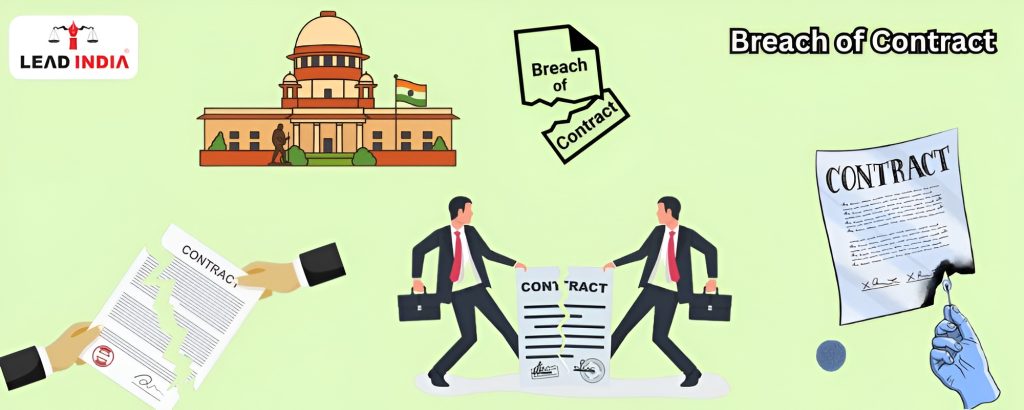
Contracts are foundations on which good commercial and personal relationships are built. But when one of the parties does not fulfil the terms agreed in the contract, that amounts to a breach of contract, a legal wrong which entitles the injured party to seek legal remedies. This manual explains the procedure of taking legal action for breach of contract in India, relevant laws and case references, along with practical legal strategies.
What Does “Breach of Contract” Mean?
In simple terms, it’s when someone breaks their promise under a valid agreement.
As a lawyer who’s seen clients stuck in broken vendor deals, one thing is clear, breach isn’t just about paperwork; it affects livelihoods. It could be:
- A builder failing to deliver your flat
- A supplier missing deadlines
- A consultant quitting mid-project
Legal Backbone
The Indian Contract Act, 1872 defines breach under Sections 73 to 75 and lays out your right to compensation.
When Can You Actually Sue for Breach of Contract?
Let’s say your agreement was in writing and you’ve done your part. If the other side hasn’t delivered, you can likely sue.
But you must have:
- A valid contract
- Proof that you performed your part (or were ready to)
- A clear breach
- Real financial or personal loss
Tip from practice: Courts respect preparedness. Keep written records of emails, invoices, and communications, it can make or break your case.
What Are Your Legal Remedies?
1. Claiming Compensation for Your Losses
You can ask for damages that reflect your actual loss.
Case: Hadley v. Baxendale: Courts will only allow compensation for foreseeable losses. So, show the breach cost you revenue, time, or opportunity.
2. Forcing the Other Side to Perform (Specific Performance)
The court can be asked to enforce a contract, for instance, in transactions dealing with property, when damages do not suffice.
Statute: Specific Relief Act, 1963;
Case: K. Narendra v. Riviera Apartments: The court may refuse to grant relief on specific performance on the ground of unfairness, even though the contract is valid.
3. Injunctions: Stop the Breach in Its Tracks
There were clients stop vendors from terminating agreements mid-term using interim injunctions.
Case: Gujarat Bottling v. Coca Cola: Court ordered not to terminate until proper procedure was followed.
4. Walk Away with Legal Permission (Rescission)
Cancel the contract and stop future obligations, especially useful in high-risk service contracts gone wrong.
5. Get Paid for Work Already Done (Quantum Meruit)
If you’ve partially performed, claim payment proportionate to work completed.
Case: State of Madras v. Gannon Dunkerley & Co.: Court allowed fair payment for partial work after the contract was terminated.
How Do You Legally Enforce Your Rights? Step-by-Step
Step 1: Send a Legal Notice
Before going to court, give the other party a chance to fix things. This also shows good faith.
Why It Matters: Most of our business contract cases settle after legal notice. It’s a simple but powerful nudge.
Step 2: Draft and File a Suit
If the breach continues, file a civil suit under Order VII CPC. Your plaint must include:
- Copy of the contract
- Evidence of your performance
- How the other party defaulted
- What relief you’re seeking
Step 3: File in the Right Court
Based on:
- Location of defendant or breach
- Amount claimed (pecuniary value)
Step 4: Court Fees
Fees vary by state. We always advise clients to check this with the court registry or local advocate.
Step 5: Court Process
- Summons issued
- Reply filed
- Evidence presented
- Arguments and judgment
This journey takes time, but with patience and the right legal team, justice is very achievable.
Don’t Wait Forever, There’s a Deadline
You have three years from the date of breach to file a suit under the Limitation Act, 1963.
Case: L.K. Ahuja v. Union of India: Time runs from breach, not when you “realize” the loss.
Key Judgments Every Contractual Litigant Should Know
- M.C. Chockalingam v. Mangilal (1974): No damages if you didn’t show willingness to perform
- Satyabrata Ghose v. Mugneeram Bangur (1954): Frustration applies in rare situations
- Energy Watchdog v. CERC (2017): Mere cost increase isn’t force majeure
Can the Other Side Defend Themselves?
In court, the breaching party may claim:
- No valid contract (missing consent or consideration)
- Unforeseen event (force majeure or frustration)
- Plaintiff also failed to perform
- They mutually altered or waived the contract
Always be ready for these defenses, and prepare documentation to counter them.
Try These Out-of-Court Methods First
Many of our clients prefer Alternative Dispute Resolution (ADR) to avoid long court battles.
Popular ADR Choices
- Arbitration: Common in corporate contracts
- Mediation: Effective in family-run business disputes
- Conciliation: Used in labor and government contracts
How to Prevent Breach of Contract Disputes
Based on years of handling these disputes, here’s what works:
- Use a lawyer to draft the contract
- Be clear on payment, deadlines, penalties
- Insert a dispute resolution clause
- Keep communication in writing
- Add a force majeure clause
Even a WhatsApp message confirming delivery timelines can help protect your position.
Final Thoughts
Not all breaches of contract need to end up in court, but if they do, you are never alone. From sending a notice to getting court relief, the Indian legal framework ensures an adequate remedy if you act timely, keep records, and stay informed. And these are real chances if good lawyers represent you.
One can talk to lawyer from Lead India for any kind of legal support. In India, free legal advice online can be obtained at Lead India. Along with receiving free legal advice online, one can also ask questions to the experts online free through Lead India.
FAQs
1. What are the documents required to institute a breach of contract case in India?
There has to be a copy of the contract, proof of performance, and evidence of breach such as emails and letters, payments, or any written communication.
2. Can I file a breach of contract case online in India?
While the filing process still requires physical submission in most courts, e-filing is permitted in several High Courts and commercial courts. Always check local court rules.
3. Is it mandatory to hire a lawyer for breach of contract cases?
Not legally mandatory, but highly advisable. Legal drafting, court arguments, and evidence presentation require expertise to succeed.


 Talk to a Lawyer