
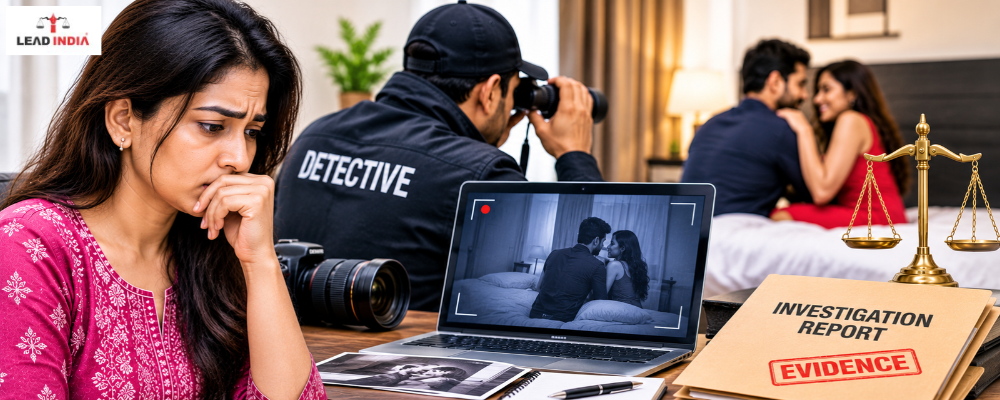
Suspecting the spouse of an extramarital affair may cause mostly emotional distress, prompting the individuals to hire private detectives to collect information. However, the investigators cannot unlawfully invade the privacy, trespass or access the personal accounts without any authority. In India, the detective-collected evidence may support the matrimonial proceedings if at all it meets the legal requirements. Therefore, understanding the privacy protections as well as the evidentiary rules before hiring the investigator is essential.
Why Do People Hire Detective Services in Matrimonial Disputes?
People generally approach the private detective agencies when they suspect that their spouse is mostly involved in the extramarital relationship but lack reliable information.
Such kind of investigations may be considered for the several reasons:
- To verify the suspected infidelity before taking the matrimonial decisions.
- To collect information relevant to the divorce proceedings.
- To understand circumstances surrounding the spouse’s unexplained activities.
- To preserve potentially the relevant photographs or any other evidence.
- To support legally maintainable claim or the defence in the matrimonial litigation.
- To avoid making any serious allegations without any sufficient information.
However, the suspicion alone does not establish adultery. A responsible investigation should focus on obtaining the relevant as well as verifiable information rather than creating the allegations or invading someone’s privacy.
Is Hiring a Private Detective Legal in India?
A person typically hires a private investigator to collect information legally. Nonetheless, India lacks a proper central statute regulating private investigation agencies through a licensing system.
The private detective agencies (regulation) bill of 2007 proposed the licensing framework for private detective agencies. However, the bill was withdrawn from the Rajya Sabha in March 2020 and was never made into a law.
Importantly, not having a specific licensing legislation does not imply that private detectives operate free from limitations. Their operations are controlled by other laws including criminal law, rules of privacy and electronic evidence.
Thus, a client should know the difference between engaging an investigator and performing illegal observation. The payment for private detective activity is not enough to render it legal.
What Can a Private Detective Legally Investigate?
Based on the situation, the investigator may conduct only minor investigations using legal techniques. Among them are:
- Observing the actions in a public accessible area without any interference.
- Taking a record of the visible movement in a legal way.
- Taking photographs in public places while respecting privacy laws.
- Taking notes about the important dates, places, and observations.
- Writing a report about the gathering of facts.
- Identifying possible voluntary witnesses who can provide information.
For instance, the investigator can watch how often the individual goes to a specific public point and keep track of the observations. The investigator is not allowed to break into private property, obtain confidential information through lies or use illegal surveillance techniques.
The legality of the methods depends on the technique used, the location, the reason for the investigation, and the situation.
What Activities Can Create Legal Problems?
The utilization of a detective does not warrant engaging in illegal actions. The investigator and client can be blamed for their actions but under different degrees of culpability according to the applicable laws.
The following actions should never be performed:
- Entering somebody’s house or property without being allowed.
- Installing hidden cameras or other recording devices in private places.
- Hacking someone’s phone or e-mails.
- Get hold of the details of another person’s calls or secret information without any legal reason.
- Making oneself look like someone else to access another person’s personal accounts.
- Threatening or stalking in relation to a suspicious partner.
- Recording sexual actions in the places where a person expects privacy.
- Taking and distributing pictures and videos in order to shame someone.
Unauthorized access to a computer system would fall under the provisions of Information Technology Act, 2000 in particular Sections 43 and 66 where it is applicable. Based on the actions of a person, he may be found guilty of crimes such as stalking, trespassing, intimidation, or voyeurism.
Can Detective Evidence Be Used in Divorce Proceedings?
Certainly. Evidence in the form of photographs, video footage, reports from investigations, and information from witnesses collected by a private investigator may be relevant to divorce or matrimonial proceedings. However, the suitability of such evidence depends on the rules of evidence and how these pieces of evidence were gathered.
This means that just because documents have been submitted to the court by a party does not mean that such documents have to be accepted by the court. The court may consider:
- Whether the evidence refers to the subject matter in dispute.
- Whether the identity of the persons appearing can be recognized.
- Whether the evidence has not been altered.
- Whether the sources of the evidence and how the evidence was collected are known.
- Whether the applicable laws on electronic records have been adhered to.
Investigators may be obliged to testify in court and clarify their investigation.
Legal Framework Governing Privacy and Investigation
The Constitution of India acknowledges the right to privacy as the crucial component of life and liberty.
In the case of Justice K.S. Puttaswamy (Retd.) vs. Union of India (2017), 9-judge bench of Supreme Court recognized privacy as constitutionally guaranteed fundamental right. However, the right to privacy is not at all absolute and any interference must meet applicable legal standards.
The Bharatiya Sakshya Adhiniyam of 2023 governs admissibility of evidence in the judicial proceedings. Sections 61 & 62 recognize the electronic records as well as the digital records, while Section 63 provides the conditions for the proof of electronic records.
As a result, the photographs, videos, messages as well as the recordings need to be stored as well as authenticated. Editing or altering any of the digital material must be avoided.
The Information Technology Act of 2000 may be applicable to investigation in the case of any unlawful access to electronic gadgets, accounts or the computers.
Role of Adultery in Divorce Proceedings
In India, adultery is no more a crime but it does give rise to civil liability under law of marriage.
In the case of Joseph Shine vs. Union of India (2018), it was ruled by the Supreme Court that Section 497 of Indian Penal Code was unconstitutional.
The judgement did not do away with the adultery as valid ground to seek for divorce under existing legislation on marriage.
To illustrate, Section 13(1) (i) of Hindu Marriage Act of 1955 lists voluntary intercourse with any other individual after marriage as one of grounds for seeking divorce.
There are also some provisions in respect of the remedies accessible under relevant family laws subject to fulfilment of their prescribed conditions.
It is also crucial to note that a relationship has to fulfil the legal requirements which are laid down by law.
Important Supreme Court Judgments
1. Joseph Shine v. Union of India (2018)
Following the declaration of Section 497 of the Indian Penal Code to be unconstitutional by the Supreme Court, adultery is no longer a criminal offence, and it was clarified that adultery can still be utilized as a legal basis for divorce in accordance with the applicable personal law.
2. K.S. Puttaswamy v. Union of India (2017)
The SC has declared privacy to be a fundamental right derived from Article 21 and part III of the Constitution of India. This has important implications in the context of surveillance and acquisition of personal information when conducting a matrimonial inquiry.
3. Himanshu Chordia v. State of Rajasthan (2026)
In the present decision, the Court took note of the material consisting of the videos and photographs which were used in cases relating to matrimonial maintenance. The court made observations concerning the private detectives, electronic surveillance, privacy, and absence of specific regulatory framework to govern detective agencies. Also, it highlighted the significance of reliable proof and applicable electronic evidence requirements.
The judgement indicates that private detective evidence can be relevant in matrimonial cases but the method of obtaining it, its authenticity and its admissibility needs to be checked.
Risks of Relying on Private Detective Evidence
Although the detective services may help gather the information, their reports should not be treated as the conclusive proof. The possible risks include:
- Incorrect identification of the individuals.
- Misleading photographs or the incomplete recordings.
- Manipulated or the edited digital material.
- Unreliable investigation reports.
- Violation of the privacy rights.
- Additional litigation arising from the unlawful surveillance.
- Financial loss caused by the fraudulent detective agencies.
Practical Tips Before Hiring a Detective Agency
Before engaging the private detective, you can consider the following precautions:
- Verify the agency’s identity, address as well as the professional background.
- Ask for written agreement describing the investigation’s scope.
- Clearly communicate that the unlawful surveillance is not at all authorised.
- Obtain the written estimate of the professional fees.
- Avoid agencies promising the guaranteed proof of adultery.
- Do not request the hacking, unauthorised recordings or the trespassing.
- Ask how photographs, videos as well as the reports will be preserved.
- Maintain the payment receipts as well as the written communications.
- Do not publish the investigation material on social media.
- Consult a matrimonial lawyer before using collected material in court.
All of these precautions can reduce the unnecessary disputes and help to ensure that investigation remains focused on the legitimate legal objectives.
Conclusion
In India, you can hire a private detective to investigate a suspected adultery case, provided that certain laws are respected. Evidence collected legally can be used in matrimonial proceedings only if it is relevant and admissible. Illegal acts such as surveillance, hacking, trespassing or harassment may lead to severe legal repercussions. Thus, people must be careful about their choice of an investigator and obtain legal advice before using investigator reports in court.
One can talk to lawyer from Lead India for any kind of legal support. In India, free legal advice online can be obtained at Lead India. Along with receiving free legal advice online, one can also ask questions to the experts online free through Lead India.
FAQs
1. Is it permissible for me to engage the services of a private investigator in order to look into the activities of my partner?
Yes. You can contract a private investigator to collect pertinent information legally. However, the private investigator’s activity must operate in accordance with privacy rights and restrictions and other laws.
2. Are pictures taken by a private investigator admissible as evidence in a divorce?
Yes. Pictures taken by the private investigator may be admissible provided they are authentic and meet the relevant requirements on admissibility.
3. Is adultery illegal in India?
No. In its ruling in the case Joseph Shine vs. Union of India (2018), the Supreme Court ruled that adultery is no longer an offence. However, the act of adultery can still serve as one of the grounds for a divorce based on the applicable matrimonial laws.
4. Can a private investigator hack into my spouse’s phone in order to get evidence?
No. Even if the private investigator is hired by you, this does not give them the legal ground to illegally access someone else’s phone, email account or social media account.
5. Can I file for the divorce which is based on a detective’s report?
A detective’s report may support the matrimonial case, but it does not automatically establish the adultery. The court considers complete evidence as well as the applicable legal requirements.


 Talk to a Lawyer