
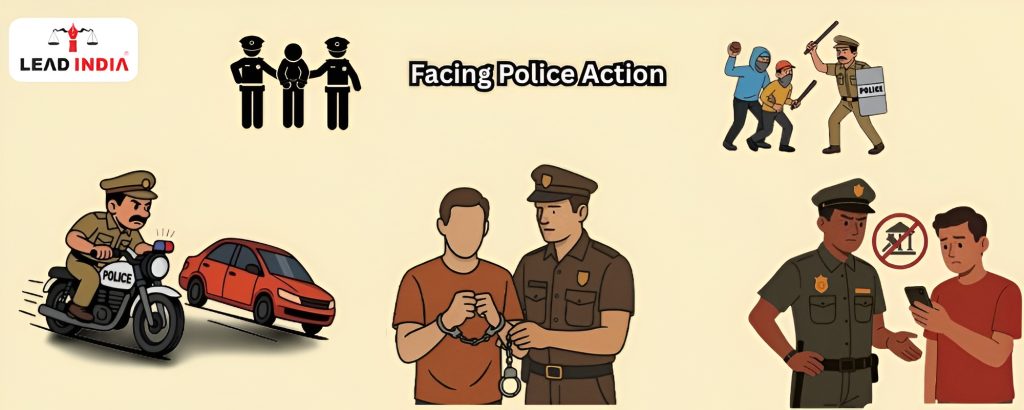
Picture yourself being flagged down by the police in the middle of the night or getting a surprise call to show up at the police station. Your heart begins to race, and you panic and feel confused. Most people wouldn’t know what to say, what to sign or who to call. But the good news is, you are not helpless.
The Constitution of India and the Bharatiya Nagarik Suraksha Sanhita, 2023 (BNSS), which has replaced the previous CrPC, has guaranteed to every citizen clear legal right while dealing with police action, most of which would protect your liberty, your dignity and possibly your future.
This article speaks plainly and clearly about polite and lawful ways to assert your rights during an arrest, a search, detention and being summoned.
What Exactly Counts as Police Action?
Police action isn’t always an arrest. It can be:
- Arrest: Taking someone into custody on suspicion of any kind of offence.
- Detention: Keeping someone in the custody temporarily for questioning.
- Search or Seizure: Checking property or belongings to find evidence.
- Notice or Summons: A written call to appear before police or court.
These are lawful actions, but only when done within limits and in respect of your rights.
Your Constitutional Shield: Articles 21 and 22
Article 21: Your Right to Life and Liberty
No police official can take away your own liberty unless the process is legal, fair, as well as reasonable.
Article 22: Safeguards During Arrest
You have three key rights:
- To know why you are arrested.
- To get legal representation.
- To be present in front of the magistrate within 24 hours.
In the case of Joginder Kumar vs State of U.P.(1994): The SC of India has warned against routine arrests. The police must highly justify every arrest in the piece of writing.
If You Are Being Arrested: Know These Rights Instantly
Right to Know the Grounds of Arrest
Under Section 37(1) BNSS, the officer must tell you exactly which offence you’re accused of.
DK Basu v. State of West Bengal (1997): The Supreme Court has ordered the police to only provide a memo of arrest, sign it in the very front of witnesses and as well as notify to a relative.
Right to Remain Silent
Article 20(3) protects you from any kind of self-incrimination. You don’t have to answer every question, only identify yourself.
Right to Call a Lawyer
You can consult a lawyer of your choice immediately. If you cannot afford one, the Legal Aid Authority must provide one free of cost.
Right to Be Produced Before Magistrate
Under Section 57 BNSS, you can’t be held more than 24 hours without judicial oversight.
From Experience: During a 2024 case in Delhi, our client was not shown the arrest memo. When we insisted under DK Basu guidelines, the officers had to prepare one on the spot. Calm insistence works better than confrontation.
Arrest Without Warrant: When Is It Actually Legal?
Under Section 35 BNSS, police can arrest without a warrant only if:
- You commit a cognizable offence in their presence.
- There’s credible information of serious crime.
- It’s necessary to prevent further offence or escape.
Arnesh Kumar v. State of Bihar (2014): The Supreme Court said, “No arrest should be made in a routine manner.”
When Police Come Home: What You Can Ask For
Check the Warrant:
Ask politely to see the warrant. Ensure it bears:
- Your name or address
- Offence mentioned
- Magistrate’s seal and signature
No Warrant Search
In urgent cases Section 185 BNSS, police can search without a warrant but must record reasons and report to a magistrate.
Witnesses During Search
Two local witnesses must be present, and you should get a copy of the search memo.
State of Rajasthan v. Rehman (1960): Evidence from an illegal search may not stand in court.
If You Receive a Police Notice for Questioning
A notice under Section 179(1) BNSS means you’re called to assist an investigation, not that you’re accused.
Your Rights:
- Must get a written notice with date and place.
- Women can only be questioned at home in the presence of a woman officer.
- You may have your lawyer accompany you.
Vineet Narain v. Union of India (1998): When the Court pointed out that investigation must be open and fair.
From Experience: The law firm accompanied a client to a police station to assist with questioning. Even having a lawyer present during the questioning meant that the officers acted in a professional manner and kept accurate notes of the appearance.
Detained Without Arrest? Here’s What It Means
Short-term detention for verification is allowed, but keeping you beyond a reasonable period becomes illegal confinement under Sections 340–342 BNS.
Sheela Barse v. State of Maharashtra (1983): The Court condemned prolonged detention without cause.
From Experience: If you ever feel you’re being kept “just for inquiry” for hours, tell them you wish to contact your lawyer or family. That single line often changes their tone.
Rights of Women and Children During Police Action
- Women: Under Section 43(3) BNSS, no woman can be arrested after sunset or before sunrise without a magistrate’s written permission. Only a woman officer can make the arrest.
- Minors: Children under 18 come under the virtue of Juvenile Justice Act (2015).
Remedies Against Illegal Arrest or Harassment
- File a Habeas Corpus Petition: You can immediately set yourself free from the unlawful detention by applying under Article 32 (Supreme Court) or Article 226 (High Court).
- Complaint to Magistrate or Human Rights Commission: Submit written evidence (CCTV shots, medical reports) about the illegal detention or the mistreatment you suffered.
- Demand for Compensation: Rudal Shah v. State of Bihar (1983): The Supreme Court awarded compensation to a person who was wrongfully detained for 14 years.
Custodial Violence What the Law Says
DK Basu v. State of West Bengal remains the cornerstone. It requires:
- Medical checks every 48 hours
- Display of arrest details in control rooms
- Accountability of officers involved
Relevant BNSS Provisions: Sections 58-59 (medical examination) and Sections 176-177 (judicial inquiry for custodial death)
From Experience: The law firm has handled a case where a detainee’s injuries were ignored. A simple medical certificate later became the strongest evidence for compensation.
How Lawyers and Legal Aid Can Help Immediately?
You’re entitled to legal assistance from the moment of arrest. You can contact your District Legal Services Authority (DLSA) or you can also call the NALSA Helpline.
Khatri (II) v. State of Bihar (1981): The Court decided that denying the legal aid violates the fundamentals of Article 21.
From Experience: In police stations, a lawyer’s presence changes everything, officers follow procedure, memos are recorded correctly, and intimidation drops drastically.
Practical Checklist What to Do During Police Action?
- Stay calm and cooperate, anger worsens situations.
- Ask for ID cards, note names and badge numbers.
- Record details, time, location, names.
- Call a lawyer or relative immediately.
- Don’t sign blindly, read before signing.
- Ask them for a copy of the FIR or the arrest memo.
- Maintain the dignity, calm, as it earns respect.
Conclusion
While police powers are necessary for law and order, when unchecked they create fear. If you understand the protections afforded by BNSS 2023 and by the Constitution of India, the power of the police can be used as a strong protective factor.
When dealing with police officers, be brave and stay calm. Be aware of your rights and consult a qualified criminal defence attorney. Knowledge and awareness are a more protective factor than any type of fear.
One can talk to lawyer from Lead India for any kind of legal support. In India, free legal advice online can be obtained at Lead India. Along with receiving free legal advice online, one can also ask questions to the experts online free through Lead India.
FAQs
1. What are my basic rights if I am arrested by a police officer in India?
You have the right to be informed of the reason for your arrest; to consult a lawyer; the right to remain silent; and to be produced before a magistrate within 24 hours.
2. Can the police officers arrest me without the warrant?
Yes, but the officer can arrest for cognizable offences under section 35 of the BNSS and must record of written reasons.


 Talk to a Lawyer