
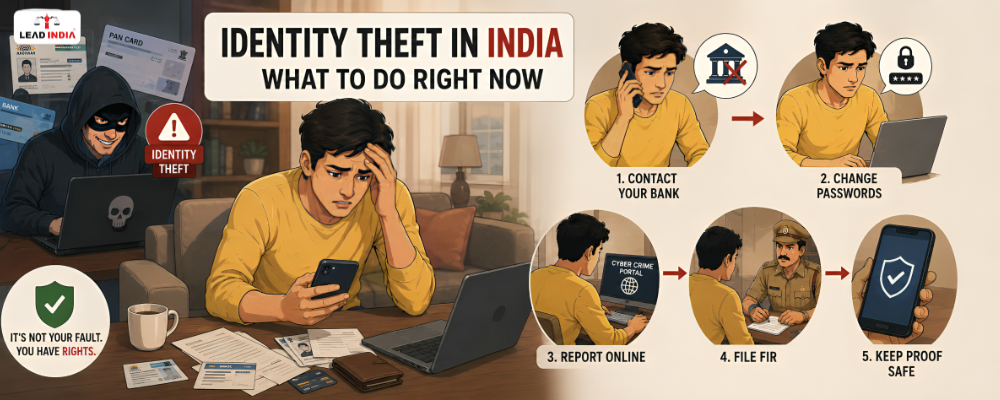
When someone hears that the Aadhaar has been misused, the loan has been taken in their name, or the money has been withdrawn from the bank account without their permission, the first questions is:
- “Will I be held responsible for this fraud?”
- “Can I recover my money?”
- “Will the police even register my complaint?”
This confusion is very much natural. Knowing how to legally define identity theft, what your rights are, and what you need to do immediately will help protect you from monetary loss, criminal liability, and being subjected to long-term harassment.
What Identity Theft Is and What It Is Not
Identity theft means that someone has used your personal information without permission to impersonate you for purposes of fraud or financial gain or to take an illegal advantage of you.
This may include misuse of:
- Aadhaar number
- PAN details
- Bank credentials
- OTPs and passwords
- Digital signatures
- SIM card issuance using forged documents
- Fake loan applications
- Fake social media profiles
Identity theft does not only happen over the Internet; identity theft can occur through either means (physically or digitally). Forgery of documents to create an account in your name also constitutes identity theft.
Additionally, you should be aware of the fact that identity theft is not just an issue related to banking institutions, but is also a crime punishable under Indian Law, and may lead to imprisonment.
What Identity Theft Really Means in Practice
In general, identity theft usually begins with the exposure of some information that the thief collects from various sources. Examples of how this happens are phishing emails, fake investment calls, social media scams, unsecured Wi-Fi networks, and sending documents containing your personal information to someone who is unknown to you.
As mentioned above, once your identity has been compromised, the results can range from serious consequences to very damaging results. For example:
- Unauthorized bank withdrawals
- Loans opened in your name
- Damage to credit score
- Police inquiries
- Harassment from recovery agents
- Reputational harm
- Emotional distress
The identity theft does not automatically mean that you will be then legally liable. However, the delay in reporting can weaken all your legal protection. The law provides the remedies, but timing is very much critical.
Legal Framework Governing Identity Theft in India
The identity theft in India is governed by:
- The Information Technology Act of 2000
- The Bharatiya Nyaya Sanhita of 2023
- The RBI Customer Protection Guidelines
- The Bharatiya Sakshya Adhiniyam (for the digital evidence)
Information Technology Act, 2000
Identity theft is covered under Section 66C of the Information Technology Act in India. Specifically, the fraudulent act of using someone’s electronic signature, password or other unique identification number will be punished with a maximum sentence of 3 years in prison and/or a fine.
Section 66D of the Act states that it pertains to the offence of cheating by personation via computer resources. Cheating by personation will usually be charged in relation to computer-related crimes such as phishing, fake investment schemes and online impersonation.
Under Section 43 of the Act, there is provision for victims to recover damages for data theft and/or for any unauthorised access to their data.
Bharatiya Nyaya Sanhita, 2023
It creates new criminal laws to govern offences such as cheating, forgery, personation, and/or criminal breach of trust, which will apply to serious cases of identity misuse. Where a person has committed a serious misrepresentation of their identity through forgery and has used that misrepresentation to obtain loans or open a bank account, the provisions of forgery will apply.
RBI Zero Liability Policy
- The Reserve Bank of India has issued clear guidelines under the Customer Protection framework.
- If you report unauthorized electronic transactions within three working days, you may have zero liability.
- If reported within four to seven working days, limited liability may apply.
- Banks are required to provisionally credit the amount in genuine cases and complete investigation within prescribed timelines.
Is Identity Theft Mandatory to Be Reported?
Yes. Identity theft is a cognizable offence. The police are legally then required to register the FIR when there is sufficient information provided. If police refuse:
- You may approach the Superintendent of Police.
- You may file an application before the Magistrate.
- You may seek appropriate writ remedy from the High Court.
What You Should Practically Do Right Now
If you think your identity has been stolen:
- Call the national cyber fraud helpline at 1930 immediately.
- Contact your bank in writing to block any suspicious transactions.
- File a complaint on the National Cyber Crime Portal.
- Report an FIR at the closest police station or cyber cell.
- Keep all digital evidence, such as SMS alerts and emails.
- Review your CIBIL and Credit Report.
Waiting to report often delays your chance of getting your identity back.
Who Can Be a Victim of Identity Theft
Identity theft doesn’t just happen to big shots and people with lots of money. Students, salaried employees, business owners, homemakers, and even elderly people are frequently victimized by thieves. There is no minimum income to qualify as a victim. The law defines any person who has lost their identity as a victim if someone misuses their personal information.
How the Legal Process Moves Forward
Step 1: Registration of the Complaint
Cyber portal complaint or FIR is registered.
Step 2: Bank Communication
Written complaint and claim under RBI guidelines.
Step 3: Investigation
Police may trace IP address, bank account trail, and digital footprints.
Step 4: Freezing of Fraud Accounts
Fraudulent beneficiary accounts may be frozen.
Step 5: Charge Sheet
If the evidence supports, the charges are filed.
Step 6: Compensation
- The victim may seek restitution or compensation through court.
- The timeline depends on the complexity as well as the cooperation from financial institutions.
What Happens After FIR Is Registered
Registration of FIR does not automatically recover money. However, it legally strengthens your position. You may:
- Seek refund from bank
- File consumer complaint for negligence
- Claim compensation under IT Act
- File civil suit for damages
- Seek court-monitored investigation in serious cases
Practical Benefits of Acting Quickly
Immediate action:
- Increases chance of transaction reversal
- Prevents further misuse
- Protects credit score
- Strengthens your legal case
- Reduces risk of wrongful criminal implication
Courts often examine whether the victim acted promptly.
Legal Importance of Identity Theft Laws
Identity theft provisions do not automatically restore money. However, they provide:
- Criminal punishment for offender
- Legal recognition of victim’s rights
- Basis for compensation
- Protection against wrongful liability
Courts treat digital evidence seriously when properly preserved.
Identity Theft and Consumer Protection Law
- If the bank fails to follow the RBI guidelines or if it ignores the timely reporting, the consumer complaint can be filed as per the Consumer Protection Act, 2019.
- False claims about security or negligence in protecting customer data may attract compensation and penalties.
- Using fake documents or impersonation may also attract liability as per the Bharatiya Nyaya Sanhita, 2023.
Identity Theft vs Banking Dispute
- Identity theft is a criminal offence. A simple banking dispute is contractual.
- If the fraud involves impersonation, forged identity, or the hacking, the criminal provisions apply.
- If it is merely transaction misunderstanding, it may remain civil.
- Understanding the difference is crucial before initiating legal action.
What You Should Not Do
- Do not ignore small unauthorized transactions.
- Do not delete digital evidence.
- Do not rely only on verbal bank assurances.
- Do not delay FIR registration.
- Do not share OTP or personal details again during panic.
Mistakes during initial hours often create long-term problems.
How We Help Victims of Identity Theft
We assist victims in:
- Filing properly drafted complaints and FIRs
- Invoking correct IT Act and BNS provisions
- Communicating with banks under RBI framework
- Filing consumer complaints
- Seeking compensation for financial and reputational loss
- Protecting clients from wrongful criminal implication
Our primary approach usually focuses on the immediate protection, strategic legal action, as well as the long-term resolution.
One can talk to lawyer from Lead India for any kind of legal support. In India, free legal advice online can be obtained at Lead India. Along with receiving free legal advice online, one can also ask questions to the experts online free through Lead India.
FAQs
1. Is identity theft a crime in India?
Yes. It is totally punishable as per IT Act and Bharatiya Nyaya Sanhita.
2. Can I recover money lost in online fraud?
Yes, especially if reported within three days under RBI zero liability policy.
3. Can police refuse to register FIR in cyber fraud?
No. Identity theft is a cognizable offence.
4. Will I be liable for a loan taken in my name fraudulently?
If you report promptly and prove impersonation, liability may not be imposed on you.
5. How long does the investigation take?
It depends on complexity, but early reporting improves recovery chances.


 Talk to a Lawyer