
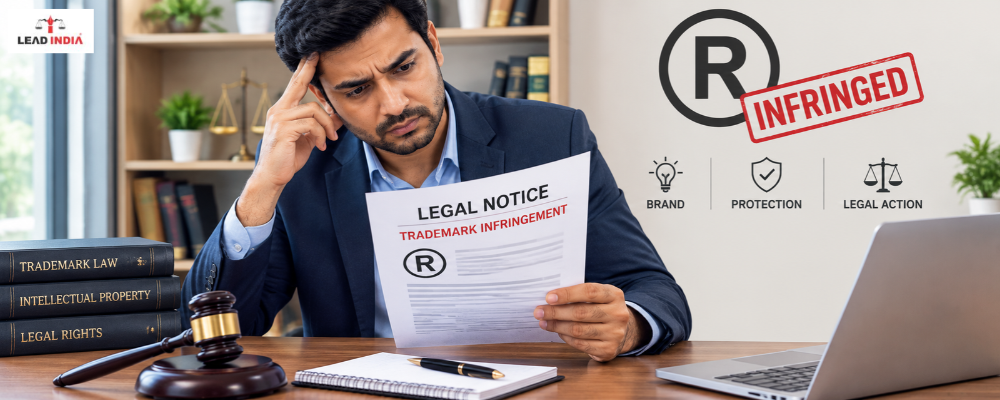
A trademark helps people to identify one company’s goods or services apart from another. It can include the name, a logo, an emblem, a tag, or any other clear sign. These marks can bring real business value.
If a firm thinks someone else is using a similar trademark, it may take legal steps. A legal notice for trademark infringement may ask the recipient to stop using the mark that is in dispute. It may also ask them to stop selling or sharing ads that use it. The letter can request a written promise that the person will not use it. It can also ask for payment to cover harm the owner claims.
What the notice says might be correct, or it might be wrong. Some points can be argued. So, it makes sense to treat the matter as serious. You should reply to the letter. Try not to react too fast by flatly denying it, and do not ignore it either.
Why Understanding a Trademark Notice Matters
Receiving a Trademark notice could be a first step to commence a civil dispute and other legal aspects. An incorrect reply, use of a trademark during disputes, or obliteration of relevant records can put the recipient in a jeopardized situation.
Understanding the notice helps businesses to:
- Assess the strength of the allegations;
- Protect existing commercial interests;
- Avoid unnecessary admissions;
- Identify legitimate legal defences;
- Explore settlement opportunities; and
- Reduce risk of expensive litigation.
The prompt legal assessment allows the recipient to make the informed decisions while protecting the business reputation and continuity.
What Is a Trademark Infringement Legal Notice?
A legal notice for trademark infringement is a serious letter in which claims of unauthorized use of a trademark or a similar mark and a request for corrective measures are put forth. The notice can be issued by the holder of the trademark or by the holder’s lawyer.
The notice commonly contains:
- Details of the complainant and its trademark;
- Registration numbers, classes and relevant goods or services;
- Particulars of the alleged infringement;
- Evidence of the disputed use;
- Demands for discontinuation or modification;
- Requests for undertakings, damages or costs; and
- A deadline for responding.
A legal notice is not at all itself a court judgment. Its allegations must be fully evaluated against any of the relevant facts, statutory provisions as well as the available evidence.
Why Might You Receive a Trademark Notice?
The business may receive the notice for several reasons, including:
- Using a registered brand name without authorisation;
- Adopting a logo resembling another business’s logo;
- Selling goods bearing an allegedly infringing mark;
- Using a similar domain name or social media identity;
- Advertising products through potentially confusing branding;
- Using protected marks on packaging, labels or websites; or
- Continuing disputed use after receiving an earlier warning.
Sometimes, the businesses independently adopt mostly the similar names without knowing about existing trademarks. Nevertheless, the lack of knowledge does not automatically eliminate liability. The legal position mainly depends on all the applicable provisions, nature of the mark, goods or services involved as well as the circumstances of the use.
What Should You Do Immediately After Receiving the Notice?
The initial action is to mainly maintain composure and refrain from making any hasty comments. The notice should not be considered as the confirmation of any misconduct nor be seen as meaningless warning.
1. Examine the notice very thoroughly.
Identify claims, remedies requested, the relevant trademark registration and the deadline for a reply. Find out if the notice is connected with a registered mark, passing off or both.
2. Check the trademark status.
Search all of the relevant information in Indian Trade Marks Registry to check the ownership as well as the registration status of the trademark, classes and goods and services that are registered. Knowing this may not solve your every problem, but it helps prove the rights of the claimant.
3. Keep the evidence.
Keep invoices, ads, packages, screenshots of websites, sales papers, correspondence, designs and documents that show when the name was used for the first time. Don’t destroy or change any documents that may be somehow related to the dispute.
4. Check your rights.
Gather all the trademark applications, trademark registrations, licenses as well as the agreements and proof of use. Whether registration of the trademark was made before or later may matter.
5. Seek help from the trademark attorney.
A Trademark lawyer can assess all the allegations, identify possible defences as well as prepare any of the suitable responses before the deadline.
6. Avoid any unnecessary admissions.
Do not acknowledge the infringement, promise compensation or sign the undertaking without understanding all of its legal consequences. You need to consider whether temporarily suspending disputed use is commercially sensible and legally advisable or not.
Legal Framework Governing Trademark Infringement
The principal legislation is the Trade Marks Act, 1999.
Section 27 generally prevents the infringement action for the unregistered trademark, while preserving common-law remedy of passing off. Section 28 sets out the rights conferred by the registration, subject to the Act. Section 29 defines circumstances constituting infringement of a registered trademark.
Section 30 identifies certain limits on the effect of registered trademark rights. Section 34 protects qualifying prior users in specified circumstances, while
Section 35 addresses certain bona fide uses of a person’s name or place of business and descriptions of characteristics of goods or services, subject to statutory conditions.
Under the provisions included in Section 134, it is possible to institute specified trademark matters in courts having jurisdiction as per the Act. Provided in Section 135 are the remedies that may be based on a series of things, like injunctions, damages or accounts of profits, conditioned by the applicable laws.
Also very significant is the provision in Section 135 providing for the matters concerning the meaning of damages or accounts of profit, specifically including innocent infringement.
How to Prepare an Effective Reply
A reply should address all allegations individually, remain professional as well as also avoid any unsupported assertions.
The effective response generally includes:
- Acknowledgement of receipt without admitting liability;
- Identification of disputed or admitted factual allegations;
- Details of the recipient’s business and use of the mark;
- Relevant registration, prior-use or licensing documents;
- Reasons why the marks or commercial activities may be distinguishable;
- Clarification of inaccurate statements in the notice; and
- A reasoned position on demands and the proposed resolution.
The recipient has to consider stopping using branding subject to the dispute where the infringement is probable, making the adjustments to the packaging, or discussing in reaching a settlement. The arrangement should indicate all of its scope, timeliness, area of the application, and repercussions for violation.
In cases of unfounded accusations, the responses may outline legal and factual bases for objections and claim for the proof.
Possible Defences Against Trademark Infringement
The appropriate defence depends on the claim and the evidence. The potential arguments include:
- Prior use: Section 34 may protect qualifying earlier users against any certain claims based on later registration.
- Different marks or the commercial circumstances: The differences in appearance, pronunciation, meaning, goods, services as well as the customer groups may help to demonstrate an absence of likely confusion, wherever it is relevant.
- Statutory exceptions: Section 30 may permit for the certain uses under the specified conditions, including the qualifying descriptive or the referential uses.
- Invalid registration: Depending on each circumstance, the recipient may investigate whether registration can get challenged through the legally available procedures or not
- Passing-off requirements: Where claimant relies on the passing off, the relevant requirements concerning the goodwill, misrepresentation as well as the damage must be examined.
- Authorisation or consent: The valid licence, assignment or any other permission may provide the defence within its scope.
No, the defence succeeds automatically. The strength of each and every argument depends on evidence, the precise allegations as well as the applicable law.
What Happens If You Ignore the Notice?
Failure to act on the notice does not imply a violation. Nonetheless, such a situation has the potential of inflaming conflict beyond the reasonable boundaries.
If at all the claimant so chooses, he or she can initiate the court proceedings resulting in injunction, compensation for the damages or profits gained due to any illegal actions. Moreover, the application for interim measures can be accepted.
If papers from the court show up, follow all relevant rules of procedure and find a lawyer immediately. Failing to meet the rigid deadlines may jeopardize the defense significantly.
Keep the notice, proof of the delivery, correspondence as well as any other documents. By acting fast and wisely, one may mitigate the serious disputes.
Can Trademark Disputes Be Settled?
Yes. Most of the conflicts can be settled through the mode of mediation, negotiation or the written settlement agreement.
The possible solutions include changing the name of brand, changing the design of the logo, limiting use to particular goods as well as services, getting a license, coming to the agreement on grace period, or determining the terms and conditions of the coexistence.
Before accepting settlement, you need to make sure that it does not include the introduction of application, transfer of the domain name, destruction of the goods, payment of compensation or the limitations on future business.
An agreement should include all of the obligations, time frames as well as the terms of use of the brand along with the confidentiality measures where necessary.
Practical Tips for Protecting Your Business
The businesses can reduce the trademark disputes through the preventive measures:
- Conduct the trademark searches before adopting the new brand.
- Apply for the registration in appropriate classes.
- Preserve the dated records demonstrating any genuine commercial use.
- Obtain the written permission for the licensed branding.
- Monitor the competing marks as well as the relevant marketplace activity.
- Review the packaging, advertisements as well as the online content regularly.
- Maintain any accurate ownership as well as the assignment records.
- Respond promptly to the credible legal notices.
- Seek for professional advice before making any admissions or signing undertakings.
- Establish the internal procedure for handling the intellectual property complaints.
All of these practices support the brand protection and make it easier to establish history as well as legitimacy of the commercial use whenever the disputes arise.
Conclusion
Getting a notice about trademark infringement can feel alarming, but try to stay calm. Treat it like a prompt to review facts, not like an emergency. First, confirm what rights the sender says they have. Do not skip this step. Then collect proof that supports your side. Keep records of when you used the mark and how you used it.
Next, read the claims and compare them to the Trade Marks Act, 1999. Look closely at the parts that seem relevant. After that, prepare a response that is quick and grounded in what the law actually allows. What you do next depends on the details. You might fight the claim. You could also change the mark that is being challenged. In some cases, talking with the other party may help. If you guess without reading the notice, you can end up worse off.
One can talk to lawyer from Lead India for any kind of legal support. In India, free legal advice online can be obtained at Lead India. Along with receiving free legal advice online, one can also ask questions to the experts online free through Lead India.
FAQs
1. Does receiving the trademark notice mean I have infringed the law?
No. the notice contains the allegations, not the final judicial determination. The claim must be assessed against all of the evidence and applicable law.
2. Should I reply to the trademark infringement notice?
The timely, carefully drafted response is very much generally advisable. You can obtain legal advice as well as check the stated deadline before you are responding.
3. Can I use the trademark if I adopted it first?
The prior use may provide the protection as per Section 34 in the qualifying circumstances. The evidence, nature of use as well as the competing rights must be examined.
4. Can the trademark dispute be settled without going to the court?
Yes. The negotiation, mediation, licensing or the written settlement may resolve any dispute, depending on parties’ rights as well as their circumstances.
5. What if the trademark owner’s registration expired?
Verify the current registry status as well as the relevant renewal or restoration circumstances. The expiry does not necessarily eliminate each and every possible claim, including the passing off.


 Talk to a Lawyer