
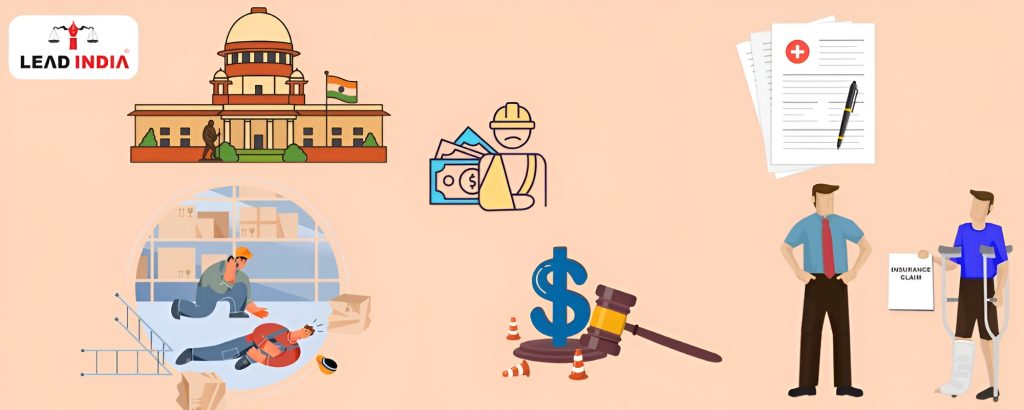
An injury during working hours is a serious matter. It turns lives upside down with medical expenses, loss of income, and an uncertain future. But remember, you have never been alone, and also, you need not shoulder all the financial burden by yourself.
If you meet an injury or fall ill due to your work, Indian law entitles you to seek compensation. This plain and practical guide explains how workplace injury compensation is sought in India, the laws protecting you, and steps you must take immediately after facing injury in the workplace to save your rights.
Know Your Rights Before It’s Too Late
Most workers do not appreciate that they can legally demand compensation after a workplace accident.
Here is what protects you under Indian law:
- Employees’ Compensation Act, 1923: Compensation for bodily injury, disability, or death whilst at work.
- ESI Act, 1948: Completed under the ESI Act, you can receive medical care and cash benefits.
- Tort actions and negligence claims: if your employer has failed to provide a reasonably safe workplace, you may recover additional compensation.
What Counts as a Workplace Injury?
It is not just big accidents that may happen that involve falling cranes or explosions.
Clients have claimed for
- A delivery boy injured in a road accident while on duty.
- A chemical plant worker who developed lung disease after long term exposure.
- A simple office employee who had severe stress and depression due to harassment in the workplace.
If your injury or illness is directly related to your work, you can claim for compensation, including long term illnesses and occupational diseases.
Step-by-Step Process Followed for Claiming Compensation for Workplace Injury
Step 1: Report Immediately
Many claims fail because workers delay reporting accidents. In one case, a construction worker’s leg injury went unreported for a week, and his employer tried to deny liability.
Always file a written report immediately, keep a copy, and get witness statements if possible.
Step 2: Medical Proof is Your Strongest Weapon
Your employer or ESIC hospital must examine you.
Tip from my experience: Always keep every prescription, test result, and doctor’s note, even if minor. These become your biggest support during the claim process.
Step 3: File a Claim Under the Employees’ Compensation Act
In most cases, we file Form A with the Employees’ Compensation Commissioner. One client earning ₹12,000/month received 50% of his monthly wages multiplied by a legal factor, resulting in ₹4.8 lakh compensation.
Remember: You have 2 years from the accident date to file this claim.
Step 4: Use the ESI Scheme (If Applicable)
For employees under ESI coverage, compensation is quicker:
- Immediate medical treatment in ESI hospitals.
- Cash benefits during recovery.
- Disability benefits paid directly to your bank account.
Step 5: Go to Court If Employer Was Negligent
In one case, a worker fell from scaffolding with no safety gear provided. We filed a civil negligence suit against the employer, and he got additional damages over and above legal compensation.
Landmark Cases That Strengthen Your Claim
- Pratap Narayan Singh Deo v. Srinivas Sabata (1976): Supreme Court held employers liable even when they tried to pass the blame to contractors.
- National Insurance Co. Ltd. v. Mubasir Ahmed (2007): Compensation payable even if the accident wasn’t worker’s fault.
Your Rights and Employer Duties
- Safe workplace and protective equipment are not optional.
- You cannot be fired for filing a compensation claim.
- Employers must report accidents and pay compensation promptly.
- If they don’t, the Commissioner can enforce payment like land revenue arrears.
What If Your Employer Refuses to Pay?
One of the clients lost an eye due to a machine malfunction. His employer outright refused compensation, claiming he was careless.
We took the case to the Commissioner, produced medical records and witness statements, and got him ₹8 lakh compensation, recovered by law as arrears. Never accept verbal refusals, take legal action.
Common Problems Injured Workers Face
- Lack of knowledge about rights.
- Employers intimidating workers.
- Delayed or partial payments.
- Informal sector workers struggling to prove wages.
Solution: Always keep payslips, medical records, and written communication. A good lawyer can fight intimidation tactics.
Key Recommendations After Real Cases
- Report accidents immediately in writing.
- Keep detailed medical and wage records.
- Don’t sign any settlement papers without legal advice.
- File under the Employees’ Compensation Act or ESI within 2 years.
- Use a lawyer who specializes in labour law for faster results.
Final Word
Workplace accidents are terrible, but they do not need to be the reason why your family suffers financially in the future. The good news is that the law in India is there to help you, however you really should do it quickly and keep records.
One can talk to lawyer from Lead India for any kind of legal support. In India, free legal advice online can be obtained at Lead India. Along with receiving free legal advice online, one can also ask questions to the experts online free through Lead India.
FAQs
1. Can I claim compensation for mental stress or harassment from the workplace?
Yes. Some injuries can be classed as psychological-and therefore severe stress, harassment, or trauma. An employee can claim compensation for these injuries, especially if, medical treatment occurred, or the employee could not return to work.
2. How long do I have to file for a workplace injury claim in India?
The Employees’ Compensation Act prescribes a maximum period of two years from the date of accident or date of diagnosing of occupational disease to institute a claim. ESI claims need to be reported immediately on the occurrence of a claim for an easy processing.
3. Can I claim compensation if my employer refuses or delays payment?
Yes, you can approach the Employees’ Compensation Commissioner or file a case in civil court for negligence. The Commissioner can order recovery of compensation as arrears of land revenue if the employer defaults.


 Talk to a Lawyer