
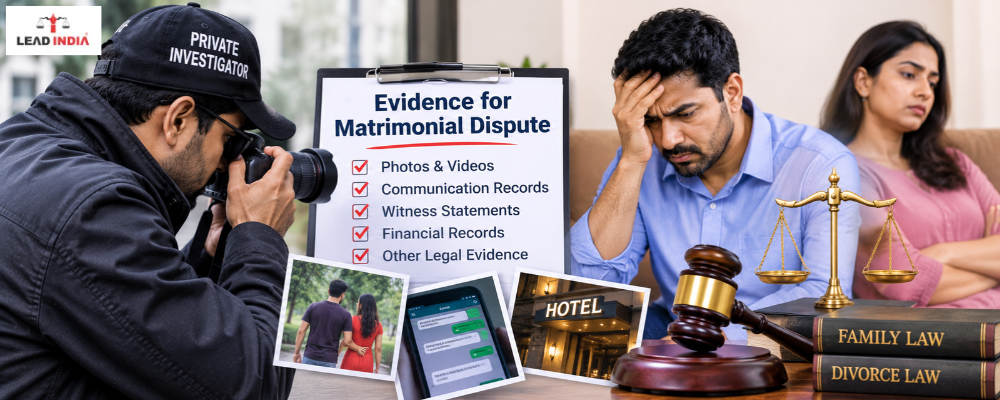
The matrimonial disputes involving adultery, cruelty, desertion or the financial concealment may require reliable evidence. The private investigators can help to collect the relevant photographs, videos as well as the witness information through various lawful methods. However, they cannot exercise the police powers or unlawfully access the private information. Any collected evidence must satisfy all of the legal requirements concerning the relevance, authenticity as well as the admissibility before being relied upon in the matrimonial court proceedings.
Why Evidence Matters in Matrimonial Disputes
Proof is critical in asserting the truthfulness of statements in matrimonial cases. The courts decide disputes based on the statements, the evidence, and the statements of witnesses. Evidence is relevant in cases of:
- Accusations of infidelity.
- Violence, bullying or abusive conduct.
- Abandonment or separation.
- Arguments about money or financial matters.
- Child custody and child welfare issues.
- Hiding income, property, or financial data.
Nevertheless, all accusations need to be substantiated with the relevant proof. Speculation, guessing or unproven information does not impose any liability.
What Is a Private Investigator?
A private investigator is an individual or an organization that is hired by the customer regarding investigation of facts and information about certain issues.
In matrimonial disputes the investigator may be involved in observing what is done in public places, finding some required facts, detecting witnesses and preparing reports on findings.
However, their function is limited and they cannot perform criminal investigations according to law, exercise police power, force answering questions from people and obtaining secret information from national authorities and private organizations.
The Private Detective Agencies (Regulation) Bill, 2007 was proposed to be adopted for regulation and licensing of private detective agencies but it was not accepted as law. As a result, private investigation remains under other laws.
What Information Can a Private Investigator Legally Collect?
Lawful ways to gather information are available to private investigators depending on the specific purpose and background of the investigation. Fact-finding methods can involve:
- Witnessing a person’s behaviour in publicly accessible areas in a lawful way.
- Taking photos or videos of a person in public if it is lawful.
- Noting dates, times, and places for observations.
- Figuring out who will give facts as a witness voluntarily.
- Gathering available-for-free information necessary for the case.
- Generating reports based on original observations.
- Keeping the collected photos and electronic evidence.
To illustrate, for example, a private investigator can observe a husband and wife in public but should not enter a private property and clandestinely record personal things or acquire confidential information in an unlawful way.
What Information Cannot Be Collected Unlawfully?
The employment of an investigator does not imply the legal use of illegal surveillance or any unauthorized intrusion.
Here are the actions that no investigator is allowed to perform:
- Hacking of the spouse’s phone, email or social media.
- Gathering call records without legal knowledge.
- Get access to banking or secret financial information illegally.
- Install hidden cameras or microphones in private rooms.
- Go into the home or another property without obtaining permission.
- Take pictures of private actions in places where the person is not expecting to be seen.
- Make sure to impersonate someone else in order to obtain classified data.
- Follow the person or intimidate.
- Publish anyone’s private videos or pictures.
Obstruction to access computer information is regulated by the provisions of the Information Technology Act, 2000. Besides that, based on a person’s actions one can see that violations cover trespassing, stalking, voyeurism, etc.
Thus, the clients should not ask their investigators to act illegally even if they believe that it can help in their marriage case.
Can Private Investigator Evidence Be Used in Family Court?
Yes, it is possible, subject to the right circumstances. The evidence supplied by a private investigator can be used in a family law proceeding as long as it meets the relevant evidential requirements.
However, the report of a private investigator is not definitive evidence of the facts. The court can look at:
- The correspondence of the information to the issue.
- Witnessing of the events by the investigator.
- The authenticity of photographs and videos.
- The editing or manipulation of the material.
- The identification of the individuals involved.
- The explanation of the method of data collection.
- The statutory compliance of e-evidence.
The investigator may need to give evidence in court in order to confirm the facts and present the report.
Family courts have a degree of flexibility under the Family Courts Act, 1984, but this does not give the litigants the right to intervene in private life or use false evidence.
Legal Framework Governing Private Investigations
Private investigations in matrimonial disputes abide by various statutes.
1. Article 21 of the Constitution of India
Article 21 speaks of life and personal liberty including the right to privacy. While taking to oneself other valuable information, the investigator has to respect the individual’s privacy interests. It is privacy that may forfeit itself, but interference into one’s privacy must be based on law and must satisfy the criteria as per law.
2. The Information Technology Act, 2000
The IT Act concerns crimes that relate to unauthorized access and violations related to cyber activities. Sections 43 and 66 may provide some degree of applicability where prohibited access or dishonest conduct is connected to computer resources.
3. The Bharatiya Sakshya Adhiniyam, 2023
Sections 61 and 62 grant recognition to electronic and digital records, while Section 63 provides the conditions that ought to be satisfied to admit them. Photographs, videos, voice recordings, and other now electronic material require that conditions for admissibility be satisfied.
4. The Bharatiya Nyaya Sanhita, 2023
Depending upon the underlying facts, the provisions relating to stalking, trespass, criminal intimidation, and voyeurism may become relevant in this light. The offence is mostly dependent upon the conduct, acts and statutory ingredients.
5. Matrimonial Laws
The applicable personal laws determine grounds for divorce, judicial separation, maintenance as well as any other matrimonial relief. The evidence must relate to a legal issue being decided.
Important Judicial Decisions
1. Himanshu Chordia v. State of Rajasthan (2026)
In this case, the Supreme Court dealt with a matrimonial maintenance conflict in which photographs and videos were collected via private investigators in a problematic manner. The Court raised concerns regarding the legality of the material, the right to gather it, privacy and privacy laws, and the lack of special regulation of the activities of private detectives.
The Court called for a system of accountability to be created and ordered the judgment to be forwarded to the Ministry of Law and Justice and the Law Commission of India for consideration.
2. Justice K.S. Puttaswamy (Retd.) v. Union of India (2017)
A nine-member bench of the Supreme Court recognized the right to privacy as a fundamental constitutional right since it is guaranteed by the Constitution. The decision represents an essential constitutional basis for the protection of personal data from unlawfulness.
3. Joseph Shine v. Union of India (2018)
In this case, the Supreme Court declared Section 497 of the Indian Penal Code on adultery void. However, adultery continues to have civil implications in accordance with the family law and can still be used in divorce cases.
Risks of Using Unlawfully Collected Evidence
Relying on improperly collected evidence may create additional legal complications for the person who hired the investigator. The potential consequences include:
- Criminal or civil liability for unlawful surveillance.
- Privacy-related legal proceedings.
- Challenges to authenticity and reliability.
- Rejection of the evidence that fails the legal requirements.
- Claims involving harassment, intimidation or trespass.
- Damage to credibility of the party presenting the material.
A person should not assume that the evidence becomes lawful merely because it is intended for use in matrimonial dispute. The court must independently assess all of its relevance and admissibility.
Practical Tips Before Hiring a Private Investigator
There are things everyone must bear in mind before hiring a private detective:
- Establish the identity and business location of the detective agency and its professional history information.
- Provide a thorough explanation of the reasons for the investigation.
- Enter into a written contract stating the scope of work the private investigator will carry out.
- Prohibit hacking, breaking and entering as well as unauthorized observation activities.
- Ask about investigation methods and the rates.
- Ask for original photographic and video records when possible.
- Keep original electronic files intact.
- Keep payment receipts and written documents.
- Abstain from disclosing any data collected by the investigator in social networks.
- Consult a divorce lawyer before showing any evidence in a court of law.
- A reasonable investigation should result in gathering needed information while minimizing the chances of quarrels over law prosecution issues.
Conclusion
The private investigators may use lawful means of gathering relevant information in engaging marital disputes, such as conducting public surveillance, taking photos, collecting witness information and factual reports. However, they should not hack, obtain classified materials illegally or carry out any illegal surveillance. The evidence has to be relevant and authentic before it can be used by any court for the purposes of making a decision. So, people should choose investigators very carefully and ask lawyers for advice before making use of the evidence obtained.
One can talk to lawyer from Lead India for any kind of legal support. In India, free legal advice online can be obtained at Lead India. Along with receiving free legal advice online, one can also ask questions to the experts online free through Lead India.
FAQs
1. Is it possible to hire a private investigator to investigate matrimonial disputes?
Yes. You can hire a private investigator to gather information, but he/she cannot act as police and violate anyone’s legal rights.
2. Can a private investigator take pictures and videos?
Yes, as long as this will be in accordance with the law without violating anyone’s privacy or legal restrictions. In addition, the investigator must prove the evidence that has been collected.
3. Can a private investigator access my spouse’s phone and WhatsApp messages?
No. The detective agency cannot hack or penetrate anybody’s private account illegally. Unauthorized access may result in serious legal consequences.
4. Will a report written by a private investigator be accepted in the family court?
It may be accepted if it is relevant and proven. The judge may check the reliability of the evidence, whether the investigator might testify.
5. Is the private detective agency regulated by Indian law?
There is no recent all-encompassing central licensing scheme under the mentioned Bill. Nevertheless, the private investigators usually follow other laws that can be applied.


 Talk to a Lawyer