
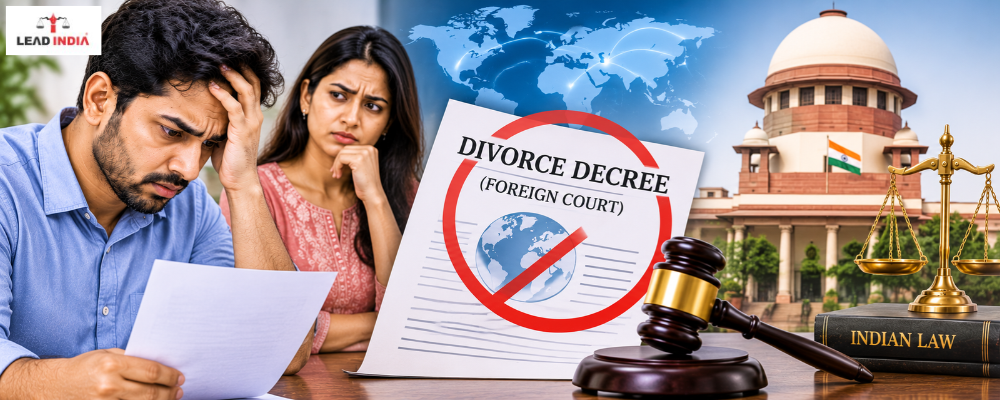
The International marriages as well as the migration have increased the cross-border matrimonial disputes. The spouse abroad may obtain the divorce while the other remains in India. Although it is valid in the issuing country, the decree must independently satisfy all the Indian recognition rules. A decree that fails those requirements may not dissolve the marriage for Indian legal purposes.
Why Recognition of a Foreign Divorce Matters
The recognition affects the marital status, remarriage, maintenance, inheritance as well as any related proceedings. Relying on an unrecognised decree may expose a spouse to further litigation. The issue is whether Indian law accepts the foreign court’s authority and decision, considering the applicable personal law, facts and procedure.
Legal Framework Governing Foreign Divorce Decrees
According to Section 13 of the Code of Civil Procedure, 1908, the general rule of law states that a foreign decision is under normal circumstances, conclusively applicable to the issues involved therein as per the given exceptions. Where the foreign ruling belongs to any of the following six categories, it is not conclusive: lack of jurisdiction; there is no verdict based on merit; error in the application of international law; natural justice has been violated; or the judgment has been procured through fraud or the matter pertains to the violation of Indian law. Section 14 raises a rebuttable presumption regarding jurisdiction with regard to the production of the duly certified foreign judgment in accordance with the law of evidence and the circumstances of the case.
In Y. Narasimha Rao v. Y. Venkata Lakshmi, (1991) 3 SCC 451, the Supreme Court has delivered a crucial judgment wherein it ruled that as far as matrimonial matters are concerned, the jurisdiction of the foreign court and the grounds for divorce must, in normal circumstances, correspond with the law governing the parties. Thus, the rules may vary according to the specific circumstances of the case and the law under which the marriage took place.
When Can Indian Courts Refuse Recognition?
Recognition may be refused if an exception under Section 13 CPC applies. Not each and every foreign divorce is invalid, but neither is every decree automatically effective in India. The courts assess the jurisdiction, participation, applicable law as well as the procedural fairness. A challenge requires the evidence as well as a recognised legal ground, not the mere disagreement with the outcome.
Lack of Jurisdiction of the Foreign Court
If it is shown that the foreign court did not have the right to hear the case according to the rules followed in India, then the decree can be rejected. Temporary presence arranged to obtain the divorce decree will not establish substantial connection. In the case of Y. Narasimha Rao, the court held that a residence has a wider meaning than a brief stay to obtain a decree. The court has to apply the law of marriage and determine whether the parties presented themselves voluntarily and unconditionally in the foreign court.
Jurisdiction entails an inquiry of facts. Genuine residence and voluntary participation might play a role, but the Indian court considers the situation and relevant matrimonial law.
Decree Not Given on the Merits
Section 13 permits for the refusal where the judgment was not at all given on the merits. The ex parte decree requires for scrutiny, though the absence of the respondent who does not automatically invalidate it. Under Y. Narasimha Rao, the decision should rest on a ground available under the law governing the marriage and follow genuine adjudication or legally effective submission by the respondent. Obtain the petition, pleadings, evidence, orders and final judgment; the decree’s label alone is not decisive.
Conflict with Indian Matrimonial Law
A foreign judgment may be denied recognition if it fails to conform to relevant Indian marriage law. As an instance, a foreign annulment obtained on grounds that are not lexically available under the Hindu Marriage Act of 1955 would remain unrecognized in India, in particular to the applicable legal principles and exceptions in this regard. The Supreme Court in Y. Narasimha Rao rejected a decree obtained by basing it on an irretrievable breakdown since the law regulating the marriage did not allow for this ground.
Furthermore, the court put forth several limited circumstances under which a foreign decree may be acknowledged. This includes, among others, a case where the case is brought in a forum where the defendant dwells or resides permanently or, however, provided that the defendant comes to the court without restrictions and contests the merits.
Violation of Natural Justice
The recognition may be refused where the proceedings violate natural justice. The spouse must have the fair opportunity to know the case and then respond. Any defective service, inadequate notice or the barriers to presenting defence may be relevant. The courts examine whether respondents could effectively contest the case.
Preserve all the notices, emails, envelopes, travel records as well as any correspondence. The courts assess the evidence rather than presume each and every foreign proceeding unfair.
Fraud or Misrepresentation
A decree obtained by the means of fraud may be denied for recognition. The fraud may concern merits or facts establishing the jurisdiction, such as the false address, concealed facts or the misrepresented residence. In the case of Y. Narasimha Rao, jurisdictional misrepresentation contributed to the refusal of recognition.
The spouse alleging the fraud should identify false statements or the concealment as well as provide evidence. The bare allegation may be very much insufficient; the court considers whether the fraud affected judgment or jurisdiction.
Practical Steps for the Indian Spouse
The spouse who wishes to challenge the foreign divorce decree should take the following steps:
- You need to obtain a certified copy of the final decree and, wherever possible, the petition, pleadings, evidence as well as the procedural orders.
- You need to preserve the documents concerning service, residence, citizenship, domicile, travel as well as the participation in the foreign case.
- You need to identify the law governing marriage, including the relevant personal law or the statute.
- You need to seek advice from the Indian matrimonial lawyer about the Section 13 CPC as well as the appropriate proceedings.
- You need to avoid remarriage or making any consequential legal decisions solely on assumption that foreign decree is recognised in India.
- You have to present a timely, evidence-based challenge before a competent Indian court where it is necessary.
Keep all the copies securely, record all the filing dates, as well as obtain translations where the documents are not in English. Do not alter or selectively submit the records; complete all of the court papers that will help establish the relevant facts.
Where proceedings remain very much active abroad, obtain advice there too, because the deadlines and the appeal options may be governed by the foreign law and also affect evidence available in India later.
The appropriate remedy depends on facts as well as the purpose for which the recognition is disputed. A lawyer can assess whether to contest decree in the existing proceedings or seek appropriate declaration or any other relief. Time limits as well as the procedural requirements should be checked promptly.
Conclusion
The courts in India do not outright reject foreign divorce rulings because they were obtained in another country. However, recognition is not automatic. Section 13 of the CPC permits refusal on grounds of lack of jurisdiction, absence of merits, breach of Indian law, violation of natural justice, fraud, or contrary to the Indian public policy provisions. Y. Narasimha Rao is a leading authority in this area of law. The Indian spouse has to analyze the decree along with the relevant matrimonial laws; also get legal advice to act appropriately.
One can talk to lawyer from Lead India for any kind of legal support. In India, free legal advice online can be obtained at Lead India. Along with receiving free legal advice online, one can also ask questions to the experts online free through Lead India.
FAQs
1. Is each and every foreign divorce decree valid in India?
No. The Indian courts examine whether it satisfies the Section 13 CPC as well as the principles applicable to marriage.
2. Can India refuse ex parte foreign divorce?
Yes, where the statutory exception applies, including the lack of jurisdiction, absence of the merits decision or the violation of natural justice. The ex parte status alone is not at all automatically decisive.
3. What if the foreign court grants the divorce on the ground that is not available under the Indian law?
The decree may not get recognised where the Indian matrimonial law governs the marriage as well as the foreign judgment refuses to recognise that particular law, subject to the applicable exceptions.
4. Which case is very much important for the foreign divorce recognition?
The case of Y. Narasimha Rao v. Y. Venkata Lakshmi, (1991) 3 SCC 451, is the leading Supreme Court decision.
5. What are the documents that a spouse should preserve?
The decree, petition, court orders, service records, correspondence, as well as the evidence relating to the residence and participation should be preserved.


 Talk to a Lawyer