
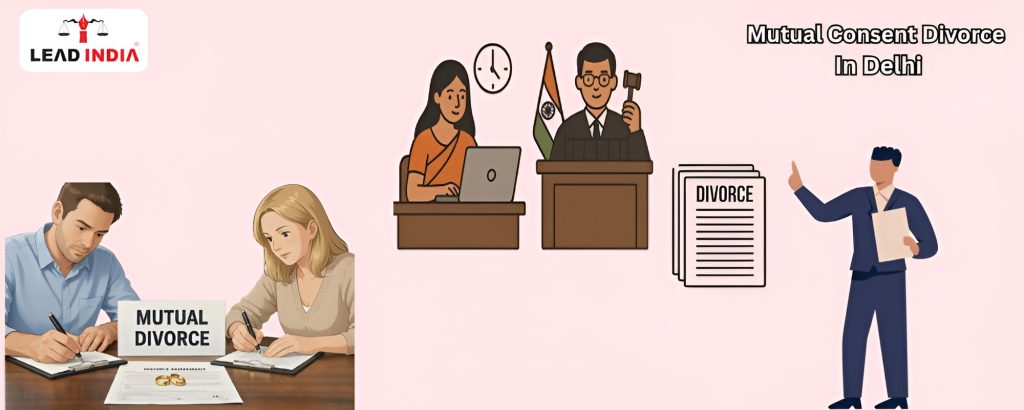
The different ways that a marriage can become difficult and/or frustrating for both parties can vary widely. Many couples at this stage of their marriage are attempting to legally separate when it is clearly not in their best interest to continue with either the relationship or the marriage. In numerous cases of mutual consent divorce in Delhi, the courts will make it very easy for you to peacefully and legally end your marriage in the way that is in your best interest while at the same time providing a fair process to each spouse to be treated with dignity during the entire process.
The professionals at Lead India will provide you with step-by-step guidance and information about how to go about the mutual consent divorce process and, as a result, will remove a lot of the associated stress involved in navigating the legal system. Above all, we want to provide the best advice to couples who live in Delhi and want to end their marriage by mutual consent, so we recommend that this process be initiated with open and truthful communication between the parties involved rather than with lawyers. It is absolutely necessary to clear out the future of marriage for both parties and how all the financial matters will be settled, especially when there are children involved.
What Is Mutual Consent Divorce?
Mutual consent divorce means that both spouses agree to the divorce. There is no finger-pointing or abuse of any kind in the process. In an opposing divorce case, the couples are continuously fighting through the court with long procedures, depositions, and much litigation. The Indian courts will grant a divorce based upon the conditions listed below that both husband and wife agree upon:
- The husband and wife did not live together
- The husband and wife can no longer live with one another
- The husband and wife have jointly decided to terminate the marriage
The courts want to make sure the agreement between the spouses is made voluntarily, willingly, and with full knowledge of what the consequences will be.
Legal Provisions Applicable in Delhi
- The Hindu couples file mutual divorce as per Section 13B of the Hindu Marriage Act of 1955
- The couples married as per civil law file in compliance with the Special Marriage Act of 1954
The family Courts in Delhi strictly examine the compliance with all these provisions before granting the decree.
Essential Conditions Before Filing
- One Year of Separation: The law requires that spouses must have lived separately for at least one year before filing the joint petition. Living separately does not always mean separate houses; it means that marital obligations were not being performed.
- Free and Voluntary Consent: The consent needs to be free from pressure, threat, fraud, or the emotional coercion. Even after the filing, either spouse can then withdraw the consent before the final decree, in which case the divorce cannot be granted usually.
- No Scope for Reconciliation: The court will make a brief attempt at reconciliation. If the spouses clearly state that reunion is not possible, the process moves forward.
Issues That Must Be Settled Mutually
Before approaching the court, both spouses must clearly resolve the following:
Child Custody and Visitation
If the children are involved, custody as well as the visitation terms needs to get settled keeping the child’s welfare as the highest priority. The courts in Delhi can carefully scrutinize all these arrangements.
Maintenance and Alimony
Alimony can be lump sum or it can be monthly payment, or it is sometimes waived altogether. The settlement must very clearly mention the particular amount, mode, as well as the finality to avoid future disputes.
Property and Financial Settlement
All the movable as well as the immovable assets, including the bank accounts, investments, loans, as well as the jointly owned property, needs to be clearly addressed in the settlement.
A properly drafted settlement agreement is very much crucial, as the vague clauses often lead to the enforcement problems at later stage.
Documents Required for Mutual Consent Divorce in Delhi
In practice, Delhi Family Courts usually require:
- Marriage certificate
- Address proof of both spouses
- Proof of separation
- Income proof or financial disclosure
- Photographs of the parties
- Settlement agreement
- Affidavit stating free consent
Incomplete or the inconsistent documents are one of the most common reasons for the delays.
Jurisdiction Where to File in Delhi?
It can only be filed in the Delhi Family Court:
- Where the marriage was solemnized
- Where the couple last lived together
- Where the either spouse is currently residing
Filing in the correct jurisdiction is essential, especially when one spouse works outside Delhi or is an NRI.
Step-by-Step Court Procedure
Filing of Joint Petition (First Motion)
Both the spouses jointly file the petition stating the terms of settlement as well as the reasons for separation. The statements are then recorded in court.
Cooling-Off Period
Traditionally, the court mostly grants a 6-month cooling-off period. However, the courts in Delhi may wish to waive this period in most appropriate cases wherein the reconciliation is impossible as well as all the issues are settled.
Second Motion
After the cooling-off period or the waiver period, both the spouses again appear before the court to usally confirm their final decision.
Final Decree of Divorce
Once the court is fully satisfied that the consent is genuine as well as all legal conditions are then fulfilled, the final decree of divorce is generally passed by legally dissolving the marriage.
How Long Does Mutual Consent Divorce Take in Delhi?
- With the cooling-off period: around 6-8 months
- With the waiver: sometimes 2-3 months
Timelines depend on court workload, document readiness, and cooperation between parties.
Why Legal Guidance Still Matters
Although the mutual consent divorce is simple than the contested litigation, the mistakes in drafting settlements, affidavits, or the jurisdiction can mostly create various serious future complications. Legal guidance makes sure that:
- Your rights are fully protected
- The settlement is legally enforceable
- Court procedures are completed smoothly
Why Hire Lead India for Filing a Mutual Consent Divorce in Delhi?
At Lead India, we totally understand that filing a mutual consent divorce is a very sensitive and emotional decision that requires clarity, trust, as well as professional guidance. Here are why hundreds of clients rely on:
- Experienced Family Law Team: The skilled divorce lawyers with the right experience in handling mutual consent as well as the contested divorce matters.
- Tailored Legal Strategy: We mostly design the customized legal approach based on your specific circumstances as well as the mutual agreements.
- Transparent Advice: We provide honest as well as the practical guidance, and not just what sounds very reassuring.
- Confidentiality Assured: Your personal information as well as the discussions are mostly handled with the complete discretion.
- Strong Legal Support: We make sure that your rights and their interests are fully protected throughout the mutual divorce process.
Conclusion
Mutual consent divorce is the most efficient way to end the marriage whenever both the spouses agree that the separation is fully inevitable. With the clear communication, proper documentation, as well as the correct legal advice, the couples can avoid any kind of unnecessary stress as well as the prolonged court battles.
At Lead India, we basically aim to reduce the emotional burden that is associated with divorce, legal support as well as the expert assistance. If you are considering the mutual consent divorce in Delhi in 2026, by taking the informed legal advice at the right time can usually help you move forward with dignity, clarity, as well as the legal security.
FAQs
1. Where can the mutual consent divorce mostly be filed in Delhi?
It can be usually be filed where the marriage took place, where at all the couple last lived together, or wherein either of the spouses resides.
2. Is the personal appearance of both spouses at all mandatory?
Yes, both of the spouses must appear before the court of law for the first as well as the second motion statements.
3. Is one year of the separation mandatory?
Yes, the law mostly requires at least one year of living separately before the filing of the mutual consent divorce.
4. Can the cooling-off period be waived off in Delhi?
Yes, in the Delhi Family Courts may waive the six-month cooling-off period if at all the reconciliation is impossible.


 Talk to a Lawyer