
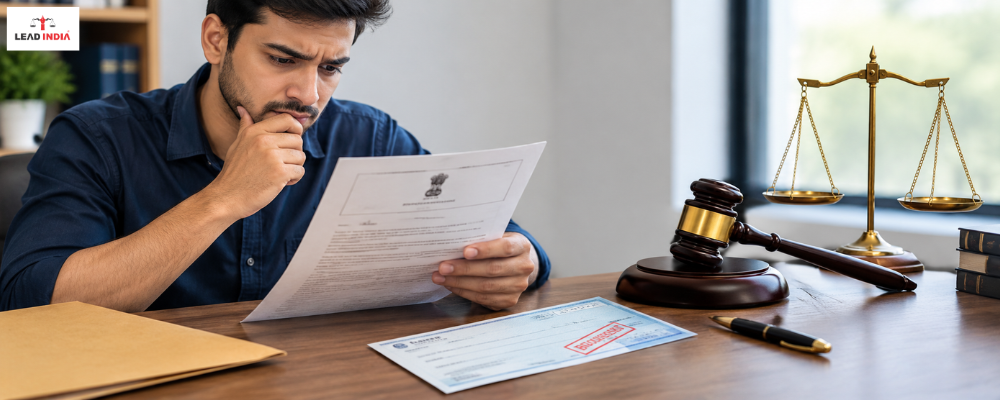
Being served with a court summons in a dishonoured cheque case can provoke stress and dread. In the case pursued under Section 138 of the Negotiable Instruments Act, 1881, the offence occurs when a cheque for a legitimate debt is dishonoured, and the conditions prescribed by the law are satisfied. A person accused should not be distressed about the summons nor avoid it but should carefully read the complaint, gather all relevant documents, comply with the summons, and consult a lawyer.
What Does a Court Summons in a Cheque Bounce Case Mean?
The court summons is the formal direction issued by court requiring the accused to appear before the concerned court in connection with the complaint.
In cheque bounce matter, the complainant generally alleges that the:
- Cheque was issued by the accused;
- Cheque was presented for payment;
- Cheque was dishonoured by the bank;
- Complainant issued the required legal demand notice; and
- Despite receiving notice, the accused failed to make required payment within prescribed period.
Once a court takes the case into account and issues the necessary summons, it is expected that the accused will respond to the action of the court.
The issuing of a summons does not imply that the accused is guilty. The matter should still proceed in accordance with the judicial system, and the accused will be in a position to defend himself.
Why Should You Not Ignore the Summons?
Disregarding a court summons can lead to unwanted legal issues.
When the accused does not appear in court multiple times without securing the necessary exemption from the courts, legal action may be taken by the court to compel the accused to appear before them.
Therefore, after receiving the summons, the accused should:
- Verify the case number and court details;
- Identify the complainant and the allegations;
- Check the date fixed for appearance;
- Obtain a copy of the complaint and relevant documents;
- Consult a lawyer;
- Appear before the court as required; and
- Discuss possible defence or settlement strategies.
A person should never assume that matters will disappear simply because they do not attend court.
What Should You Do After Receiving the Summons?
To begin with one should read the summons carefully.
The accused has to check the name of the court; case number; name of the complainant; section under which the complaint is filed; date of appearance; and instructions stated in the summons.
The next step would be to procure and review the complaint and other connected documents.
The accused must take special care to review the evidence such as, cheque, bank return memo, statutory notice, proof of service of notice, transaction papers, bank statements, agreements, receipts, and previous correspondence exchanged with the complainant.
It is important to keep and preserve every relevant electronic communication including e-mails, WhatsApp and SMS messages, and other papers relevant to the transaction.
The accused must not make any careless confessions or give any emotional reply to the complainant without understanding the legal implications.
Understand the Allegations Against You
The cheque bounce case is based on the specific statutory requirements. Therefore, the accused should understand exactly as to what the complainant is alleging.
For example, the complaint may relate to:
- Repayment of a personal loan;
- Business transactions;
- Payment for goods or services;
- Repayment of borrowed money;
- Settlement of an outstanding liability; or
- Another legally enforceable financial obligation.
It is essential for the defendant to ascertain if the check had actually been issued with respect to forged liability and if the amount of money claimed by the complainant is true.
There may be some scenarios when the check was issued in security, its relation to the amount has already been settled, the check has been misused, or there was an authentic dispute about the deal.
Such matters should be cautiously examined rather than simply on an oral rejection.
Check Whether the Legal Requirements of Section 138 Were Followed
A cheque bounce complaint needs to satisfy statutory requirements applicable to Section 138 of Negotiable Instruments Act.
- The accused should examine whether:
- The cheque was presented within its validity period;
- The cheque was returned unpaid;
- The statutory demand notice was issued within the prescribed period after receiving information regarding dishonour;
- The notice was properly served or legally deemed to have been served;
- The drawer failed to make payment within the statutory period after receipt of the notice; and
- The complaint was filed within the applicable limitation period, subject to legally permissible extensions.
Any material defect concerning these requirements may become relevant to the defence.
However, limitation and procedural questions can be fact-specific. Therefore, the complete record should be examined by a legal professional before relying upon any technical objection.
Appearing Before the Court
After receiving the summons, the accused should comply with the court’s direction regarding appearance.
Depending upon the circumstances and applicable procedure, the accused may seek appropriate relief regarding personal appearance where legally permissible.
On the first date of appearance, the court may consider the presence of the accused and proceed with the matter according to the applicable procedure.
The accused should not assume that every cheque bounce case automatically results in immediate arrest.
Instead, the appropriate response depends upon the stage of the proceedings, the court’s orders, the nature of complaint, and conduct of the accused.
A lawyer can examine the summons and case record and advise the accused about the appropriate procedural steps.
Can You Get Bail in a Cheque Bounce Case?
Questions regarding bail commonly arise after receiving a summons.
The legal position depends upon the circumstances and the procedural stage of the case. A cheque dishonour prosecution under Section 138 is a criminal proceeding, but the accused should not automatically assume that receiving a summons means immediate incarceration.
If the court requires the accused to seek bail or bond, appropriate steps should be taken through the court.
The accused should ensure compliance with court directions and avoid unnecessary absence.
A lawyer can advise whether bail, exemption from personal appearance, or another appropriate procedural application is required in the particular circumstances.
Possible Defences in a Cheque Bounce Case
A cheque bounce case should be defended on the basis of facts, documents, and legally available grounds.
Possible defences may include:
- Absence of a legally enforceable debt or liability;
- The cheque was issued as security in circumstances relevant to the defence;
- The underlying amount had already been paid;
- The cheque was misused;
- The amount claimed is incorrect or disputed;
- The cheque was not issued for the liability alleged;
- Material alteration or other irregularity concerning the cheque;
- Defects concerning the statutory demand notice; or
- Failure to establish the necessary statutory requirements.
However, merely saying that “I did not owe money” may not by itself be sufficient.
The defence should be supported, wherever possible, by documents, bank statements, agreements, correspondence, payment records, invoices, receipts, or other circumstances that create a legally sustainable defence.
Can the Matter Be Settled?
Yes, cheque bounce disputes can often be resolved through settlement between the parties, subject to the applicable legal procedure and the court’s orders.
Settlement may be considered where both parties are willing to resolve the financial dispute instead of continuing with lengthy litigation.
Before entering into any settlement, the accused should ensure that:
- The settlement terms are recorded in writing;
- The exact amount payable is clearly specified;
- The payment schedule is clearly mentioned;
- The consequences of default are understood;
- Appropriate court proceedings are completed; and
- The accused obtains documentary proof of the settlement and payment.
The accused should not rely solely on oral assurances that the case will be withdrawn after payment.
Documents You Should Collect
After receiving a summons, the accused should collect all documents relating to the transaction. These may include:
- Copy of the court summons;
- Copy of the complaint;
- Cheque copy or cheque details;
- Bank statement;
- Cheque return memo;
- Legal demand notice;
- Proof of delivery or service of notice;
- Loan or transaction agreement;
- Invoices and bills;
- Receipts and payment records;
- Correspondence with the complainant;
- WhatsApp or email communications;
- Documents showing repayment, if any; and
- Any other material relating to the underlying transaction.
What Happens If You Do Not Appear Before the Court?
Failure to appear despite a court direction can lead to further procedural complications.
The court may issue appropriate orders to secure the presence of the accused depending upon the circumstances and applicable law.
If the defendant is unable to turn up for a specific date then he/she should apply for permission from the court instead of simply staying away.
Repeated non-appearance can create complications and adversely affect the position of the accused.
The safer approach is to comply with court directions and obtain appropriate legal assistance whenever personal appearance is difficult.
Rights of the Accused in a Cheque Bounce Case
The accused has important legal rights throughout the proceedings.
These include the right to:
- Know the allegations made against them;
- Obtain relevant case documents;
- Engage a lawyer of their choice;
- Present a defence;
- Challenge the complainant’s allegations in accordance with law;
- Produce relevant evidence where legally permissible;
- Cross-examine witnesses as provided by law;
- Seek appropriate procedural relief from the court; and
- Pursue settlement where both parties are willing.
At the same time, the accused should comply with the lawful directions of the court and then avoid taking steps that may unnecessarily prejudice all of their defence.
Practical Tips After Receiving a Court Summons
After receiving the cheque bounce summons, the accused should carefully follow all of these practical steps:
- Do not panic after receiving summons.
- Do not ignore the court date.
- Read the summons carefully.
- Obtain a copy of complaint and supporting documents.
- Understand the exact transaction involved.
- Verify the cheque amount and date.
- Check the bank return memo.
- Examine the statutory notice and its service.
- Collect all payment records and communications.
- Preserve original documents safely.
- Do not make unnecessary admissions.
- Consult a lawyer experienced in cheque bounce matters.
- Consider whether settlement is commercially and legally appropriate.
- Comply with all court directions.
- Keep records of every payment or settlement made.
The more accurately and faster the defendant understands the nature of the case, the more chances he/she has to choose appropriate legal tactics to deal with it.
After having received the court summon in a cheque bounce case, the accused must act promptly and carefully. He/she should understand the charges brought against him/her, analyze the legal requirements, gather needed documents, appear in court without fail, and consult a lawyer. Taking into account the circumstances of the case, some defenses or settlement may work.
How Lead India Can Help?
- Provide the legal guidance after receiving court summons in the cheque bounce case.
- Help understand allegations and the legal procedure as per Section 138 of the Negotiable Instruments Act.
- Assist in reviewing the cheque, bank return memo, legal notice, complaint, and other relevant documents.
- Help identify possible legal defences based on the facts and available evidence.
- Assist in preparing an appropriate legal response and representation before the court.
- Provide assistance regarding bail, exemption from personal appearance, and other appropriate procedural remedies wherever applicable.
- Assist in negotiating and documenting settlement with the complainant.
- Provide legal representation throughout the cheque bounce proceedings.
One can talk to lawyer from Lead India for any kind of legal support. In India, free legal advice online can be obtained at Lead India. Along with receiving free legal advice online, one can also ask questions to the experts online free through Lead India.
FAQs
1. What should I do after receiving the cheque bounce court summons?
Do not ignore it at all. Check court date, obtain copy of complaint and supporting documents, collect all the relevant transaction records, as well as consult a lawyer regarding appropriate response.
2. Does receiving the summons mean that I will be arrested?
Not necessarily. A summons is a direction to appear before the court. The procedural consequences depend upon the facts, stage of the case, and orders passed by the court.
3. Can I settle a cheque bounce case after receiving the summons?
Yes, the parties may explore settlement, subject to the applicable legal procedure and the court’s orders. Any settlement should be properly documented.
4. What are the common defences in a cheque bounce case?
Depending on facts, the possible defences may include absence of legally enforceable debt, repayment of amount, misuse of cheque, security-cheque circumstances, disputed liability, or the failure to satisfy statutory requirements.
5. What happens if AT ALL I do not appear before court?
Ignoring court directions can lead to further procedural action to secure your appearance. If you cannot attend, you should seek appropriate relief from the court instead of simply remaining absent.


 Talk to a Lawyer