
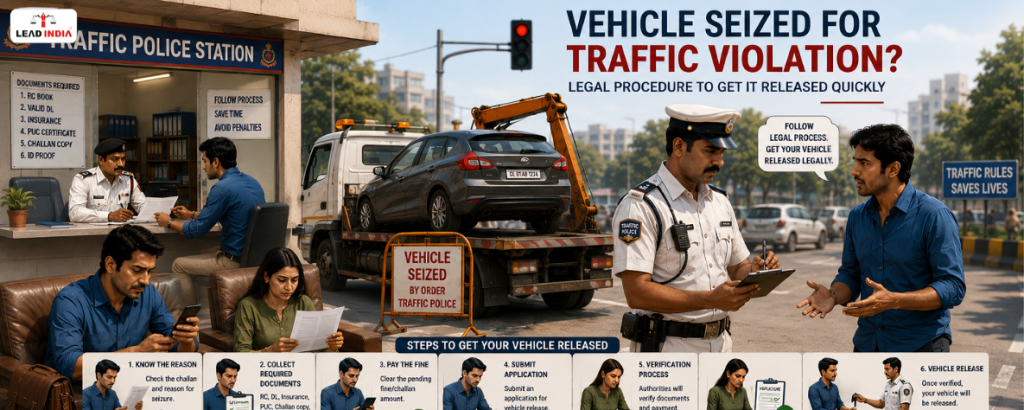
When the vehicle owner hears that their car or their bike has been seized by the police, the confusion that arises in mind is: “Will my vehicle remain in the police station for months, or can I get it released quickly?”
This confusion is very much natural.
Understanding as to when the vehicle can legally be seized, for how long it can be detained, as well as what are the exact procedures that must be followed for the release helps you avoid any kind of unnecessary delay, yard damage, as well as financial loss.
What Vehicle Seizure Is and What It Is Not
Seizure doesn’t guarantee permanent loss; it refers to temporary detention of the vehicle by a legitimate authority pending investigation, enforcement action or agreement concerning the vehicle.
Under the 1988 Motor Vehicle Act, traffic authorities are permitted to hold vehicles in specific circumstances. Courts have the authority, under the Bharatiya Nagarik Suraksha Sanhita, 2023, to give interim custody of items seized, including vehicles.
An error commonly checked by people is that once their vehicles are detained, they cannot be recovered until the trial’s outcome. This is inaccurate; generally, courts will allow for the restitution of detained vehicles throughout their investigations via an intermediate custody order, called “supurdari.”
Seizure does not imply fault. Your vehicle may be released pursuant to compliance with procedures and approval of the court, even if the proceeding continues.
What Vehicle Seizure Really Means in Practice
Seizure of vehicles usually happens for offences such as documentation issues, permit violations or driving under the influence (of alcohol), for investigatory purposes, as well as when a vehicle is involved in a criminal offence.
When police seize a vehicle, they will create a ‘seizure memo’ (panchnama) which will explain why the vehicle has been seized and the vehicle will be maintained in either the police station or an area designated for storing vehicles. Vehicles that are stored in outdoor areas will deteriorate much faster; e.g. tyres will get damaged, batteries will lose their charge, rust will form on the vehicle, and the resale value of the vehicle will decrease.
Because of this reality, courts in India have consistently determined that seized vehicles should not remain idle while awaiting disposition, and that they must be released to the owner as soon as possible under acceptable terms and conditions.
Is Vehicle Seizure Legally Valid in India
This issue is important and the lawful answer is clear.
Section 207 of the Motor Vehicles Act 1988 allows Police and persons authorized to seize vehicles that have either been used without registration, without a permit, or in breach of permit conditions.
Also, Section 206 provides for the seizure of certain documents.
However, while those powers are not unlimited, there must be legal justification for a seizure. If your property has been held without reason, then you may challenge the decision by the Magistrate or High Court.
Indian courts have stated many times that although authorities may lawfully seize a vehicle, they cannot hold it perpetually without being subject to judicial review.
When Can a Vehicle Be Seized
A vehicle may be seized in situations such as:
- Driving without valid registration
- No valid insurance policy
- Expired Pollution Under Control certificate
- Driving without a valid driving license
- Drunken driving
- Involvement in an accident investigation
- Overloading of commercial vehicles
- Permit violations
- Illegal modifications
- Use of vehicle in a criminal offence
How to Get a Seized Vehicle Released
Step 1: Obtain the Seizure Memo
The police need to prepare the seizure memo containing the date, time, reason for the seizure, vehicle details, as well as the police station information. Always obtain a copy. This document is essential for further legal action.
Step 2: Rectify the Defect
If seizure is due to documentation issues, immediately correct the problem. Renew insurance, obtain valid PUC, produce permit, or complete registration. Compliance strengthens your case for release.
Step 3: Determine Whether Court Order Is Required
- For minor violations, payment of challan or compounding fee may result in release.
- For serious offences, accident cases, or criminal involvement, an application must be filed before the Judicial Magistrate for interim custody (supurdari).
Step 4: Filing Supurdari Application
An application for release of vehicle on supurdari is filed before the Magistrate having jurisdiction. The application generally includes:
- Registration Certificate copy
- Insurance copy
- Identity proof
- Undertaking to produce vehicle whenever required
The court may impose conditions such as personal bond, surety bond, or restriction on transfer of ownership.
In practical experience, courts prefer releasing vehicles after taking photographs and documentation because keeping vehicles idle serves no legal purpose.
Step 5: Comply With Court Conditions
After release, you must follow all court directions. The non-compliance can lead to the re-seizure or the cancellation of interim custody.
Important Supreme Court Judgments
- Sunderbhai Ambalal Desai v. State of Gujarat held that vehicles (which deteriorate and lose value) should not be retained by police for extended periods of time before being returned to their owners; therefore, courts are required to return such vehicles to their owners at the earliest possible moment after completing necessary documentation.
- Photographs and panchnamas were considered by the Court in General Insurance Council v. State of Andhra Pradesh to be forms of evidence that don’t need to be kept (held) for long periods of time; hence, they do not have to be kept (held) by police for extended periods of time.
- In Basavva Kom Dyamangouda Patil v. State of Mysore the Court concluded that seized property is to be held by Police until the Criminal Investigation has been completed.
All three of these cases demonstrate that vehicle owners can be protected from unnecessary delay in the return of their vehicles by law enforcement authorities.
What If Police Refuse to Release the Vehicle
If the police do not release vehicle even after the compliance:
- File an application before the Judicial Magistrate.
- If rejected unfairly, file a revision before the Sessions Court.
- In the most exceptional circumstances, you can approach the High Court as per Article 226 of the Constitution.
The courts generally favor release unless the ownership is disputed or the vehicle is fully stolen property.
Can a Seized Vehicle Be Auctioned
Auction is possible only in limited circumstances such as abandonment, failure to claim, or court order after prolonged custody. Notice must be given to the registered owner before auction.
Special Situations Vehicle Involved in Accident
Even in the fatal accident cases, the vehicles are usually released after the mechanical inspection as well as documentation. The trial can proceed without keeping the vehicle in the police yard.
Drunken Driving Cases
The driver might face prosecution and fine, but the vehicle is mostly released after the court compliance unless there are any aggravating circumstances.
Commercial Vehicle Seizure
Permit violations as well as overloading often result in seizure. Payment of penalty and production of valid documents usually leads to release.
Timeline for Vehicle Release
Minor violations may be resolved within a few days. Cases requiring court applications may take one to two weeks depending on workload and compliance. Early action significantly reduces delay.
Rights of Vehicle Owners
You mostly have the right to know the reason for the seizure, obtain the seizure memo, apply for any interim custody, as well as challenge the unlawful detention. Article 300A of Indian Constitution protects the property rights. The authorities cannot arbitrarily deprive you of the property without any legal procedure.
Practical Advice
Do not ignore the seizure. Do not assume automatic release. Act immediately. You need to ensure that the documents are updated. You can seek legal guidance if at all the case involves any criminal allegations. Timely filing of applications prevents depreciation and damage.
One can talk to lawyer from Lead India for any kind of legal support. In India, free legal advice online can be obtained at Lead India. Along with receiving free legal advice online, one can also ask questions to the experts online free through Lead India.
FAQs
1. Can the police keep my vehicle until the trial ends?
No. Courts generally release vehicles during investigation upon application.
2. Is the lawyer very much compulsory for the vehicle release?
It is not compulsory, but professional drafting improves the chances of a quick release.
3. What are the documents that are required for the release?
Registration Certificate, insurance, identity proof, and undertaking before court.
4. Can the vehicle be released in accident cases?
Yes, after inspection and documentation.
5. What if the ownership gets disputed?
The court may hear from both the parties before granting custody.
6. Can the vehicle be re-seized after the release?
Yes, if at all the court conditions are violated.


 Talk to a Lawyer